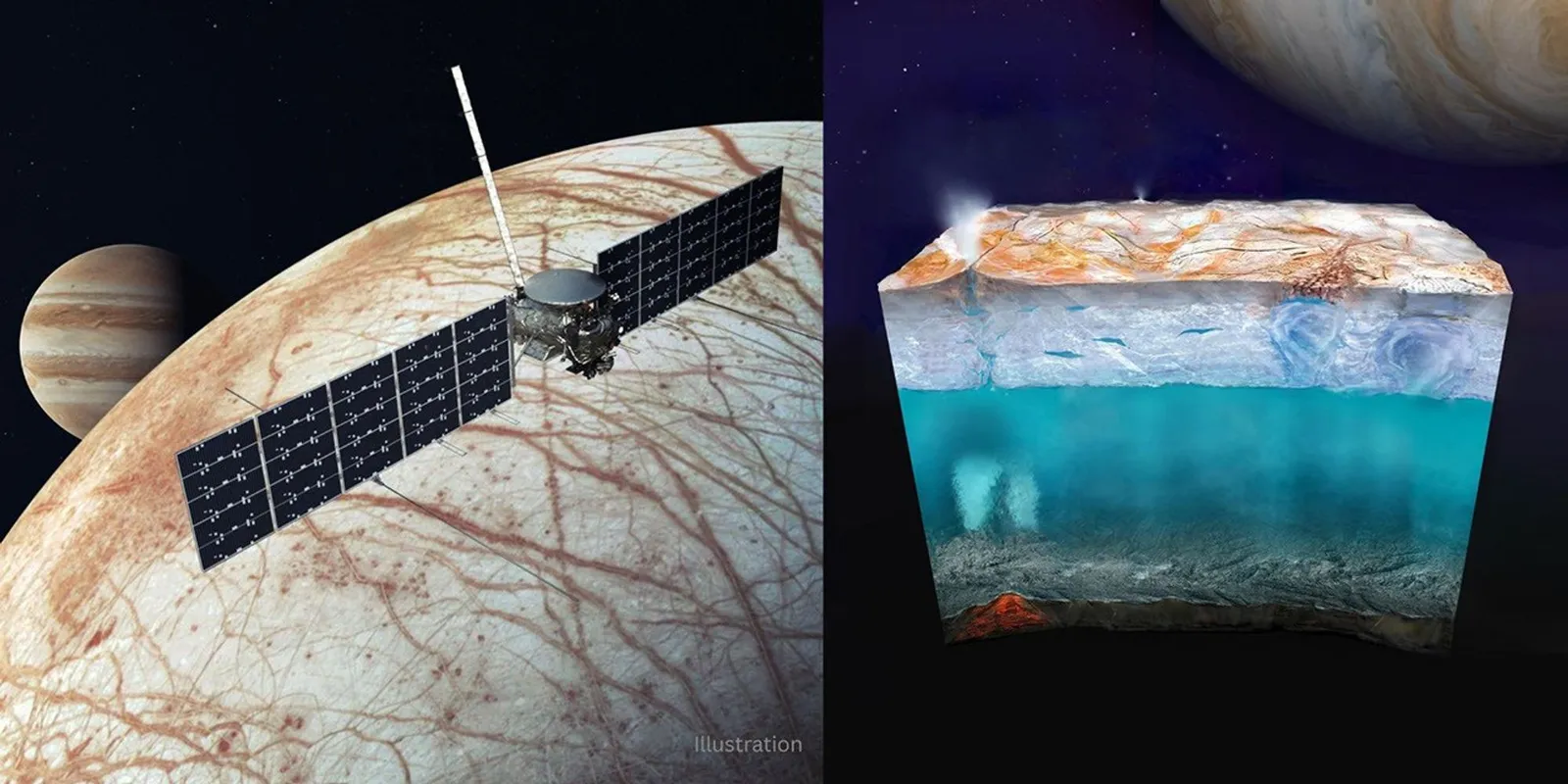
Beneath kilometers of ice on the moons of Jupiter and Saturn lie oceans of liquid water. Europa, Ganymede, Enceladus, and Titan are among the solar system bodies believed to hold water as ice, vapor, or liquid beneath their surfaces — a list that also includes the dwarf planet Pluto, some comets, and even Uranus. These are the places scientists consider the most promising candidates for finding life beyond Earth.
The problem is that conditions there are hostile to almost any technology. Surface temperatures drop to −180°C, and ionizing radiation reaches 5 megarad — 50 times the dose lethal to a human. Standard electronics simply fail in such environments, and until now the only solution was heavy protective enclosures.
Warm boxes become dead weight
Previous missions to the Moon and Mars placed their electronics inside so-called "warm boxes" — insulated, heated enclosures that keep internal temperatures close to Earth-like conditions and shield components from radiation.
For missions to distant ocean worlds, this approach stops working. Every extra kilogram and watt on the way to Jupiter or Saturn comes at a steep cost, and warm boxes are inherently heavy, power-hungry, and bulky.
NASA framed the requirements differently: the electronics needed to be commercially available, flexible enough for tasks ranging from communications to control, highly integrated and low-cost, while delivering order-of-magnitude improvements in size, weight, power, and cost — without any protective enclosure at all.
Silicon-germanium turns cold into an advantage
The solution came from a team at Georgia Tech led by Professor John D. Cressler, working with researchers at NASA's Jet Propulsion Laboratory (JPL) and the University of Tennessee-Knoxville.
At its core are transistors built from a silicon-germanium (SiGe) alloy. The physics works in their favor in cold environments: the nanoscale SiGe alloy accelerates electrons moving through the transistor as it switches, and this effect grows stronger, not weaker, as temperature drops. The result is faster performance in the cold, rather than the degradation typical of conventional electronics.
The second factor is radiation resistance. In standard transistors, the most radiation-vulnerable regions are made of oxide materials. The SiGe transistor's physical structure dramatically minimizes those layers, allowing the components to withstand high radiation doses without failing.
The team developed SiGe transistor models for circuit design and used them to build a library of analog, digital, and radio frequency (RF) building blocks. A prototype integrated circuit based on this library was validated to a Technology Readiness Level of TRL 5/6 — confirmed on Earth in conditions simulating an ocean world as closely as possible.
A communications module smaller than a fingernail passes the test
The project's key milestone is a working X-band (8–12 GHz) RF communications link smaller than 10 mm². It transmitted modulated radio data at −180°C while simultaneously exposed to continuous radiation of 5 Mrad.
No team had previously designed and tested a system with this combination of capabilities. The full integrated circuit that houses this module measures just 5×5 mm.
A communications module like this could serve as an electronic data interface for a distributed sensor network, a lander, an orbiter, ice-cap boring machinery, or an underwater vehicle.
From ocean worlds to the Moon and Mars
The developers note that ocean world conditions represent the worst-case combination of cold and radiation found anywhere in the solar system. That means the SiGe components built for Europa or Enceladus are immediately applicable to less extreme environments — the Moon, Mars, and Earth orbit.
On the Moon, radiation exposure is more modest, but temperatures remain extremely cold. SiGe radars and communications links could operate unprotected on the boom of a lunar rover during nighttime traverses near the equator, and with reduced heating requirements inside permanently shadowed craters, where sunlight never reaches.
Design files for the component library, transistor models, test results, and design recommendations are already available for reuse within NASA and can be directly integrated into future missions — including those headed for the icy ocean moons themselves.