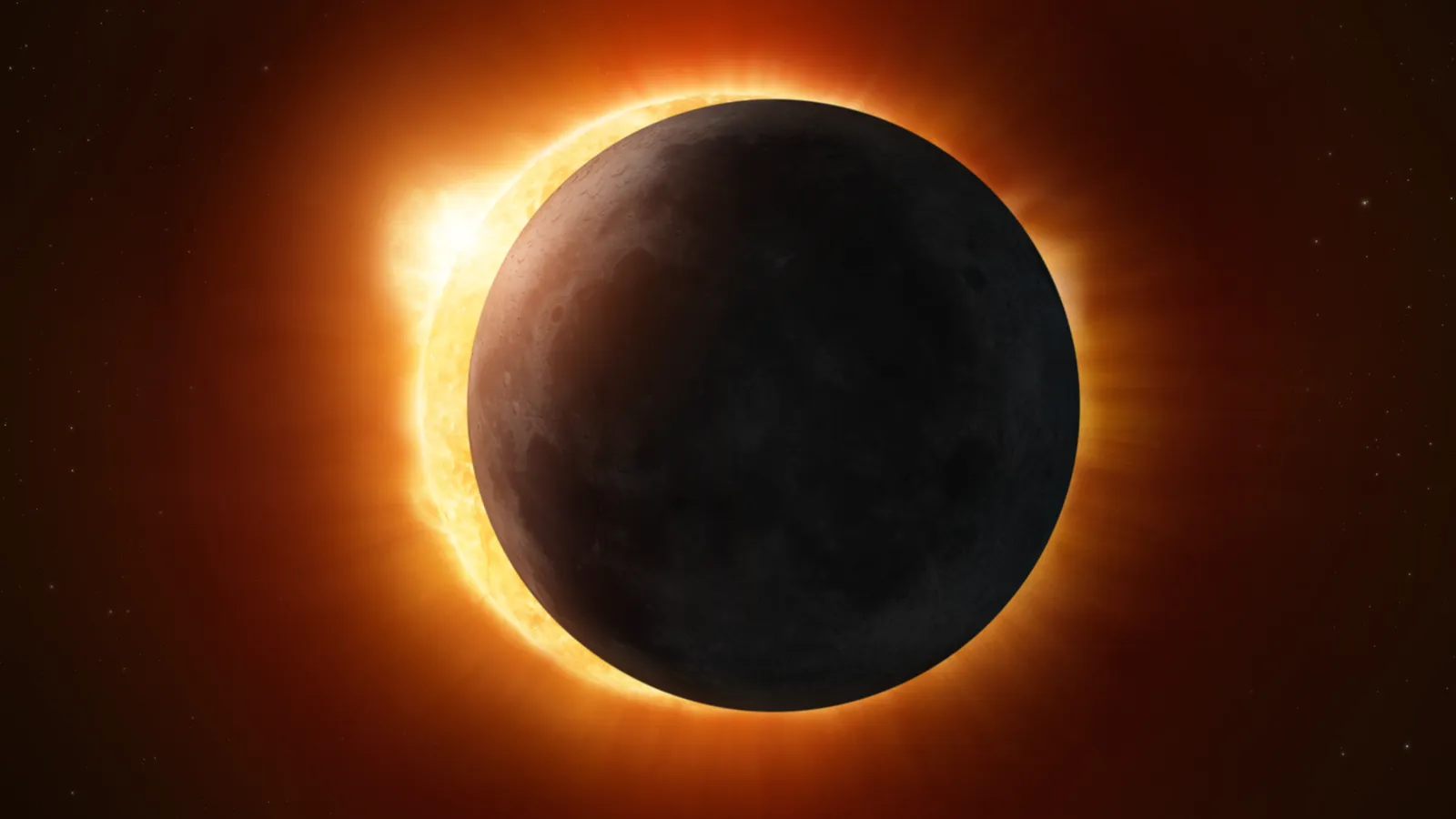
On August 12, 2026, people across Europe will get a rare chance to witness a total solar eclipse without traveling to another continent. The path of totality will cross Greenland, Iceland, and then mainland Europe — Spain and a small area of northeastern Portugal. The rest of the continent will see a partial eclipse.
The event carries particular significance for the scientific community. The European Space Agency (ESA) is preparing an international broadcast and a public observation programme, combining spectacle with an explanation of the physics behind it.
How the Moon blocks the Sun
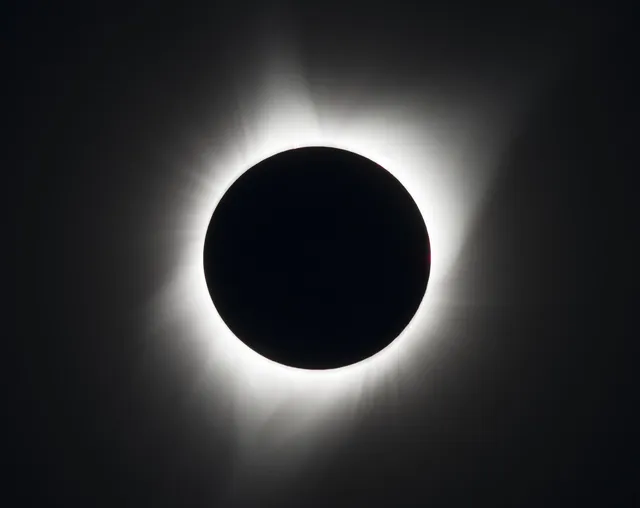
A total solar eclipse happens when the Moon passes directly between Earth and the Sun, completely covering the solar disk. At that moment, the corona becomes visible — the thin, extremely hot outer layer of the Sun's atmosphere that is normally invisible against the disk's brightness.
This alignment is possible thanks to an optical coincidence: the Sun is roughly 400 times larger than the Moon in diameter, but also roughly 400 times farther from Earth. As a result, both objects appear nearly the same size in the sky, allowing the Moon to precisely cover the solar disk.
Mainland Europe last saw this spectacle in 2006. The August 12, 2026 eclipse will be the first in twenty years.
Spain gets the widest band of shadow
Among all European territories within the path of totality, Spain has the largest area of totality. The eclipse will cross the country from west to east and continue over the Balearic Islands — offering the most favorable viewing conditions on the continent.
For mainland Spain, the event is unique for another reason: it is the first total solar eclipse since 1905. It also opens a series of three eclipses visible from the country between 2026 and 2028 — a rare case of one territory falling within the path of totality three times in a short span.
Broadcast from Javalambre Observatory and the León programme
ESA is organizing a live broadcast from the Javalambre Astrophysical Observatory in Teruel — a facility located directly within the path of totality. The broadcast will be hosted by space scientist and science communicator Dame Dr. Maggie Aderin, with participants including Carole Mundell, ESA's Director of Science. The stream will be available in English via ESA Web TV and YouTube.
In parallel, the city of León will host a free public observation programme, organized together with the University of León and the city council. It will feature talks by ESA experts on solar physics and space missions, along with educational activities in Spanish, synchronized with the international broadcast.
Carole Mundell described the significance of the event this way:
A total solar eclipse is one of those rare moments when millions of people can look up together and feel both wonder and curiosity. It is a shared moment that connects us to the Universe and reminds us that the desire to explore and understand is one of humanity's greatest strengths.Carole Mundell, ESA Director of Science
Missions studying the Sun from within
The eclipse also draws attention to ongoing solar research by European space missions. Among them is Solar Orbiter, which studies solar wind and magnetic activity up close, Smile, focused on the interaction between solar wind and Earth's magnetosphere, and Proba 3, which uses two satellites flying in precise formation to artificially recreate eclipse-like conditions and observe the Sun's corona without waiting for a natural event.
ESA has also prepared educational materials for schools and the public, available in English and Spanish, with guidance on safe observation. Looking at the Sun without certified eclipse glasses is dangerous even during the partial phases. Viewing without protection is only safe for the brief moments of totality, when the Moon fully covers the solar disk — and as soon as the Sun begins to reappear, glasses must be worn again immediately.