The Vera C. Rubin Observatory on Cerro Pachón in Chile has officially begun the defining program of its existence — the ten-year Legacy Survey of Space and Time (LSST). The project is funded by the U.S. National Science Foundation (NSF) and the Department of Energy's Office of Science, and the observatory is jointly operated by NOIRLab and SLAC National Accelerator Laboratory.
The observatory is named after astronomer Vera Rubin, who provided the first convincing evidence for the existence of dark matter. Her name now belongs to a telescope built to capture what has been called the greatest cosmic movie ever made — a decade-long sequence of images showing how the sky changes night after night.
A 3200-megapixel camera scans the sky every 40 seconds
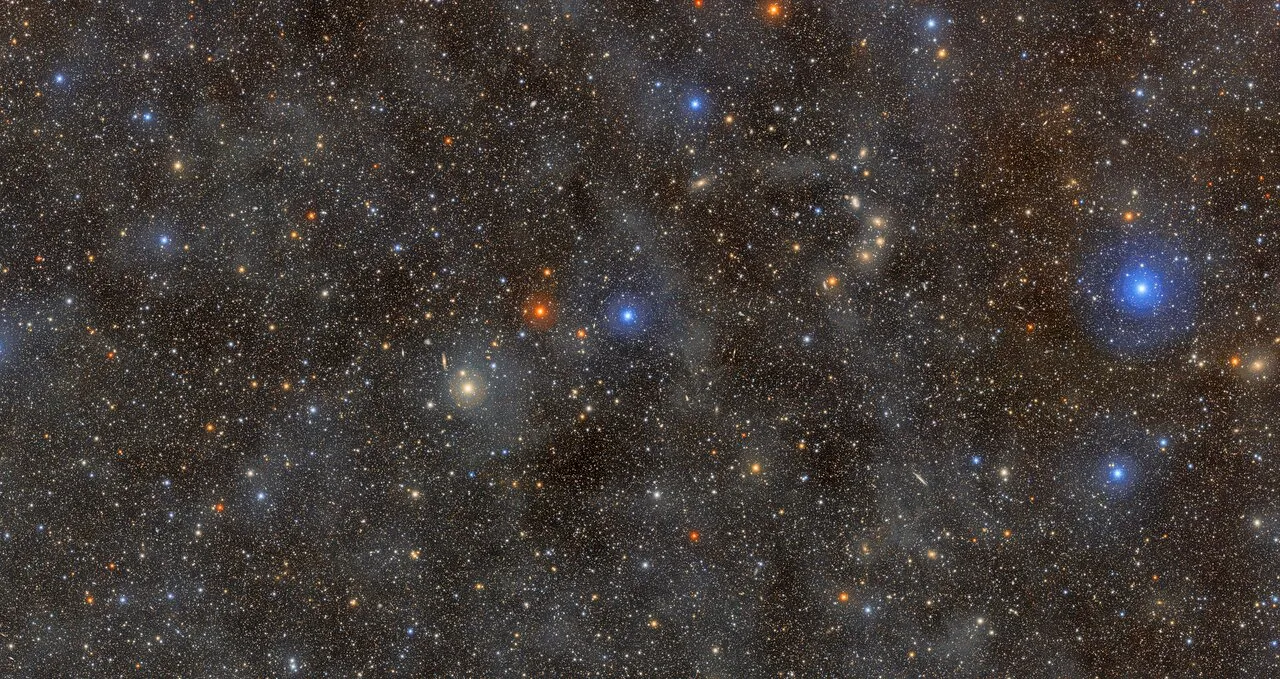
The observatory's main instrument is a 3200-megapixel digital camera, the largest ever built. Paired with a wide-field mirror capable of moving rapidly across the sky, it captures a new detailed image roughly every 40 seconds.
Each night the telescope takes around a thousand exposures and gathers about 10 terabytes of data. By comparing new images with previous ones, the system automatically flags anything that has changed: flares, moving objects, shifts in brightness. This generates up to seven million alerts per night.
Processing such a stream by hand is impossible. Instead, the alerts are immediately routed to alert brokers — automated systems that sort and classify events so astronomers worldwide can react quickly and point other telescopes at objects of interest.
Over 11,000 new asteroids in a month and a half of testing
Even before the survey officially began, during test observations, the observatory had already proven itself. In just a month and a half of trial operations, it found more than 11,000 previously unknown asteroids.
Among them are 33 near-Earth objects — asteroids whose orbits pass close to Earth — and 380 trans-Neptunian objects, which orbit far beyond Neptune. One of the newly found asteroids turned out to be the fastest-spinning body larger than 500 meters ever discovered, located in the main asteroid belt.
Phil Marshall, Deputy Director of Rubin Operations at SLAC, summed up the result:
Millions of alerts in just the last couple of months show that Rubin is up and running as a discovery machine. Now we're putting it all together.Phil Marshall, Deputy Director of Rubin Operations, SLAC
Dark matter, dark energy, and multi-messenger astronomy
Cataloging the Solar System is only part of the mission. The survey's central scientific goal is studying dark matter and dark energy, which shape the structure and accelerating expansion of the Universe.
Detecting such effects requires not single snapshots but repeated observations of the same patch of sky over years. Over ten years, each point in the southern sky will be imaged roughly 800 times. This will allow astronomers to track slow and rare processes: supernova explosions, pulsating stars, changes in distant galaxies.
The observatory will also advance multi-messenger astronomy — the study of cosmic events through multiple signals such as light, gravitational waves, and cosmic rays. Rapid, color-rich images of transient phenomena — stellar explosions, actively feeding black holes, collisions between compact objects — will help telescopes around the world quickly follow up on these fleeting events.
Once the survey is complete, the final dataset will contain billions of objects and trillions of measurements. The data will be released regularly and made openly available — the first time such a vast volume of astronomical data will be accessible to both scientists and the public.