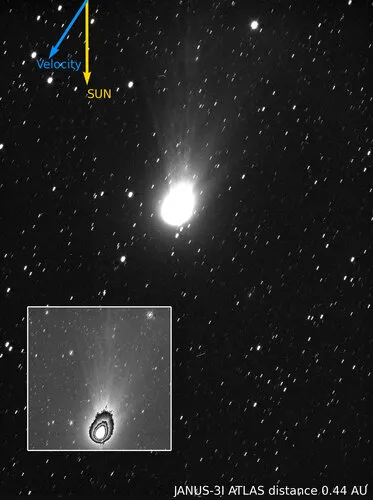
One advantage of the JUICE mission (Jupiter Icy Moons Explorer) is that, on its long journey to Jupiter, the spacecraft occasionally passes near interesting objects elsewhere in the Solar System. In November 2025, that object was interstellar comet 3I/ATLAS, the third known visitor from beyond our Solar System. The JANUS camera captured it on November 6, seven days after the comet's perihelion (its closest approach to the Sun), from a distance of roughly 66 million kilometers.
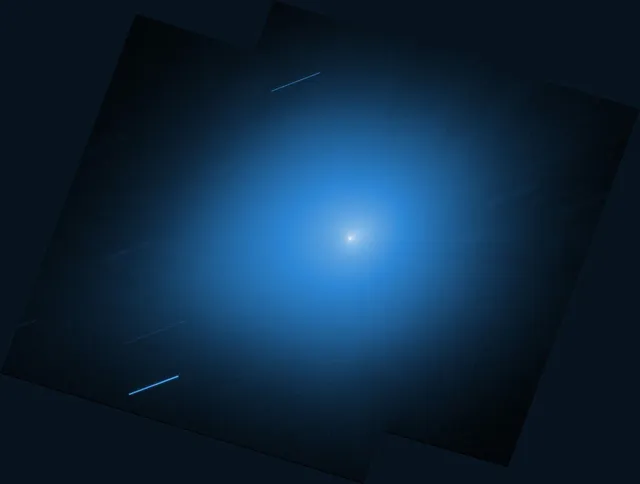
The image is black and white, and it does not show a sharp object in the usual sense. The comet's nucleus — the solid body at its core — is not visible: it is too small and hidden beneath its own cloud of gas and dust. Instead, the camera captured the coma, a bright halo of gas surrounding the nucleus, and a long tail with hints of rays, jets and filamentary structures.
What the JANUS camera actually captured
Two arrows mark the image: a yellow one pointing toward the Sun, and a blue one showing the comet's direction of motion. Together they reveal how the tail is oriented relative to the Sun: gas and dust streaming from the nucleus under solar heating are pushed by sunlight and the solar wind in a characteristic direction.
A separate inset shows the same data processed to highlight the coma's structure. It reveals concentric, ragged-edged shells fading from dark to light — a signature of layers of gas and dust ejected by the comet at different points during its approach to the Sun.
In total, JANUS took more than 120 images of 3I/ATLAS across a wide wavelength range. The instrument team is now working through this full set to understand what it reveals about the comet's behavior and structure.
Five instruments trained on one comet
The JANUS image is only part of the observation campaign. Throughout November, five of JUICE's science instruments observed 3I/ATLAS simultaneously: JANUS, MAJIS, SWI, PEP and UVS.
MAJIS and UVS are spectrometers, splitting the comet's light into its components to determine the chemical makeup of the gas in the coma. SWI investigates the comet's composition through a different method, observing in the submillimeter range. PEP measures particles, so its team is analyzing the flow of charged particles around the comet. Alongside these, a separate ESA team working with JUICE's navigation camera also photographed the object.
Together, this data is meant to build a complete picture: how the comet behaved as it passed the closest point of its orbit to the Sun, and what it is made of.
Why the data took so long to arrive
The observations were made back in November, but the results only reached the teams last week. The reason lies in orbital geometry: after the observations, JUICE ended up on the opposite side of the Sun from Earth.
In that position, the spacecraft used its main high-gain antenna not for its usual purpose but as a heat shield, protecting its instruments from solar radiation. Data instead had to be relayed through the smaller, medium-gain antenna, at a much lower transmission rate.
As a result, instrument teams had to wait months before receiving their own observations in full. Now that the data has finally arrived, analysis is underway in earnest.
What is known so far, and what comes next
The main preliminary conclusion is that, despite its interstellar origin, 3I/ATLAS behaves like a perfectly ordinary Solar System comet. Its gas and dust emissions, and the formation of its coma and tail, match what would be expected from a "normal" comet rather than something unusual.
The instrument teams plan to meet in late March to combine the results of spectrometry, composition and particle-flow analysis with the processed JANUS images. Only then will it become clear exactly what JUICE's observations have revealed about the origin and structure of 3I/ATLAS.