Eccentric Black Hole Binaries Will Sharpen LISA's Cosmological Measurements
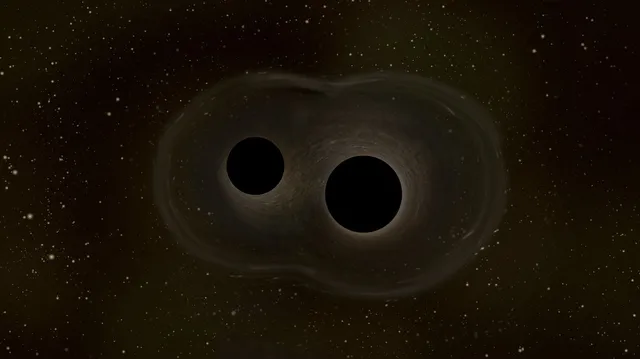
A team led by Jia-Hao Zhong modeled how orbital eccentricity in massive black hole binaries affects parameter estimation for the future LISA gravitational-wave observatory. Using the EccentricFD waveform and five-year mock event catalogs built from three population models (popIII, Q3d, Q3nod), the authors show that additional harmonics induced by eccentricity break degeneracies among waveform parameters.
At an initial eccentricity of e0=0.4, sky localization and distance precision improve by up to a factor of ten. The number of usable bright standard sirens rises accordingly, for instance from 6 to 12 events under the Q3d model. The relative uncertainty on the Hubble constant for that model drops from 8.17% to 4.35%, tightening constraints on the dark energy equation of state and modified gravitational-wave propagation.
Galaxy MXDFz4.4: A Lyman Continuum Emitter Just 250 Myr After Reionization
An international team led by Ilias Goovaerts has identified MXDFz4.4, a galaxy at redshift z=4.442 in the MUSE eXtremely Deep Field, as a source of ionizing (Lyman continuum) radiation detected just 250 million years after the end of cosmic reionization — the highest-redshift confirmed LyC emitter to date.
The LyC flux was measured at 5.3 sigma in the F435W filter (4.2±0.8 nJy), corresponding to an escape fraction of 50-100% after correcting for intrinsic photon production and intergalactic medium absorption. For the first time at such an early epoch, the team tested Lyman-alpha halo morphology as a tracer of ionizing escape, finding that a recent burst of star formation likely boosted both photon production and escape, making the galaxy a strong candidate contributor to cosmic reionization.
The FUEL Survey: A Far-UV Legacy Atlas of Extragalactic Fields from Hubble
A team led by Aliakbar Kavei has released the Far-Ultraviolet Extragalactic Legacy (FUEL) survey, a Hubble far-UV imaging archive (ACS/SBC, F150LP filter, about 1600 Å) covering three key extragalactic fields — GOODS-S, GOODS-N and COSMOS. The dataset comprises 365 orbits across 151 pointings over 44.7 square arcminutes, reaching typical depths of about 28.7 AB magnitude.
The catalog lists 1,068 galaxies cross-matched with existing 3D-HST and CANDELS catalogs; the redshift distribution of detected sources peaks around z≈0.6 and declines toward z=1.2, where the Lyman limit shifts out of the filter's sensitivity range. The survey fills a gap in high-resolution far-UV imaging between z≈0 and z>1, providing a foundation for studies of star formation, dust and ionizing photon escape, with data already available through the MAST archive.
The Dark Fate of Ultra-Faint Dwarfs: Gravothermal Collapse in Action
Researchers Moritz Fischer and Hai-Bo Yu ran detailed N-body simulations of a Milky Way-like system within a self-interacting dark matter (SIDM) framework to test the gravothermal collapse hypothesis — a process in which a dark matter halo first expands as energy is transported toward its center, then begins to irreversibly contract once the core has lost enough heat.
Comparing the simulated satellites to real Milky Way ultra-faint dwarfs, whose density profiles are inferred from stellar kinematics, the team found good agreement: the observed diversity of central dark matter densities matches different stages of gravothermal evolution. Most of the studied dwarfs show high central densities, suggesting their halos have already entered the collapse phase, while the depth to which each has fallen varies from galaxy to galaxy — a difference the authors argue explains the observed spread in properties.
Pandora SmallSat: Separating Stellar Noise from Planetary Atmospheres
A team led by Yoav Rotman presented detailed simulations of NASA's upcoming Pandora SmallSat mission, which during its year-long prime mission in 2026-2027 will simultaneously monitor host stars photometrically in visible light (0.4-0.7 μm) and obtain near-infrared transit spectra (0.9-1.6 μm) of exoplanets, aiming to separate stellar variability from genuine atmospheric signals.
Modeling the atmospheres of five test planets broadly consistent with HD 209458 b, HD 189733 b, WASP-80 b, HAT-P-18 b and K2-18 b, the authors found Pandora can constrain H2O and CH4 abundances to within about 1.0 dex. Combining Pandora data with JWST near-infrared observations yields more reliable atmospheric retrievals than JWST alone, and the mission can also serve as a precursor scout for future JWST targets.