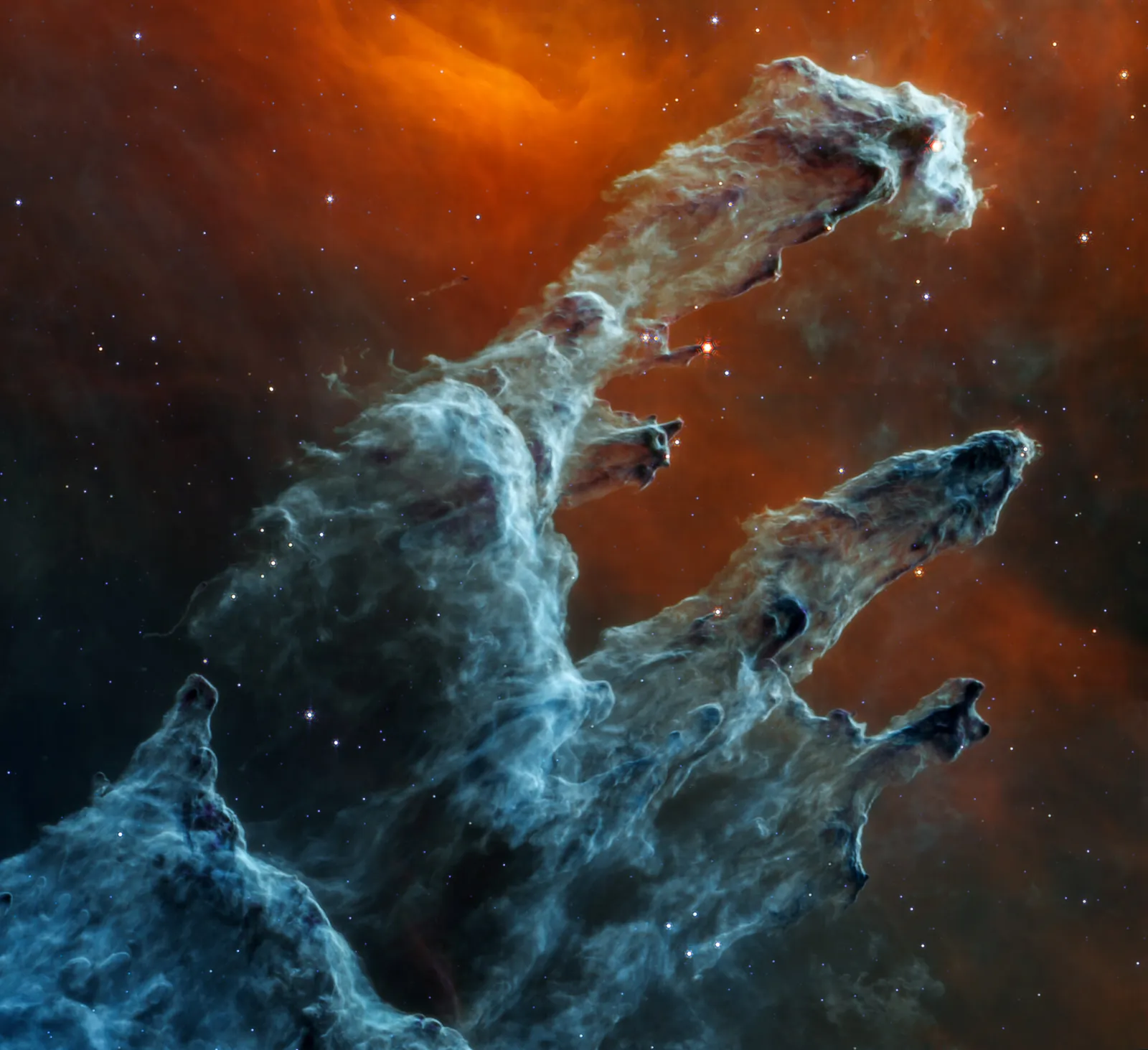
When the James Webb Space Telescope started operating, it almost immediately ran into a puzzle. At redshifts above 10 — when the universe was less than half a billion years old — the telescope kept finding bright galaxies in far greater numbers than standard galaxy-formation models predicted. Three years later, the puzzle remains unresolved, and the list of proposed fixes has grown long: more efficient conversion of gas into stars, wildly fluctuating brightness, unusually massive stars, less dust blocking the light. A new study from a team at McGill University proposes something different: cosmic strings.
What the galaxy count reveals
At the center of the puzzle is the UV luminosity function (UVLF), a deceptively simple but highly informative measurement: how many galaxies of a given brightness existed at a given cosmic time. The Hubble Space Telescope had mapped this function out to about redshift 10. James Webb pushed the boundary to redshift 17, and at the earliest epochs it found far more bright galaxies than standard ΛCDM cosmology combined with conventional star-formation astrophysics comfortably predicts.
The difficulty with any cosmological explanation is that it has to thread a very narrow needle. Boosting the growth of cosmic structure enough to explain the surplus at redshift 17 will typically also boost it at redshift 6 — where Hubble already measured the luminosity function and found nothing unusual. Prior work has shown exactly this: enhancing the matter power spectrum enough to match James Webb breaks agreement with Hubble. Any fix needs to act early and then fade away.
Why cosmic strings fit the bill
Cosmic strings are one-dimensional topological defects — cracks frozen into the fabric of spacetime during a phase transition in the very early universe. Many grand unified theories predict their existence. A network of strings mostly consists of closed loops, each characterized by energy per unit length, quantified as the dimensionless string tension Gμ, which sets how strongly a string gravitationally interacts with matter. The tightest previous constraints on this quantity came from the cosmic microwave background, giving an upper limit of roughly Gμ < 10⁻⁷.
The key feature of strings is the shape of their influence over cosmic time. A string loop can pull matter toward itself and seed a dark matter halo at essentially any epoch, even absurdly early ones. In standard ΛCDM, massive halos at very high redshift are exponentially suppressed — the universe simply hasn't had time to build them. So strings contribute most exactly where James Webb sees the surplus. As cosmic time goes on and ordinary structure formation catches up, the string contribution shrinks into irrelevance by the epochs Hubble probed.
How the hypothesis was tested
Testing this idea required predicting UVLFs across a wide range of astrophysical and cosmological assumptions — normally the domain of hydrodynamical simulations too slow to run thousands of times. Instead, the researchers built cosmic string physics into Zeus21, a semi-analytic code capable of generating a predicted luminosity function in milliseconds. This let them quickly map out how much of the observed surplus could be explained by strings versus more efficient star formation, and whether the two scenarios can be distinguished at all.
The result: a model including cosmic strings matches measured UVLFs from redshift 4 all the way to 17 without requiring an abrupt jump in star-formation efficiency or extreme stochasticity — the very ingredients most astrophysical explanations rely on. At the redshifts Hubble probed, adding strings changes almost nothing, and the data are well fit even without them. At the redshifts James Webb probed, the two models diverge: at redshift 9 the difference between the string and string-free versions is barely noticeable, but by redshifts 12, 14, and 17, the string-free model falls short of the observed abundance of bright galaxies by orders of magnitude, while the string-inclusive model keeps tracking the data.
The effect grows with redshift exactly as the argument requires
A new limit, and what comes next
Because UVLFs turned out to be so sensitive to the presence of strings, the absence of any string-like signature at lower redshift allowed the team to set a new upper limit on the string tension: Gμ ≲ 10⁻⁸, roughly ten times tighter than previous cosmic microwave background constraints. The authors caution that this limit depends on the chosen model and priors, including how star formation is parameterized — itself a kind of assumption. The dominant uncertainty isn't the strings at all; it's how poorly the star-formation efficiency of early galaxies, particularly those observed by James Webb, is currently known. Accounting for the velocities of string loops in an appendix weakens the bound somewhat, though it still improves on the Planck satellite's constraints.
The central challenge is a degeneracy: a boost in massive halos looks a lot like more efficient star formation. This may be broken by studying galaxy clustering: galaxies born in more massive halos cluster more strongly than those in smaller ones. If cosmic strings really are seeding extra massive halos at early times, they should leave a distinctive imprint on how galaxies are distributed in space. Measurements of such clustering out to redshift 10 and beyond are becoming possible.
The authors note that the appeal of this result lies in not requiring the extra galaxies to be strange. In most astrophysical explanations, early galaxies must behave differently from later ones — burning through gas faster, flickering more, forming unusual stars. In the cosmic-string picture, galaxies behave the same way throughout cosmic history; there are simply a few more places for them to form when the universe was very young. Whether that's what actually happened is a question for better measurements of early star formation and galaxy clustering — and those measurements are on their way.