Webb finds record-distant broad-line black hole
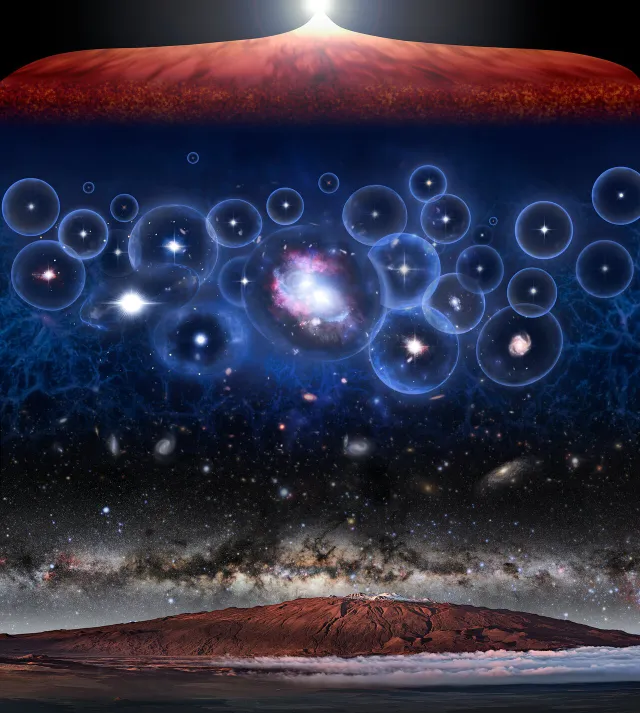
Researchers searched public JWST/NIRSpec PRISM spectra from the DAWN JWST Archive for active galactic nuclei with broad emission lines at z ≥ 6. This turned up MoM-BL-z10 at a redshift of 9.98, whose spectrum shows a broad Hβ component about 3,500 km/s wide. The signal is only at 3.87σ, so it still needs confirmation. The object's compact shape and colours resemble Little Red Dots.
The detection allowed the first virial black hole mass estimate at z ~ 10: about 36 million solar masses with the standard calibration, or roughly 2 million with an alternative one tailored to such objects. Either way, a black hole this massive only 470 million years after the Big Bang challenges growth models. It requires super-Eddington accretion onto a stellar-mass seed, or a heavier seed from the start.
Galactic merger may have seeded Milky Way's bar
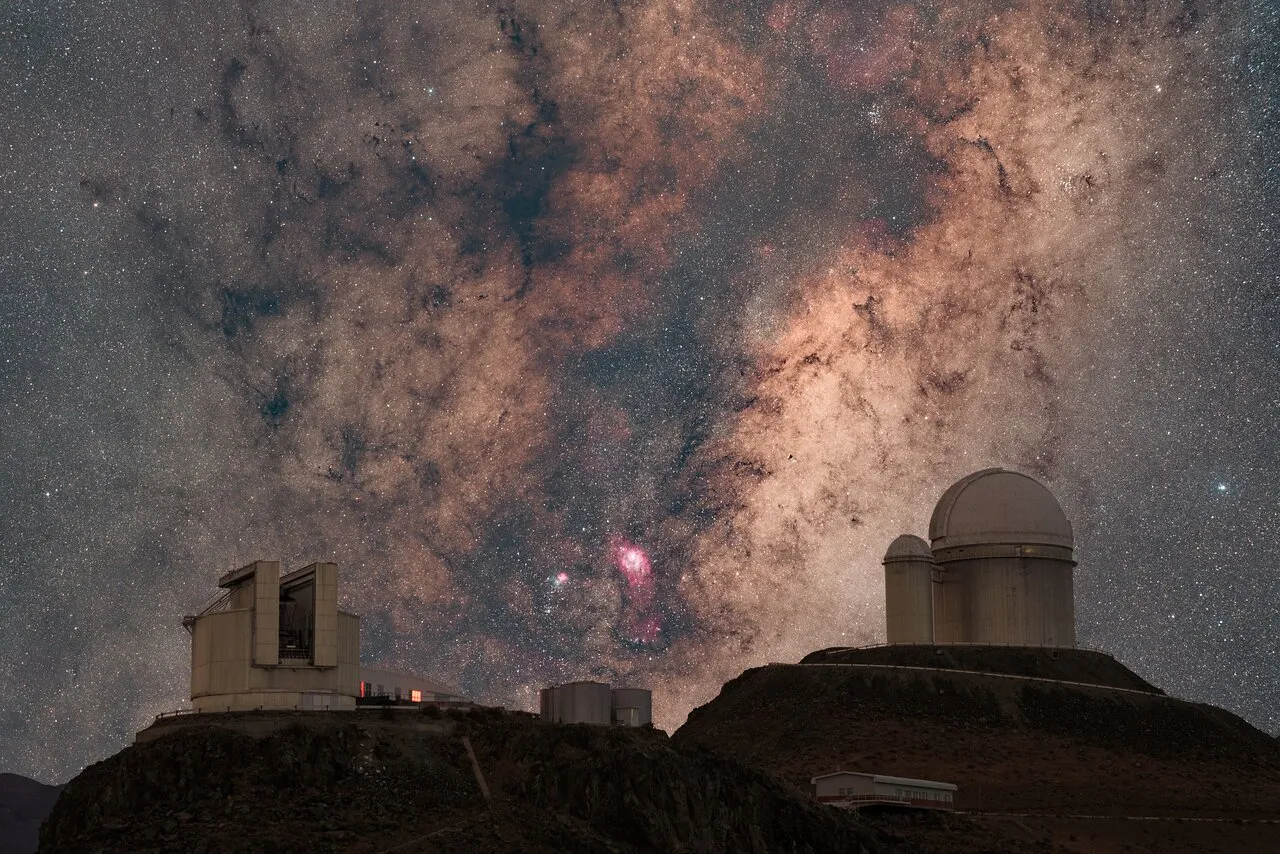
Whether the Milky Way's bar is linked to the Gaia-Sausage-Enceladus (GSE) merger, the Galaxy's last major merger, has been unclear. The bar's age is inferred from star formation in the nuclear stellar disc, traced by Mira variables, while the merger is dated using red giants. The two age scales cannot be compared directly.
The authors recalibrated the Mira period–age relation to the APOGEE red giant scale using Gaia DR3 motions of 2,394 Miras. The rise and peak of star formation in the nuclear disc fall 8.5–10.5 billion years ago, overlapping with the end of the GSE-driven starburst and the thick-to-thin disc transition. If the nuclear disc traces the bar, the merger may have seeded its formation, while fresh gas from GSE and inflowing outer-disc gas boosted the baryon dominance of the inner Galaxy.
Microlensing reveals four cold giant planets
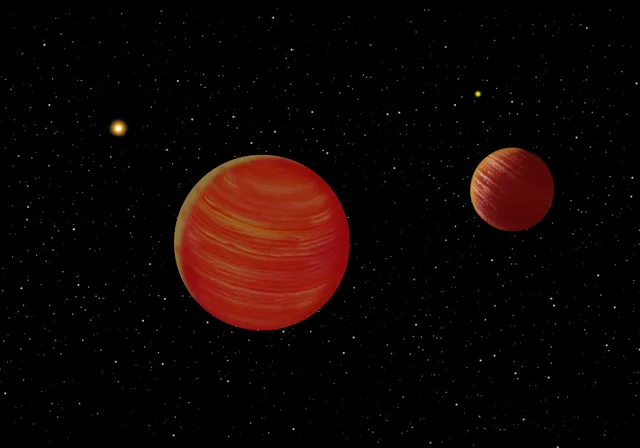
The researchers analysed microlensing events OGLE-2016-BLG-0261, KMT-2025-BLG-0026, KMT-2025-BLG-0030 and KMT-2025-BLG-2272, recorded by high-cadence surveys. The planetary signals appear as short anomalies in the light curves, with mass ratios between the lens components of about 10⁻³. Finite-source effects were measured in three of the four events.
A Bayesian analysis gives host star masses of 0.07 to 0.6 solar masses and companion masses of 0.2–2.5 Jupiter masses. Projected separations are 0.7–6 au, so all the planets lie at or beyond the snow line. The systems are 6.6–7.9 kpc away and consistent with bulge lenses. The findings enlarge the sample of cold giants and help constrain how often such planets occur around low-mass stars.
FAST detects vast hydrogen flows near compact group
Using the 500-metre Aperture Spherical radio Telescope (FAST), astronomers have discovered an extended neutral hydrogen structure in the neighbourhood of Hickson Compact Group 100 (HCG 100). The gas flows stretch over megaparsec scales, far beyond the member galaxies themselves.
The authors consider two explanations: the structure could be tidal debris left by gravitational interactions among the group's galaxies, or gas being accreted from the cosmic web. Telling these scenarios apart matters because neutral hydrogen is the fuel for star formation. Its origin shows how galaxies in dense environments gain or lose gas. The work is published in The Astrophysical Journal Letters.
Gas around Sgr A* is rich in metals
Researchers at McGill University analysed JWST data on gas orbiting Sgr A*, the supermassive black hole at the centre of the Milky Way. The telescope's infrared observations let them distinguish several gas clouds and measure the metal content of each precisely. The gas turns out to be rich in metals, most likely because exploding stars enriched the black hole's surroundings over time.
The gas is similar in composition to many of the stars orbiting the black hole, suggesting the two may have formed together. This matters because metals affect how fast gas cools, and so how readily it can fall into a black hole. Sgr A* consumes far less material than other supermassive black holes. A related study found that the gas emission cannot provide a reliable history of the black hole's past activity. Next, the team needs simulations of how the gas evolves.