Supernovae work as beacons that let astronomers trace the fate of massive stars across cosmic history. The farther the explosion, the harder it is to catch: the light fades, and spectral lines shift so far into the infrared that ground-based telescopes can barely see them. That is exactly why the discovery of SN 2023aeaf was only possible with JWST, an observatory built to work in infrared light.
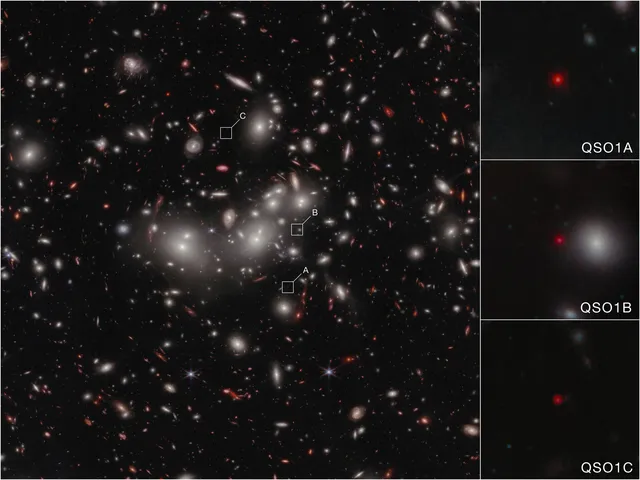
The object turned up in the COSMOS-Web survey, a large JWST program that repeatedly images the same patch of sky to track brightness changes in galaxies and catch short-lived flashes. SN 2023aeaf turned out to be one of the most distant spectroscopically confirmed explosions of its kind — its light traveled to Earth for more than 11.5 billion years.
Two images instead of a spectrum
Classifying a supernova usually relies on a spectrum — light split into wavelengths that reveal the chemical makeup and physics of the blast. But at such distances, getting a usable spectrum is difficult even for James Webb.
So researchers used a different approach: they compared two JWST images taken about one month apart in the supernova's own rest frame (due to cosmic time dilation, the actual gap between the images as seen from Earth was longer). The brightness change between these two epochs was compared against light-curve models for different supernova types, as well as archival ultraviolet observations of supernovae from the Swift telescope.
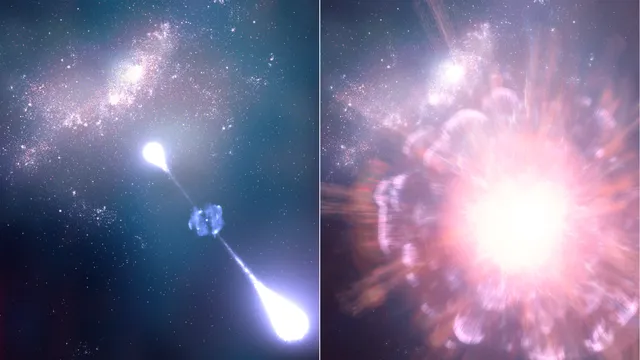
The result pointed to a Type II supernova — an explosion that happens when a massive star runs out of fuel in its core and the core collapses under its own gravity. Matching the data to models suggested a progenitor star of roughly 12 solar masses, surrounded by about 0.5 solar masses of circumstellar material — gas the star shed before it exploded.
Why the spectrum stayed silent
About 30 days after discovery (again in the supernova's rest frame), the team obtained a spectrum of the object combined with its host galaxy. But it showed no clear signature of the explosion itself.
The most likely explanation is strong hydrogen emission (the Hα line) coming from the host galaxy, which simply overwhelms the fainter signal from the supernova. This is a common problem for distant explosions: the younger and more active a galaxy is, the brighter it shines in its own emission lines, making it harder to isolate the supernova's contribution.
Because only a limited number of observation epochs were available, the researchers could not tightly constrain the explosion's properties — the progenitor mass and the amount of circumstellar material remain estimates rather than precise measurements.
A galaxy at the edge of the young Universe
Modeling the host galaxy's spectral energy distribution, using the Bayesian inference tool Prospector, showed a star-forming system with a stellar mass of about one billion solar masses and low metallicity — a heavy-element content noticeably below the Sun's.
This profile fits a broader pattern JWST is beginning to reveal among core-collapse supernovae in the early Universe: they tend to occur in bright, metal-poor galaxies with dense shells of circumstellar gas. Low metallicity affects how stars lose mass over their lifetimes, which in turn shapes the kind of supernovae they eventually produce.
SN 2023aeaf adds to a small but steadily growing sample of early-Universe supernovae found by JWST. Each new case adds detail to the picture of how massive stars were born, lived, and died in the first few billion years after the Big Bang — an era that, until recently, was largely out of reach for direct observations of individual stellar deaths.