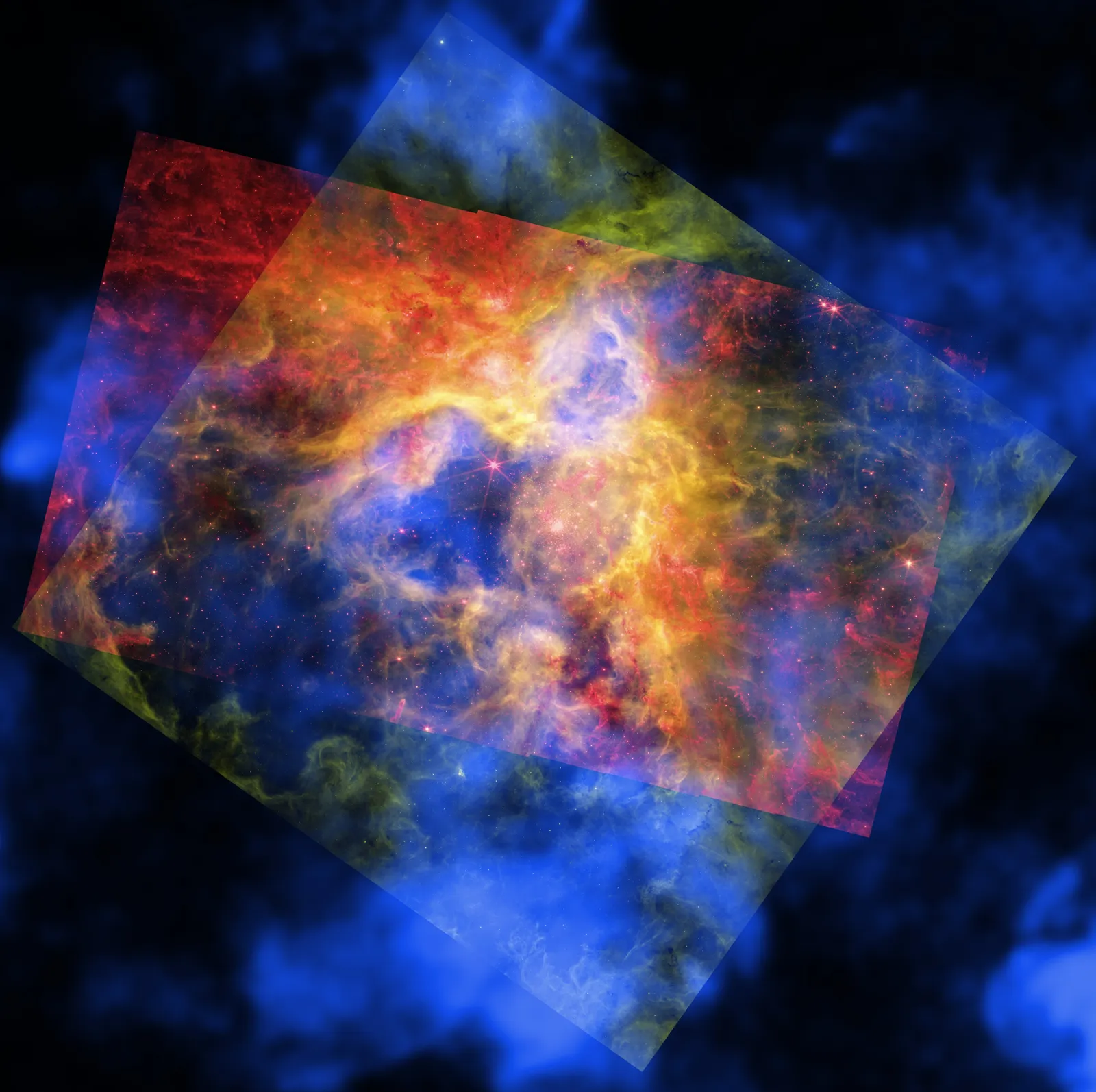
Astronomers have assembled a vivid new image of the Tarantula Nebula by layering data from three NASA space telescopes — the Chandra X-ray Observatory, the James Webb Space Telescope, and the Hubble Space Telescope. The result resembles a collage of colored cellophane sheets, with each telescope contributing its own layer of information about the same star-forming region. Behind the colorful picture lies a specific scientific puzzle: why does the nebula contain far less hot gas than models predicted?
The Tarantula Nebula, also known as 30 Doradus, sits in the Large Magellanic Cloud, a small companion galaxy to the Milky Way roughly 160,000 light-years away. It's one of the brightest and most active star-forming regions in our cosmic neighborhood, with thousands of young stars embedded in a honeycomb-like structure of gas and dust.
What Each Telescope Reveals
In the new composite, blue represents X-ray data from Chandra, which has repeatedly observed the Tarantula over the course of its mission. The X-rays trace gas blown away from the surfaces of young, massive stars and heated to millions of degrees by shock waves — much like sonic booms from supersonic jets.
Red shows infrared data from Webb, revealing thousands of young stars and swaths of cool dust — the raw material that could eventually form new stars and planets. Green marks optical data from Hubble, which uncovers hydrogen gas warmer than what Webb detects, along with individual stars visible through the nebula.
The full composite combines complete Hubble and Webb images with a large section of the Chandra data, all detailed in a recent paper published in the Astrophysical Journal. In some regions the blue X-ray layer stands alone; in others it blends with red or green data. At the center, all three data sets overlap, producing a full palette of red, orange, yellow, green, and blue.
Where Did the Energy Go?
Astronomers had previously estimated how much energy is produced by winds from young, massive stars in the Tarantula, and expected much of it to heat surrounding gas to X-ray-emitting temperatures. But the new paper found significantly less X-ray gas than predicted, raising the question of where the missing energy went and what tamed the nebula.
By combining data from Chandra, Hubble, Webb, and archival observations from the retired Spitzer Space Telescope, a team led by Jennifer Rodriguez of Ohio State University concluded that the Tarantula is losing energy through several channels at once.
First, up to half of the hot gas is leaking through the walls of gas-and-dust shells and escaping the nebula entirely. Second, mixing occurs between cold gas near the shell walls and some of the hot gas, lowering the overall temperature. Third, comparisons with computer simulations point to conduction — direct physical contact between hot and cooler material that causes temperatures to equalize, similar to a frying pan transferring heat from a burner. In the Tarantula, hot gas appears to conduct heat by direct contact with cooler gas in the shells, particularly in the densest regions, without necessarily mixing the two.
Why It Matters
Together, these three channels — leakage, mixing, and conduction — help explain why the Tarantula runs cooler than earlier models predicted. The finding matters beyond this single nebula: 30 Doradus is often treated as a local analog for intense star-forming regions in the early universe, when stars formed far more actively than they do today. Refining our understanding of how young stars exchange energy with their surroundings helps astronomers build more accurate models of how galaxies took shape over cosmic time.
The study was led by Jennifer Rodriguez of Ohio State University in Columbus, with co-authors from Columbia University, San Diego State University, the Space Telescope Science Institute, and NASA's Goddard Space Flight Center.