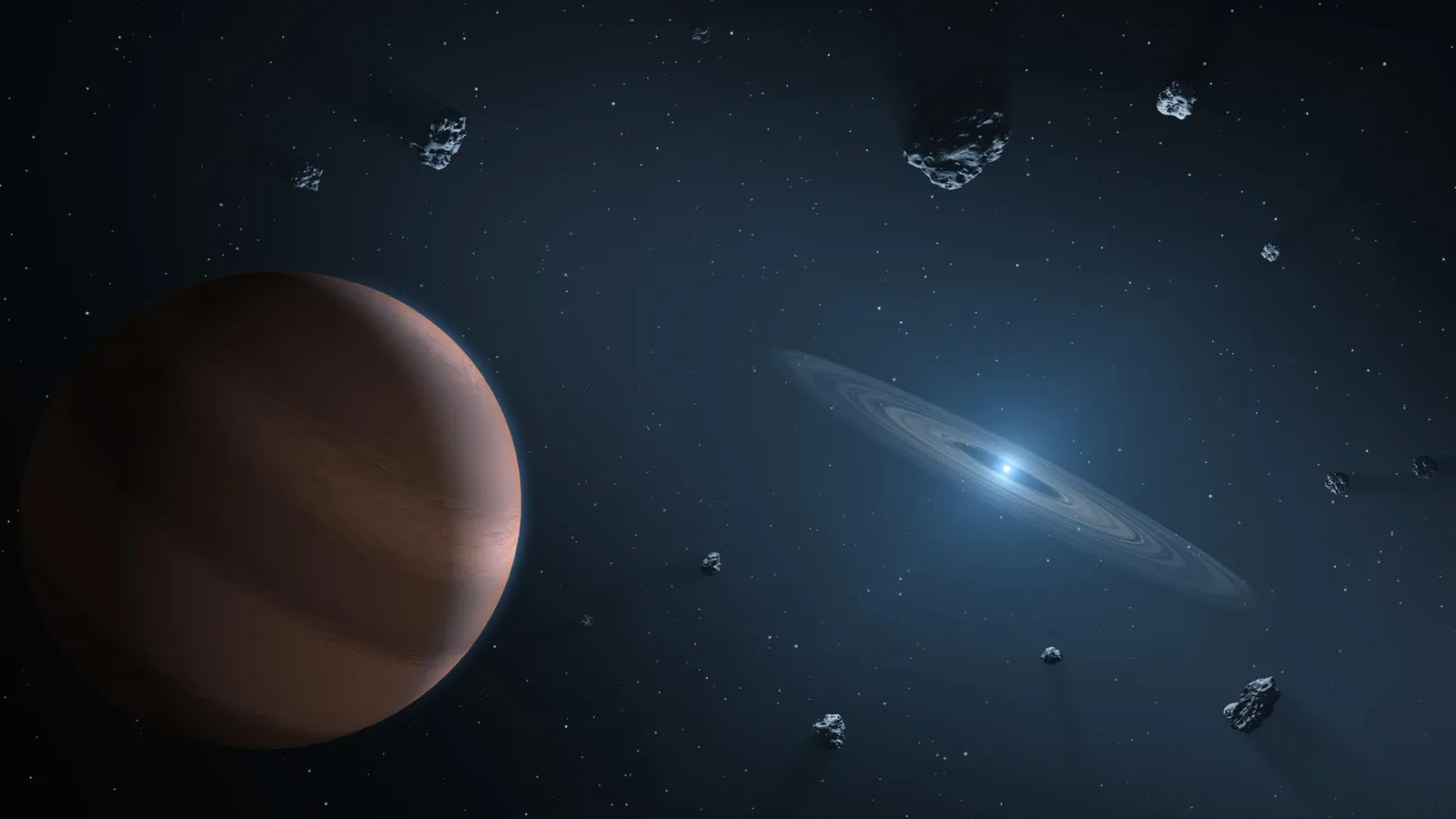
Debris disks are dusty, rocky remnants left over around stars after planet formation is largely complete. Made of asteroids, comets, and the fragments produced by their collisions, they serve as a kind of archaeological record for reconstructing a planetary system's history and architecture. One such system is γ Ophiuchi, an A1V star located 29.7 parsecs from the Sun. Earlier Spitzer imaging revealed an unusually large radial extent for its disk, while analysis of its spectral energy distribution hinted at warm dust closer to the star.
What JWST revealed
New observations used the MIRI instrument on the James Webb Space Telescope at two mid-infrared wavelengths — 15 and 25.5 microns. The resulting image showed smooth emission, free of sharp internal structure, extending to at least 250 astronomical units from the star at the longer wavelength — nearly eight times the Sun-Neptune distance.
For comparison, the researchers point to JWST's earlier results for two other well-known disks, Fomalhaut and Vega. There, mid-infrared imaging revealed a separate inner component of small grains organized into distinct ring structures. In γ Oph, no such segmentation appears — instead of separate rings, there is one continuous, radially broad stream of emission.
A collisional cascade without a break
By combining the new MIRI data with earlier observations from the ALMA radio interferometer, the authors conclude that the size distribution of dust grains stays consistent across the entire width of the disk. This is a hallmark of what's called a steady-state collisional cascade — a process in which larger bodies are continually ground down into smaller fragments through collisions, maintaining a stable balance of particles across all size ranges.
If the disk's apparent breadth were merely an optical effect — with dust actually forming in a narrow planetesimal belt and then being pushed outward by radiation pressure or other forces — the size distribution of grains would be expected to change with distance from the star. Instead, the uniformity of spectral properties throughout the disk suggests that the parent planetesimal belt itself — the bodies whose collisions produce the dust — is physically broad. By the authors' estimate, it extends from tens of astronomical units, or even closer to the star, out past 200 astronomical units.
Asymmetry and a hint of a hidden companion
Beyond its radial breadth, the image also revealed an asymmetry in the disk. This could be modeled as an offset between the disk's center and the star (a stellocentric offset), corresponding to a small orbital eccentricity of roughly 0.03. Even a modest departure from a perfectly circular shape like this is typically interpreted as evidence of gravitational influence from a companion — a planet or stellar companion perturbing the orbits of dust particles.
By the authors' calculations, such asymmetry could be produced by a mildly eccentric giant planet with a mass up to 10 Jupiter masses, orbiting beyond 10 astronomical units from the star. An alternative scenario involves a more eccentric companion, potentially up to stellar mass, located much closer in — just a few astronomical units out. A key detail: neither scenario would necessarily carve a resolvable radial gap into the disk. That means a planet or companion could remain hidden even under detailed scrutiny of the disk's structure — only its overall shape betrays a presence.
The result adds to a small but growing sample of systems where JWST allows direct comparison of dust structure across different particle sizes and wavelengths. Together with the contrasting examples of Fomalhaut and Vega, γ Ophiuchi demonstrates that the architecture of planetesimal belts can vary substantially from star to star — ranging from narrow, sharply defined rings to broad, continuous structures spanning hundreds of astronomical units around the host star.