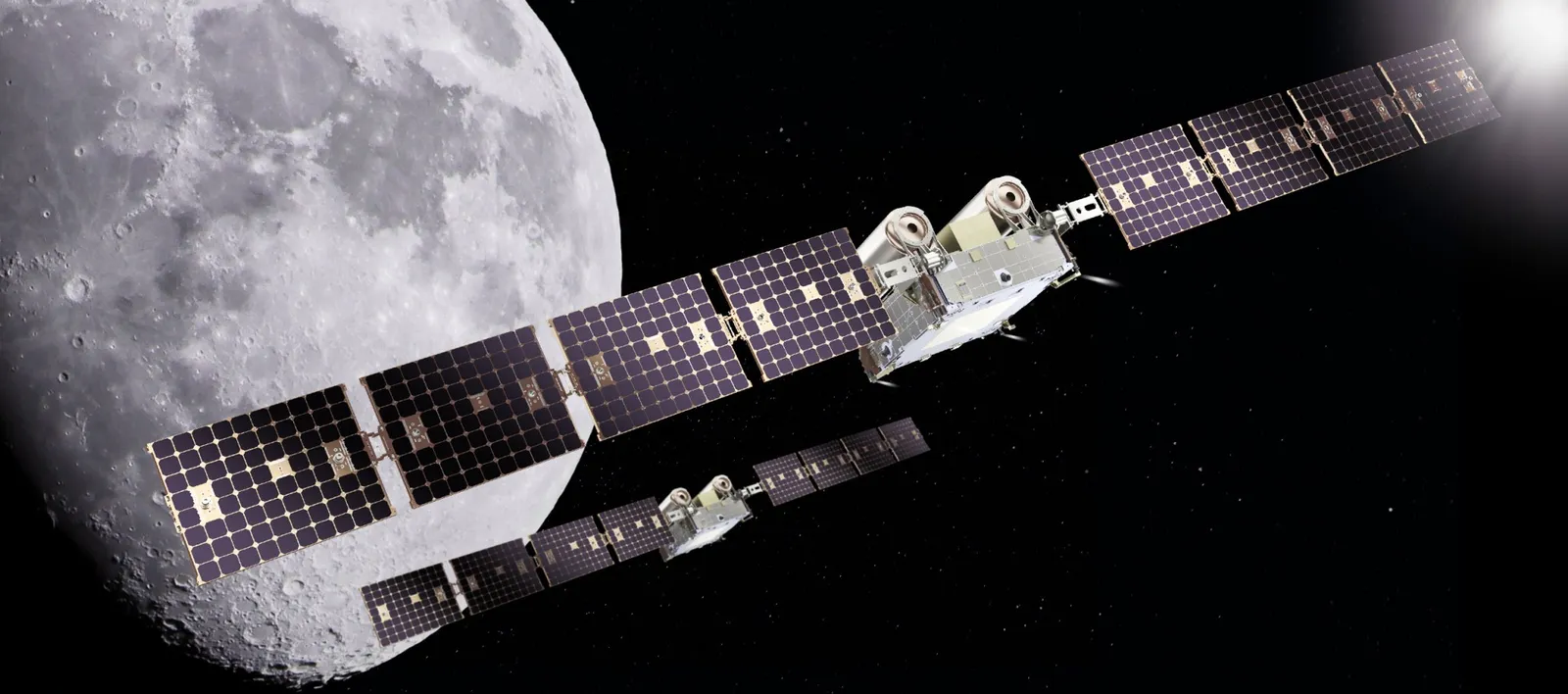
NASA continues building cislunar infrastructure for the Artemis program and a future Moon Base. As part of this effort, the agency contracted Advanced Space for a new mission, CAPSTONE 02. Its launch is targeted for 2027.
The mission will send two identical small spacecraft to the Moon. They will demonstrate rendezvous and proximity operations, autonomous navigation and communication in cislunar space. At the same time the spacecraft will continue characterizing the radiation environment near the Moon.
What CAPSTONE 02 will do
Each spacecraft is built by Terran Orbital and weighs about 400 kilograms (882 pounds).
Operators will conduct a series of rendezvous and formation-flying maneuvers in lunar orbit. The goal is to better understand the trajectories of the spacecraft under the simultaneous pull of Earth and Moon gravity. Such trajectories are called three-body orbits.
A key feature: each of the two spacecraft can switch between the roles of "chaser" and "target." This allows a broad range of scenarios to be tested under varying conditions in cislunar space.
For navigation the mission will use ground tracking, optical sensors and orientation by celestial bodies. These tools will help one spacecraft locate and rendezvous with another.
Why Artemis needs this
The relative navigation techniques CAPSTONE 02 will test are more sophisticated than those used in low Earth orbit.
They are needed for a specific task: astronauts must dock with lunar landers in lunar orbit, then descend to the surface and return. The same navigation strategies are planned for when the Orion spacecraft approaches a lander in deep space.
The problem is that these conditions cannot be fully recreated on Earth. So they must be tested directly in space.
Technology development through flight testing is how we convert hard problems into the lasting capabilities needed for a permanent presence at the Moon.
That is how Christopher Baker, lead of the In-Space Infrastructure portfolio at NASA, explains the logic of the mission.
What the first CAPSTONE already did
The original CAPSTONE mission (short for Cislunar Autonomous Positioning System Technology Operations and Navigation Experiment) became the first U.S. commercial spacecraft at the Moon.
It was also the first to enter a near rectilinear halo orbit around the Moon. This orbit is nearly stable thanks to the combined pull of Earth and Moon gravity.
The first mission validated communications, networking and autonomous navigation, and gathered operational experience in cislunar space. CAPSTONE 02 expands on those achievements: it moves from validating the orbit itself to more sophisticated operational tasks.
Software and payload
CAPSTONE 02 will also serve as a testbed for software. The spacecraft will test three navigation software suites developed by NASA. They will collect data during a low energy transfer trajectory — one that takes the spacecraft from Earth to beyond the Moon before settling into lunar orbit.
The spacecraft will carry an optical imaging payload from Lawrence Livermore National Laboratory. It will support the navigation demonstration and capture imagery of the Moon.
In addition, the mission will further mature the Cislunar Autonomous Positioning System — a method of determining a spacecraft's position relative to other spacecraft without relying on Earth-based tracking.
The goal of this whole set of technologies is to automate routine navigation tasks, reduce dependence on ground communications and make the mission model cheaper, faster and repeatable.