A hundred years ago, in the small town of Auburn, Massachusetts, an event took place that almost no one noticed at the time. Physicist Robert Goddard launched a liquid-fueled rocket — and that moment became the starting point for the entire history of modern rocketry.
Today, liquid-fueled rocket engines carry communication satellites, navigation systems, and scientific instruments into orbit, as well as missions to the Moon and beyond. It all began with an experiment that looked almost unremarkable from the outside.
A flight that lasted 2.5 seconds
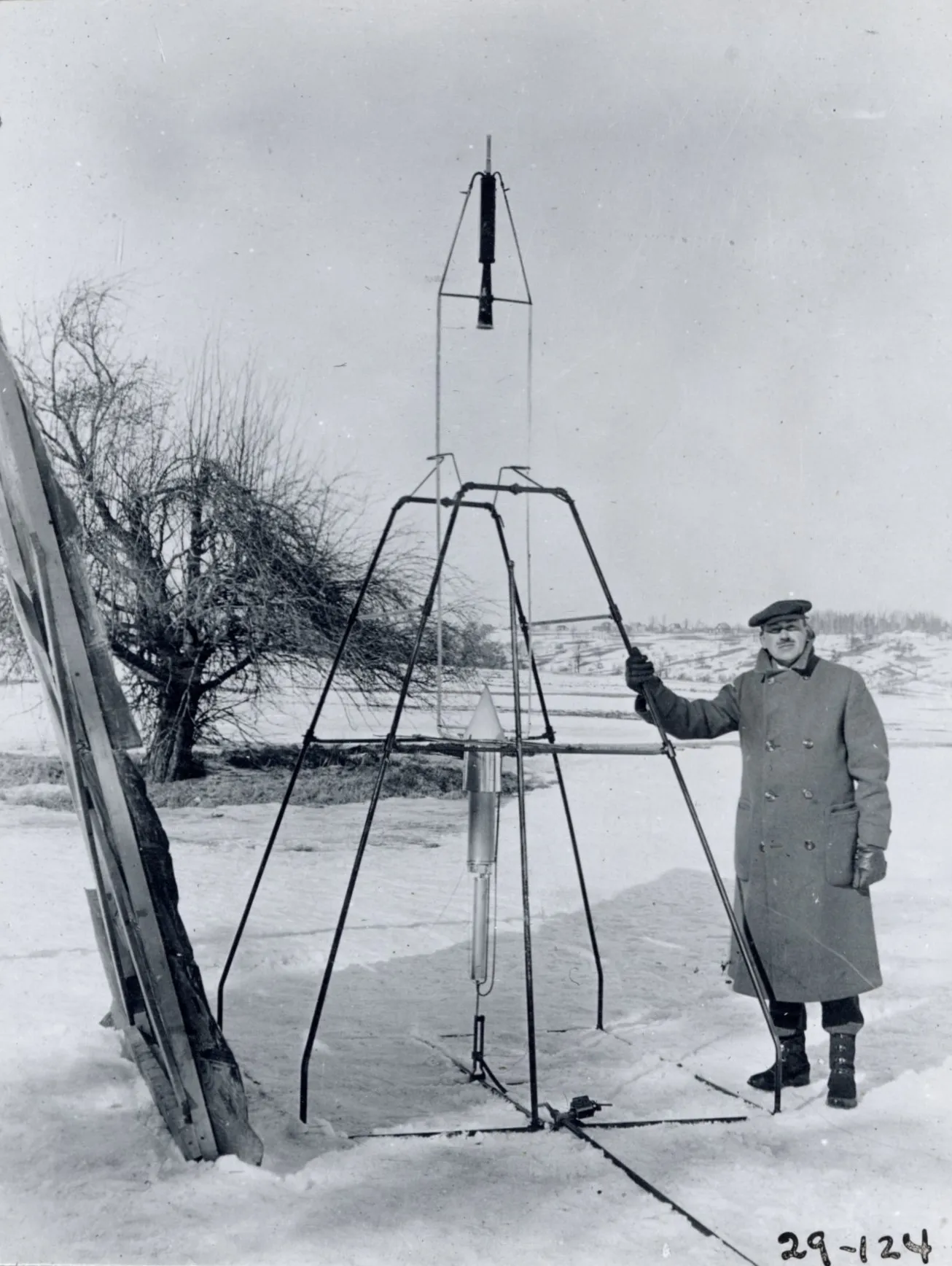
On March 16, 1926, Goddard tested his rocket at his Aunt Effie's farm in Auburn. The fuel was a mixture of liquid oxygen and gasoline.
The result was modest by any standard. The rocket flew for 2.5 seconds, reaching an altitude of 12.5 meters (41 feet), and landed in a cabbage patch 56 meters (184 feet) away from the launch site.
Despite this, the event marked a breakthrough. For the first time in history, a person built a flying craft powered by liquid propellant — a fundamentally different approach compared to solid-fueled rockets known since ancient times.
Technologies born from the experiment
Goddard did not stop after his first success. Over his lifetime, he kept refining his design and developed a series of solutions without which modern rocket technology would be impossible.
Among his inventions were systems to steer a rocket's flight path, pumps to deliver liquid fuel to the engine, and engines capable of pivoting for finer control over trajectory.
These developments laid the technical groundwork on which far more powerful and complex rocket systems were later built — from the first orbital launches to missions that broke free of Earth's gravity to reach beyond orbit.
The legacy of one experiment
The scale of Goddard's influence is well captured in how NASA describes the significance of that event a century later.
From the voyages of spacecraft to the Moon and beyond, to the launches of satellites that help us navigate, communicate, and understand our planet and the universe, the use of liquid-fueled rockets has been key to humanity's use and exploration of space.Michele Ostovar, NASA History Communications Lead
A rocket that landed in a cabbage patch less than three seconds after liftoff started a technological lineage that now extends to every modern rocket launch. Satellite constellations in orbit, lunar missions, and spacecraft studying the distant universe all trace their existence back to that modest 1926 experiment.