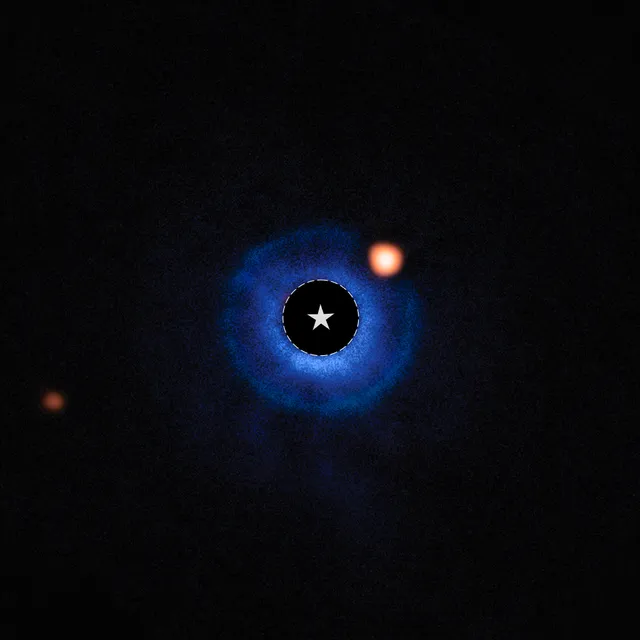
Eyes on Exoplanets by NASA is a 3D map of our corner of the Milky Way that runs right in your browser. Over 6,100 confirmed exoplanets across thousands of star systems, with data updated daily — the moment astronomers confirm a new planet, it appears on the map. But instead of listing features, here's a route. Three stops, about fifteen minutes.
Stop one: the seven planets of TRAPPIST-1
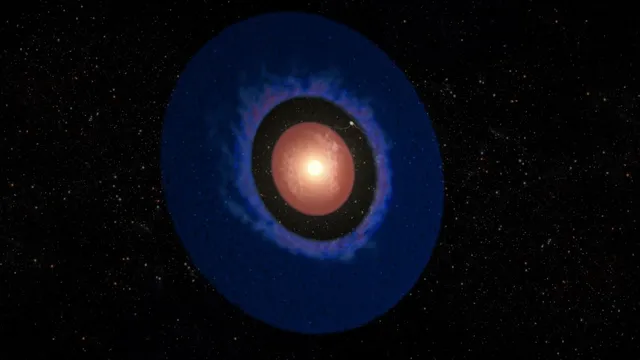
Type TRAPPIST-1 into the search. It's a red dwarf 40 light-years away, orbited by seven Earth-sized planets — the densest known system of terrestrial worlds. Zoom in and see how tightly they're packed: all seven orbits would fit inside the orbit of Mercury. Now toggle the habitable zone — the belt around the star where water can stay liquid. Three of the planets fall right into it.
Click any of them: you'll see its size compared to Earth, its orbital period, its distance from the star. A year on the TRAPPIST-1 planets lasts between one and a half and nineteen Earth days.
Stop two: the planet with two suns
Find Kepler-16b. This planet orbits two stars at once — standing on its surface, you'd watch a double sunset, like Luke Skywalker on Tatooine. When it was discovered in 2011, it was the first direct proof that planets on such orbits can exist at all. Look at its orbit in 3D — you can see the two stars circling each other while the planet circles the pair.
Stop three: the nearest neighbor
Your last search: Proxima Centauri b. It's the closest exoplanet to us — 4.2 light-years. On the map it looks nearby, but check the scale: humanity's fastest spacecraft would need tens of thousands of years to get there. Compare it with Earth: similar mass, a dim red dwarf for a star, and the planet hugs it twenty times closer than Earth hugs the Sun.
From here, you're on your own
These are just three systems out of thousands. Filters let you show only habitable-zone planets, only gas giants, or only recent discoveries. Every dot on this map is a real world that, thirty years ago, no one knew existed for sure. Runs in the browser, free, no sign-up.