For more than a century, Einstein's General Relativity and the particle physics Standard Model have explained nearly everything that can be directly measured in the Universe. Planetary orbits, the bending of light near massive bodies, particle decays — all of it matches theoretical predictions with extraordinary precision. The catch is that, together, these two theories account for less than 5% of the Universe's matter and energy.
The rest — dark matter and dark energy — has no confirmed theoretical description. A new review, prepared by a team of 11 authors and released on March 3, 2026, systematizes what modern multi-messenger astronomy — observations combining gravitational waves, electromagnetic radiation, and data from compact objects — has managed to learn about this hidden sector.
Three candidates for dark matter
Spanning 136 pages with 29 figures and 7 tables, the review considers three broad categories of hypotheses. The first is weakly interacting massive particles (WIMPs), the classic candidate searched for over decades in underground detectors and at particle accelerators.
The second category covers ultralight scalar fields, hypothesized to permeate all of space and potentially manifest not as discrete particles but as a wave-like field with an extremely small mass.
The third is primordial black holes, which may have formed before the first stars, out of density fluctuations in the early Universe. Unlike stellar-origin black holes, they are not products of massive star collapse but form at a much earlier stage of cosmic history.
The researchers cover a wide range of scales — from precision tests within the Solar System to galaxy-scale observations and full-sky cosmological surveys. This range allows the same hypotheses to be tested through several independent methods.
Neutron stars and magnetars as detectors
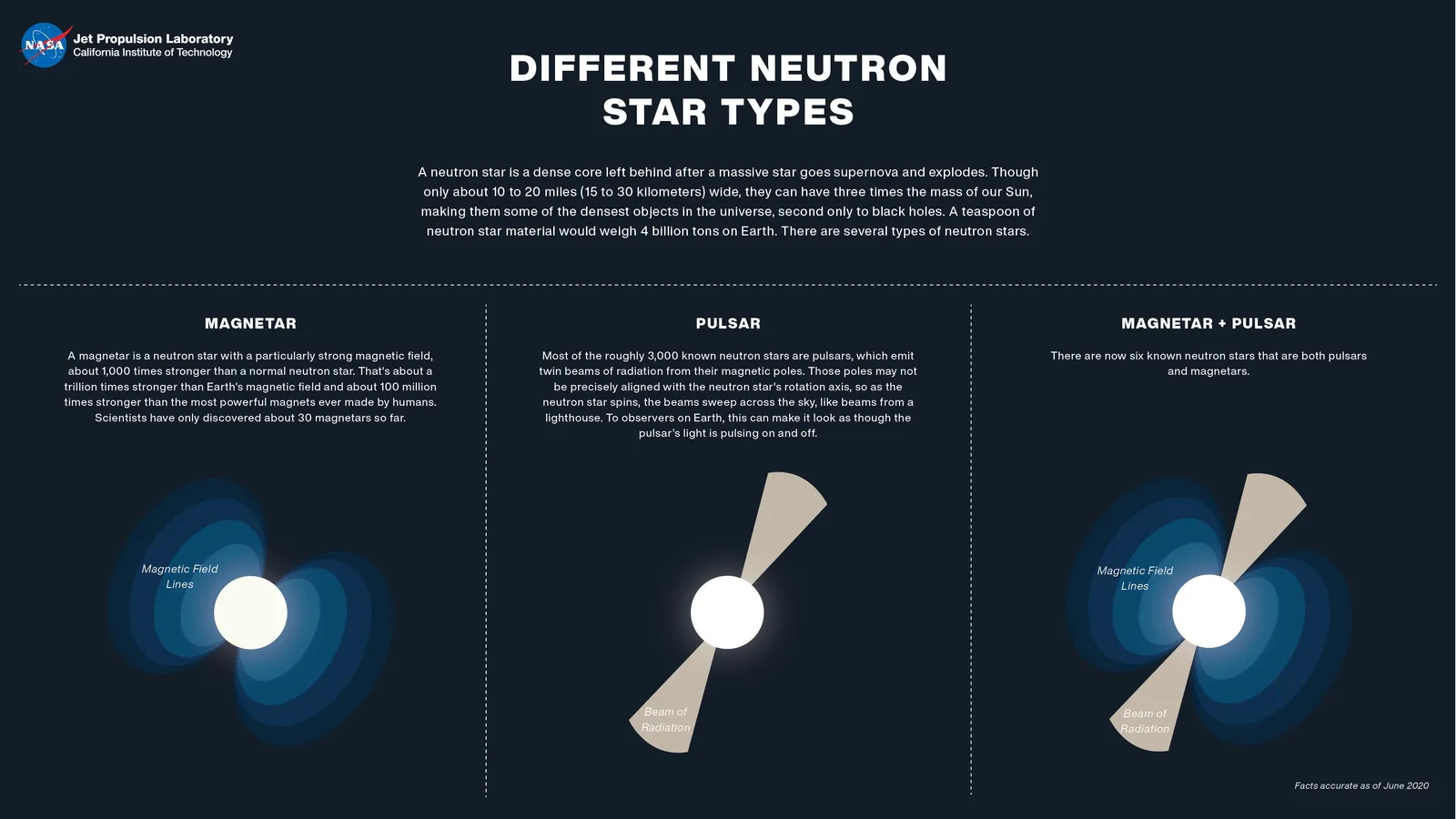
Compact objects — neutron stars, black holes, pulsars, and magnetars — receive particular attention in the review. The logic is straightforward: if dark matter can accumulate inside such objects, it should alter their physical properties.
This concerns mass, radius, and tidal deformability — a parameter describing how much an object deforms under the gravitational pull of a companion body, for instance in a binary system before merger. Today these parameters are measured with precision sufficient to compare against theoretical predictions.
The authors also consider scenarios in which dark matter does not merely accumulate but decays into Standard Model particles. Such decay could leave observable traces in high-energy astrophysical phenomena — processes such as outbursts or radiation from extreme objects.
Magnetars and pulsars are valuable because their physical parameters — from rotation to magnetic field strength — have been measured by astronomers for decades with steadily improving precision. This makes them natural laboratories for testing hypotheses that cannot be reproduced on Earth.
Gravitational waves versus modified gravity
A separate part of the review addresses extensions of General Relativity that add extra scalar fields to it. Such models predict that gravitational wave signals from merging compact objects should carry features absent from standard Einsteinian gravity.
The authors also analyze stochastic gravitational wave backgrounds — a kind of background "noise" produced by numerous individually indistinguishable events, including those linked to primordial black holes. Detecting such a background with characteristics matching primordial black hole theory would provide strong evidence for their existence.
These observations act as a kind of filter: they either confirm predictions of extended gravity models or place increasingly tight constraints on the parameters — particle masses and interaction strengths — under which such models can exist at all.
According to the review's authors, current data already narrow the space of viable theories considerably. But the decisive breakthrough is expected to come from the next generation of gravitational wave observatories and telescopes, capable either of detecting genuinely new physics or of ruling out entire classes of theoretical models for good.