
In May 2024, the Sun unleashed its most powerful storm in more than two decades. On Earth, the event is remembered for auroras visible as far south as Mexico. But the same stream of particles kept travelling through the Solar System and, within hours, reached Mars. Two European Space Agency orbiters happened to be in exactly the right place at exactly the right moment, capturing the event in a level of detail never recorded before. The findings are published in Nature Communications.
The main witnesses were Mars Express and the ExoMars Trace Gas Orbiter (TGO), both of which have spent years circling the Red Planet. This particular storm gave them a chance to apply a new measurement technique and reveal just how exposed Mars's atmosphere is to solar activity.
Three waves in a single storm
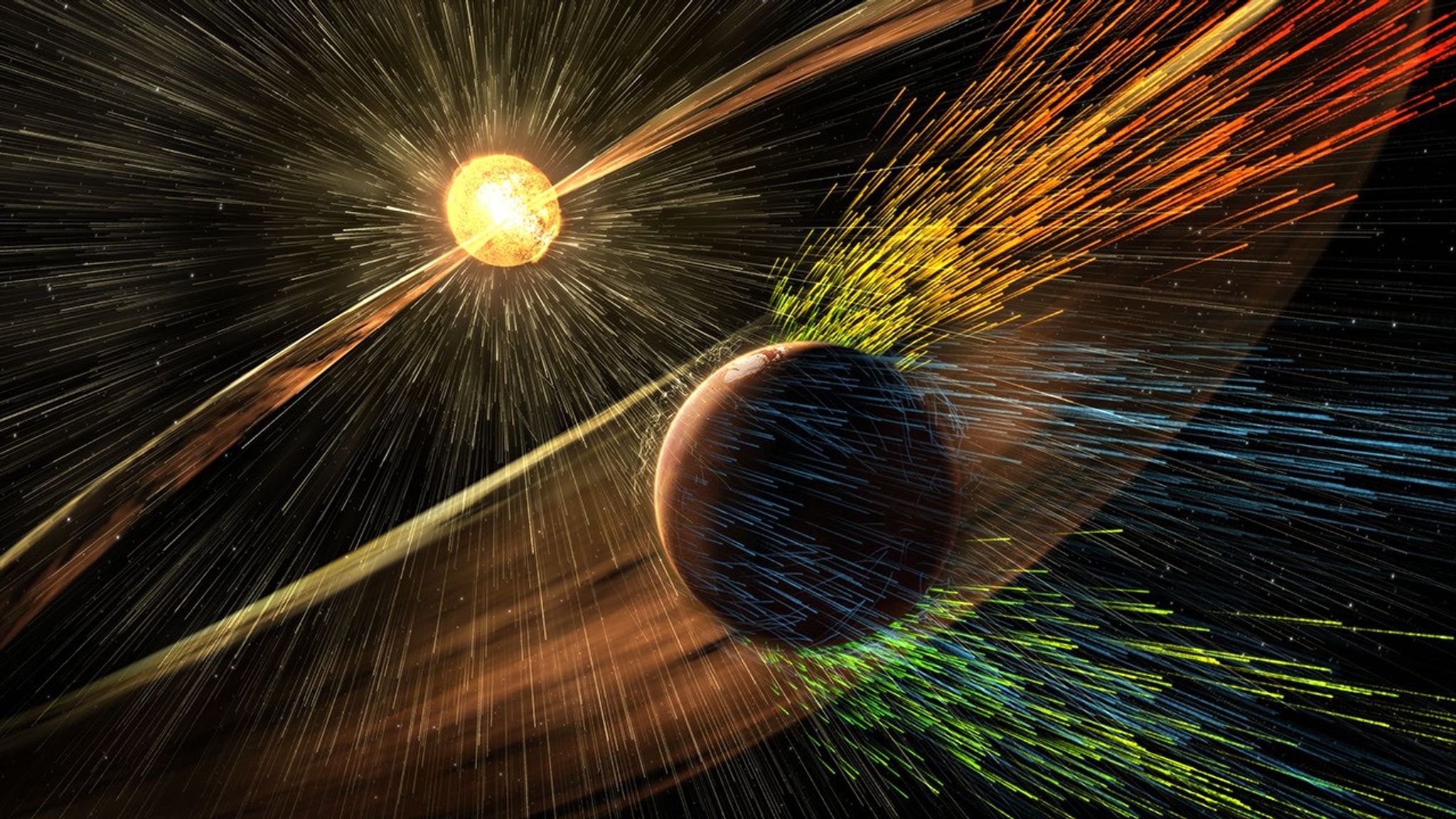
The event on 20 May 2024 was not a single blow but a sequence of three connected phenomena. First came a radiation flare, then a burst of high-energy particles, and finally a coronal mass ejection — a huge cloud of magnetised plasma hurled from the Sun's outer layers. Together, they flooded Mars's upper atmosphere with fast-moving charged particles and X-rays.
These particles collided with neutral atoms in the Martian atmosphere and stripped away their electrons, flooding the ionosphere (the charged upper layer of the atmosphere) with free electrons. At an altitude of 110 km, electron numbers rose by 45%; at 130 km, they jumped by a striking 278%. Researchers say this is the highest electron density ever recorded at Mars.
The impact was remarkable: Mars's upper atmosphere was flooded by electrons. It was the biggest response to a solar storm we've ever seen at MarsJacob Parrott, ESA Research Fellow, lead author of the study
A radio signal through the planet's atmosphere
To measure this, scientists used a technique called radio occultation between two spacecraft, applied at Mars for the first time in this context, just after the solar flare hit. The idea is straightforward: Mars Express beamed a radio signal to TGO at the exact moment TGO was disappearing over the Martian horizon. As the signal passed through the atmospheric layers, it bent — and the pattern of that bending reveals the properties of each layer, including electron density.
The technique has been used for decades to study planets, but traditionally the signal was sent from a spacecraft back to Earth. Only in the past roughly five years has it been applied between two spacecraft near Mars itself. Researchers cross-checked their results with observations from NASA's MAVEN mission to confirm the electron densities.
Timing mattered enormously: the observation was taken just 10 minutes after the major flare struck Mars. Since such measurements are currently made only twice a week at Mars, the coincidence was described as extremely lucky.
Computer glitches and a dose in 64 hours
The intense particle flux did not spare the spacecraft themselves. The storm caused computer errors aboard both Mars Express and TGO — a familiar hazard of space weather, since the particles involved are highly energetic and hard to predict. Both orbiters recovered quickly, thanks to radiation-resistant components and dedicated systems for detecting and fixing such errors.
TGO's radiation monitor recorded a dose equivalent to 200 "normal" days of exposure — all within just 64 hours. The figure illustrates just how intense the radiation flux was compared with typical background levels at Mars.
Why Mars has no shield
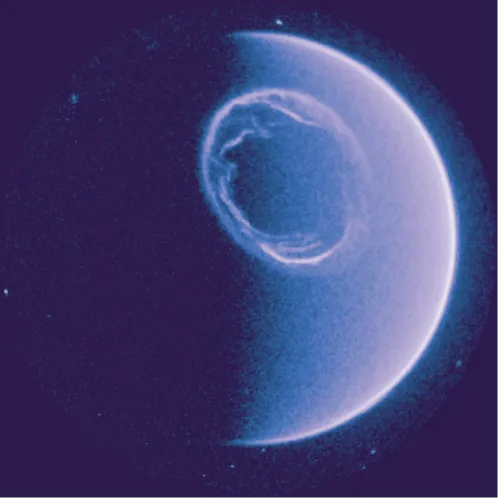
On Earth, the planet's magnetic field softened much of the blow, deflecting many particles away and channelling others toward the poles, where they produced auroras. Mars has no such shield: it lost its global magnetic field billions of years ago. As a result, the storm struck its atmosphere almost unopposed.
This is more than an academic contrast. The relentless action of the solar wind is considered the leading explanation for why Mars lost most of its atmosphere and water over billions of years. Researchers also note that a dense, electron-packed ionosphere affects how radio signals travel through the atmosphere — a factor that matters for future missions studying the Martian surface with radar.
More space-weather missions are on the way. ESA's Solar Orbiter is already watching the Sun up close, Smile will join it in spring 2026 to study how Earth's magnetic field responds to the solar wind, and Vigil, launching in 2031, will track hazardous solar activity in near-real time.