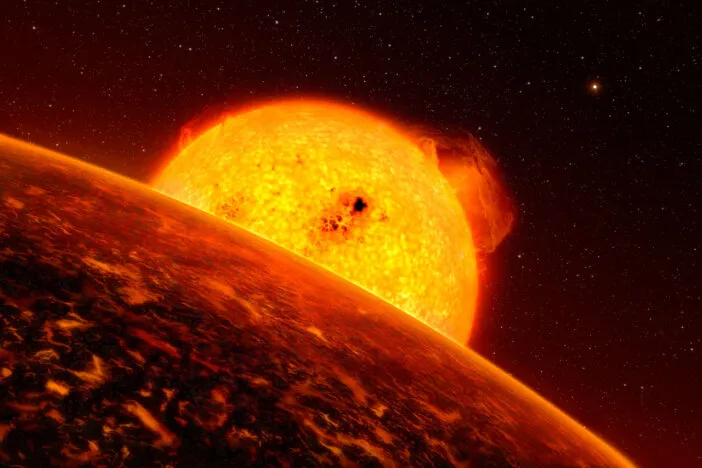
The Hubble Space Telescope has detected the secondary eclipse of a rocky exoplanet for the first time. The target is TOI-2431b, a lava world that completes an orbit around its star in just 5.4 hours. The result was published in The Astrophysical Journal Letters (Zieba et al., 2026). The lead author is Sebastian Zieba of the Center for Astrophysics | Harvard & Smithsonian.
The new data do not settle whether the planet has an atmosphere. They do show that TOI-2431b stands out from other known lava worlds.
Why secondary eclipses are valuable
Most exoplanets have been found with the transit method. A planet crosses in front of its star, and the starlight dims briefly. Thousands of planets are known this way.
Far fewer planets have been caught passing behind their stars. That event is the secondary eclipse. The dip in the combined light of star and planet is much subtler. Yet it carries valuable information. It reveals the planet's dayside temperature, the reflectivity of its surface and the properties of its atmosphere.
What was measured on TOI-2431b
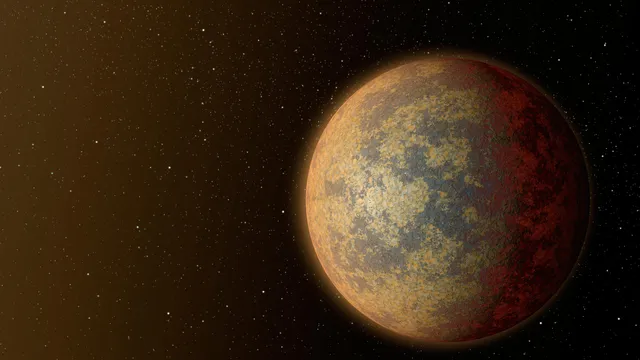
TOI-2431b orbits a K-type star. Its orbital period is 5.4 hours, the shortest of any planet with a measured mass and radius. The planet has 6.2 Earth masses and a radius of 1.54 Earth radii.
It is expected to be a lava world: a rocky planet so hot that all or part of its surface is molten. Such planets orbit extremely close to their stars. Searing radiation and stellar winds have long since stripped away their primordial atmospheres. Still, observations have shown that these planets can have atmospheres. They are deeply un-Earth-like, made of superheated rock vapor.
Zieba's team observed the planet with Hubble in the near-infrared. They combined those data with visible-light observations from the Transiting Exoplanet Survey Satellite (TESS). TESS first detected TOI-2431b in 2019.
The eclipse points to a dayside brightness temperature of 2524 K (about 2251 °C). Brightness temperature is the temperature a blackbody would need to emit the same amount of light. This is hot enough to melt many types of rock.
What's new
This is the first time Hubble has detected the secondary eclipse of a rocky planet.
There is a second surprise. The measured temperature is roughly what one would expect for a world that absorbs all incident energy and redistributes none of it. For lava worlds this is unusual. They generally appear to have a mechanism that lowers the dayside temperature: a reflective surface, a cloudy atmosphere or efficient heat transport from day to night. Here no such mechanism is evident so far. That makes TOI-2431b an outlier among the lava worlds observed to date.
How solid is the result
The data rule out neither an atmosphere nor a somewhat reflective surface. The reason lies in the wavelengths to which Hubble and TESS are sensitive. In the near-infrared and visible light, the planet's own thermal emission cannot be disentangled from reflected starlight.
The researchers modeled a possible rock-vapor atmosphere. They found that, at the wavelengths probed by Hubble and TESS, the planet's emission looks similar with and without an atmosphere. The current data are consistent with there being no atmosphere. They do not exclude one either.
What comes next
JWST should be able to separate these scenarios. It observes at wavelengths where a rock-vapor atmosphere could be detected. The paper includes a simulated JWST observation. Unlike the Hubble and TESS data, it would distinguish models with and without an atmosphere.
So this result is a first step. Hubble has shown it can place constraints on hot rocky planets. The next word belongs to JWST.