On the night of October 15, 1991, the telescopes of the Fly's Eye detector at Dugway Proving Ground in Utah recorded a flash in the sky that should not have been there. The calculation gave the energy of the particle behind it: 3.2×10²⁰ electron volts (give or take 0.9), or about 51 joules.
For an everyday object, 51 joules is almost nothing: it is what a baseball carries when thrown at about 60 mph. But here all of that energy was packed into one particle, smaller than an atom. That earned it the nickname Oh-My-God, and it remains the most energetic cosmic ray ever observed.
How to see a single particle
Nobody saw the particle itself. A cosmic ray strikes an atomic nucleus high in the atmosphere and sets off a cascade of secondary particles that rains toward the ground. Fly's Eye was a set of telescopes that watched the night sky for the blue flashes from these cascades. From the height and brightness of a flash, you can work out the energy of the particle that caused it.
Modern detectors also work from the ground. The Telescope Array observatory in Utah has 507 surface stations spread over 700 km². The cascade from the Amaterasu particle reached 23 of them across 48 km²: one impact in the atmosphere covered the area of a small city.
What that energy really means
The Large Hadron Collider, humanity's most powerful accelerator, brings protons to energies tens of millions of times lower. Nobody today could build a machine that reaches 3.2×10²⁰ electron volts.
The speed figures look stranger still. If Oh-My-God was a proton, it moved so close to the speed of light that in a race with a light beam it would fall behind by 1 centimeter every 245,000 years. Time nearly stops for such a proton: by its own clock, it would cover the roughly 4.4 light-years to Alpha Centauri in under a millisecond.
This is a conditional calculation, though. The composition of these particles is still unknown: it could be a proton, or a heavier nucleus such as iron. That affects both the speed and how far the particle could have traveled.
Why the source should be nearby
In 1966, soon after the discovery of the cosmic microwave background, Kenneth Greisen, Georgiy Zatsepin and Vadim Kuzmin realized that the Universe is opaque to the most energetic protons. They collide with photons of that radiation and lose some of their energy each time. The threshold of about 5×10¹⁹ electron volts became known as the GZK limit, and the Pierre Auger Observatory confirmed that the flux of particles drops sharply above it.
The conclusion is simple: a particle with the energy of Oh-My-God is unlikely to have crossed cosmological distances. Its source should be relatively close, by estimates within a few hundred million light-years. For heavy nuclei the estimate differs, but the point stands: the search belongs nearby.
Amaterasu and the void
On May 27, 2021, Telescope Array recorded the second most energetic particle known: 2.4×10²⁰ electron volts, about 40 joules. It was named after the Japanese sun goddess Amaterasu. The result appeared in the peer-reviewed journal Science in November 2023.
Its arrival direction pointed to the Local Void, a stretch of space with almost no galaxies next to the Milky Way. The authors offered three explanations: a magnetic field bent the particle's path by a large angle, there is an unidentified source nearby, or our understanding of particle physics is incomplete.
There's nothing high energy enough to have produced itJohn Matthews, Telescope Array co-spokesperson, 2023
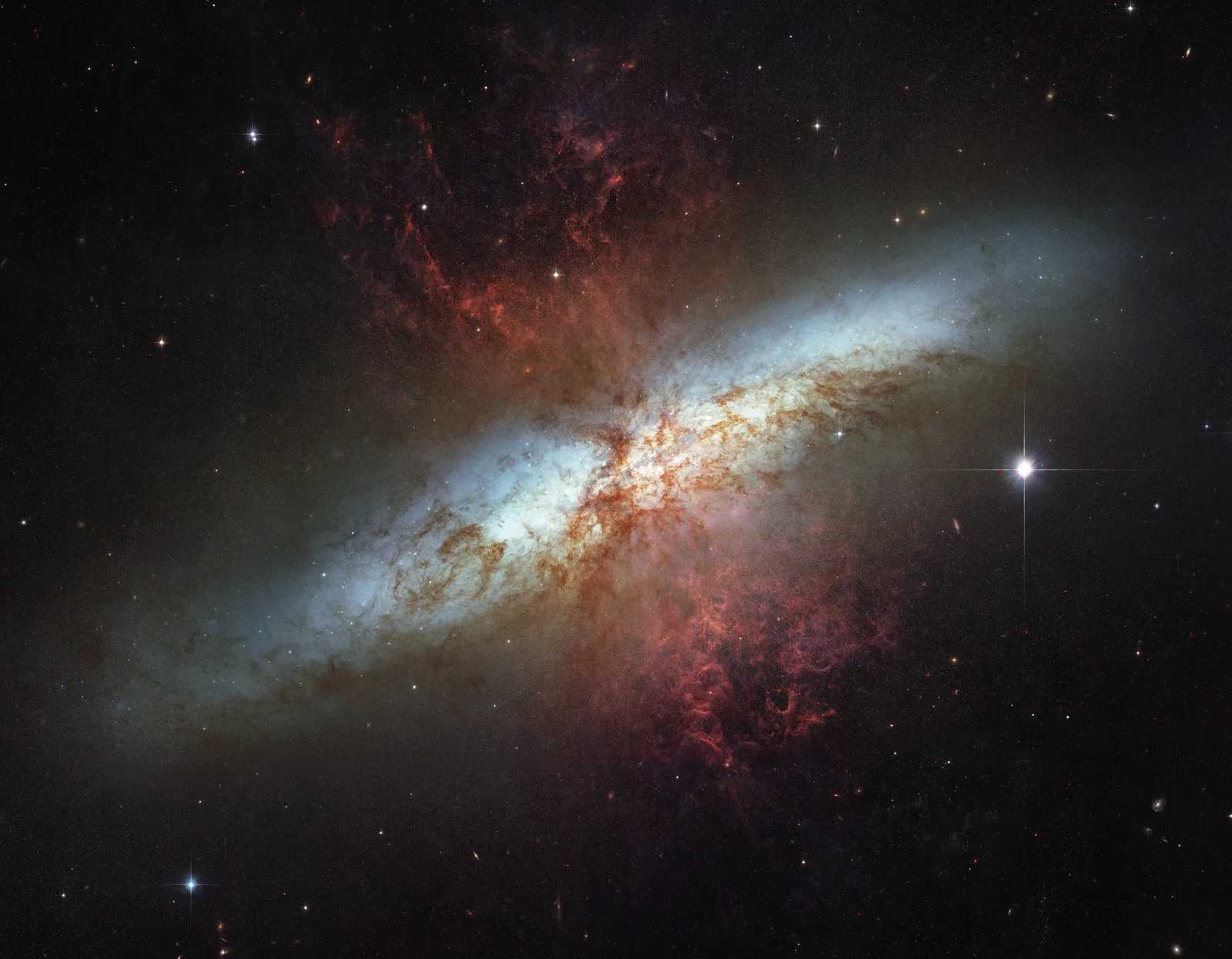
In early 2026, a study from the Max Planck Institute for Physics appeared in The Astrophysical Journal. Its authors simulated how cosmic rays propagate through magnetic fields and built maps of likely origins. The result: the Local Void is less likely than a nearby galaxy with intense star formation, such as M82. This is a statistical estimate, not a located source.
Why it matters
Cosmic rays at this energy show that the Universe accelerates matter far beyond anything that can be reproduced on Earth. Supernovae, according to Telescope Array researchers, are not enough. There are candidates, but none is confirmed.
There is a practical side too: this is a natural laboratory for physics beyond the reach of colliders. If the standard explanations fail, the answer may lie in new physics. The main obstacle is data, because such events are rare. Telescope Array is being expanded by another 2,900 km², and the Pierre Auger Observatory in Argentina already covers 3,000 km² and is upgrading its equipment. The next such particle could arrive on any night, and the odds of catching it are growing.
Image: NASA, ESA and the Hubble Heritage Team (STScI/AURA). Acknowledgment: J. Gallagher (University of Wisconsin), M. Mountain (STScI), P. Puxley (NSF).