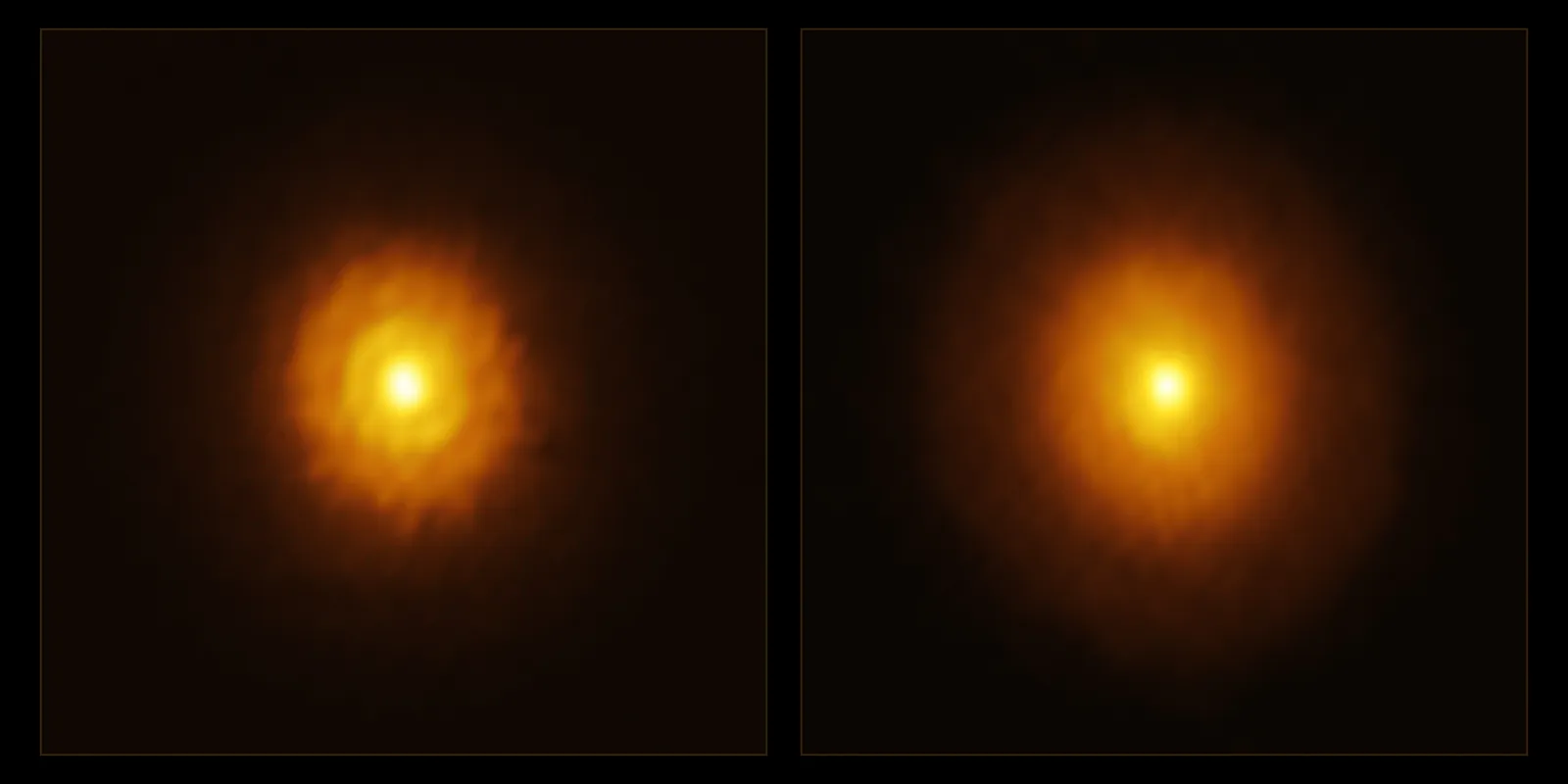
Planets are born in the gas-and-dust disks surrounding young stars, but the process itself — the growth from planetesimals into full-fledged planets — has remained almost impossible to observe directly. A young protoplanet is too faint and sits too close to a bright disk to be imaged on its own. So astronomers instead look for indirect clues: chemical or kinematic disturbances in the disk gas that betray the presence of an unseen body.
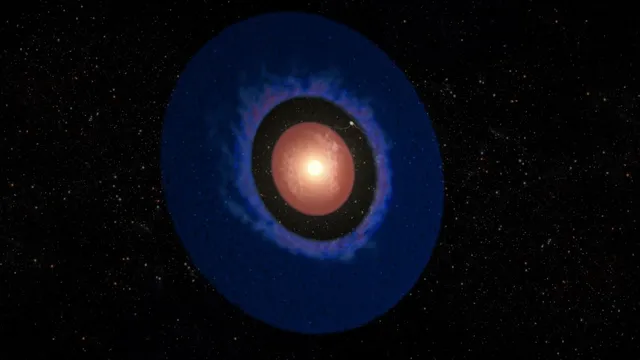
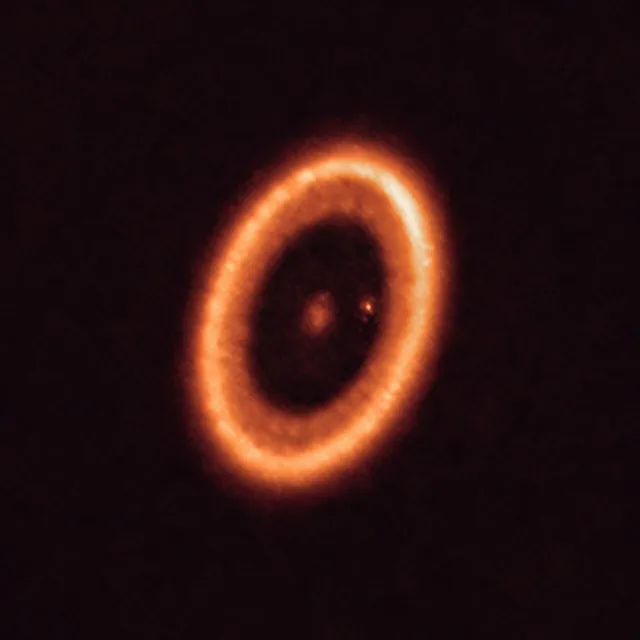
Such a clue appears to have turned up in the disk around the star PDS 66, also known as MP Mus. Using the Atacama Large Millimeter/submillimeter Array (ALMA) in Chile, a team of astronomers detected emission from two isotopologues of silicon sulfide — ²⁸SiS and ³⁰SiS — at a significance of 5σ–6σ. This marks the second detection of ²⁸SiS and the first-ever detection of ³⁰SiS in any protoplanetary disk.
A compact source at the disk's edge
The SiS emission is not spread across the disk. It is concentrated in a small region roughly 60 astronomical units from the star, in the disk's southwestern part. The source stays unresolved even at an angular resolution of about 0.5 arcseconds, meaning its true physical size is smaller than the telescope's resolving power.
Modeling of the line fluxes constrained the emitting radius to roughly 0.5–4 astronomical units — comparable in scale to the inner Solar System, spanning from about Mercury's orbit to Mars's.
The key detail is the gas kinematics at this location. The emission's velocity is consistent with Keplerian rotation around a local point mass, rather than simply tracing the disk's overall rotation around the star. That is one of the strongest arguments for a protoplanetary origin of the signal.
How much silicon this would take
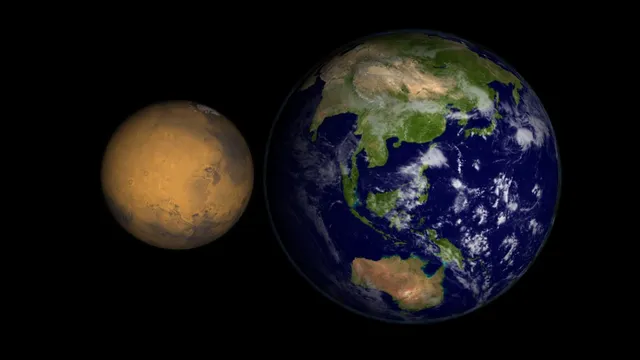
The estimated SiS mass in the source is 10²²–10²³ grams. On its own that number is unremarkable — far less than the mass of the Moon — but what matters is the fraction it represents: this amount corresponds to at least 10% of all the silicon locked up in dust grains in that local patch of the disk.
That is where the physics gets tricky. Converting that much silicon from solid dust into gas requires near-complete sublimation of a substantial share of the grains. But local processes — stellar heating, shocks, ordinary turbulence — cannot plausibly produce such efficient, concentrated vaporization in one spot. The silicon must have been gathered from a much larger region of the disk.
Pebbles falling into a protoplanet's warm envelope
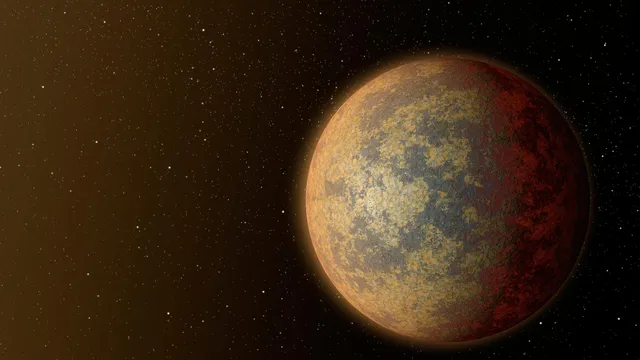
The explanation that best fits the data is a low-mass protoplanet surrounded by its own circumplanetary envelope — a shell of gas warmer than the surrounding disk material.
The mechanism the authors propose is pebble accretion: the protoplanet's gravity sweeps up small solid particles from a wide region of the disk and draws them inward. As these pebbles fall into the warm envelope around the growing body, they sublimate, releasing silicon into the gas phase. In this way, silicon gathered from a much broader area than the emitting region itself ends up concentrated in one small, localized volume.
If this model holds up, it would mean ALMA has captured not a gravitational or thermal signature, but a genuine chemical fingerprint of a planet actively forming right now. The next steps are searching for similar signatures in other disks and refining models of circumplanetary envelopes, to test how common this silicon-enrichment mechanism is during planet growth.