Hubble Spots Rocky Planet's Eclipse for First Time
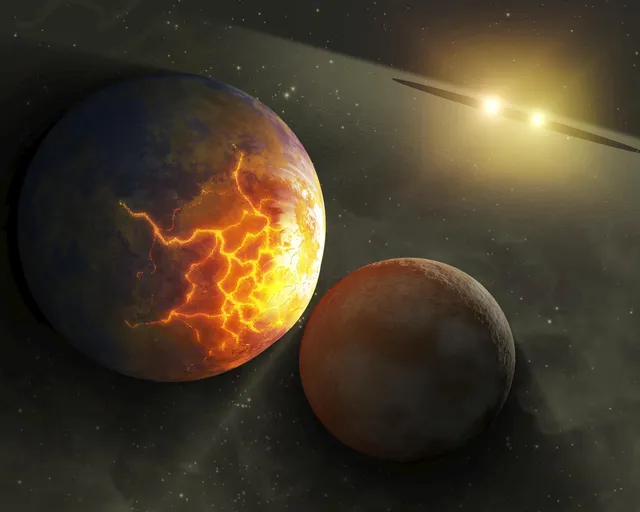
The Hubble Space Telescope has detected the secondary eclipse of a rocky exoplanet for the first time — the moment a planet passes behind its star. Thousands of planets have been found by transits in front of their stars, but far fewer have been caught on the far side. The eclipse reveals the dayside temperature, surface reflectivity and atmospheric properties.
The planet, TOI-2431b, is a lava world of 6.2 Earth masses and 1.54 Earth radii that orbits its star every 5.4 hours. Hubble data combined with TESS observations give a dayside brightness temperature of 2524 K, which matches a planet that absorbs all incoming energy and sends none to its night side. That would make it unusual among lava worlds. A rock-vapor atmosphere is not ruled out, though: at these wavelengths it looks the same as no atmosphere, so JWST may settle the question.
NASA Explores Commercial Ways to Extend Hubble's Life
On October 29, NASA issued a Request for Information asking industry what in-space servicing capabilities it could offer for the Hubble Space Telescope. The agency is exploring three options: a mission to boost Hubble to a higher altitude, servicing to enhance its capabilities, or a safe, controlled re-entry or orbital disposal at the end of its mission. Responses are open until November 30.
The reason is simple: Hubble has no propulsion of its own, and atmospheric drag slowly lowers its orbit. Analysis predicts re-entry in 2033–2034, so any rescue mission would need to launch by 2032. NASA Administrator Jared Isaacman said Hubble still has important science ahead, and extending its life would mean more discoveries.
NASA Accelerates Artemis, Targets 2028 Moon Landing
On October 23, NASA Administrator Jared Isaacman and other agency leaders updated the accelerated plan to return Americans to the Moon. Artemis III, planned for 2027, will send four astronauts aboard Orion, launched on SLS, on a 14-day mission in Earth orbit. The crew will practice rendezvous and docking with test versions of the Blue Origin and SpaceX lunar landers to reduce risk before a landing.
The landing itself is assigned to Artemis IV in 2028. Both companies have simplified their designs: Starship will refuel in Earth orbit, while Blue Origin's Blue Moon Mark 2 will be pushed toward the Moon by transfer stages. NASA is also weighing two upper-stage options for SLS, including a stretched version of ULA's Centaur V. Leaders added that hardware processing times for Artemis III have been cut roughly in half.
James Webb Builds 3D Dark Matter Map
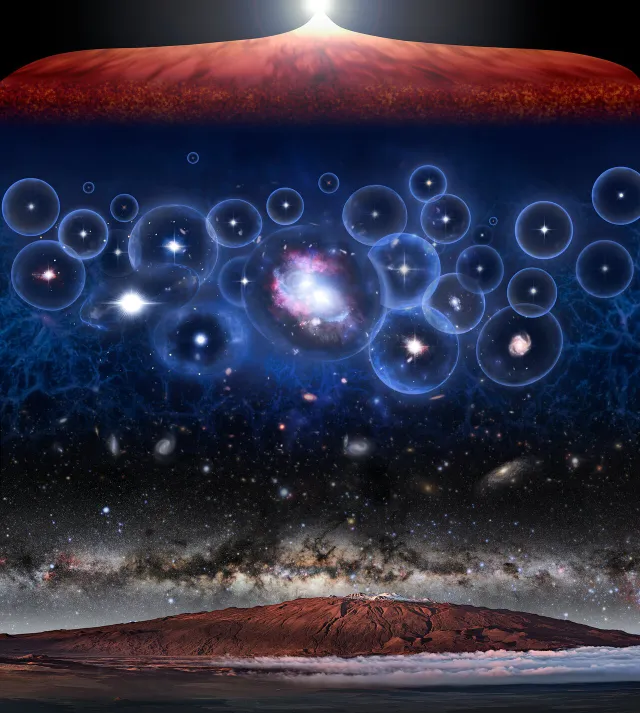
Astronomers reconstructed the three-dimensional matter distribution in the 0.54 square degree COSMOS-Web field using deep James Webb Space Telescope imaging. Two-dimensional weak lensing maps blend structures at different distances along the line of sight; the new method separates them by combining a physical lensing model with a diffusion-based generative prior learned from cosmological simulations.
The map spans 20 lens planes out to redshift z ≈ 2, twice the reach of earlier Hubble-based 3D reconstructions, approaching cosmic noon, an epoch of rapid galaxy growth. It reveals over-densities tied to galaxy clusters that earlier weak lensing maps missed. Tests show the structures are supported by the lensing signal and consistent with standard ΛCDM cosmology, and posterior sampling quantifies the uncertainties.
CHAPEA Crew Completes Year-Long Mars Simulation
On October 31, 2026, the crew of CHAPEA (Crew Health and Performance Exploration Analog) ended a simulated Mars mission, part of NASA's research into how people cope with long-duration expeditions. Matthew Montgomery, James Spicer, Ross Elder and Ellen Ellis stepped out together for the first time in more than a year and posed for a group photo outside.
For more than a year the crew tested systems, maintained crops, managed limited resources and communication delays, and carried out simulated extravehicular activities. What NASA learns about how crews adapt to long stays will inform the design of its future Moon base and the planning of missions to Mars.