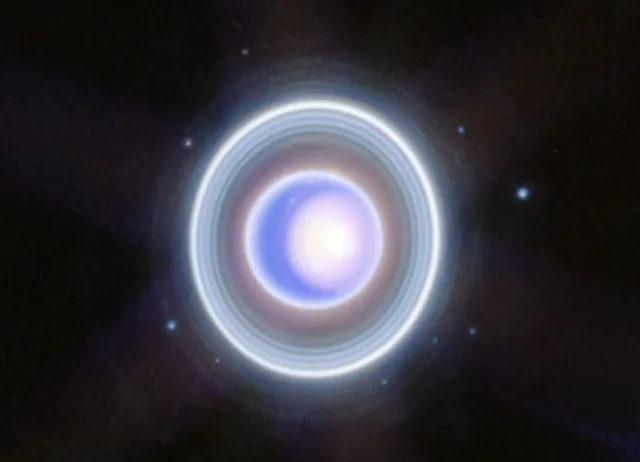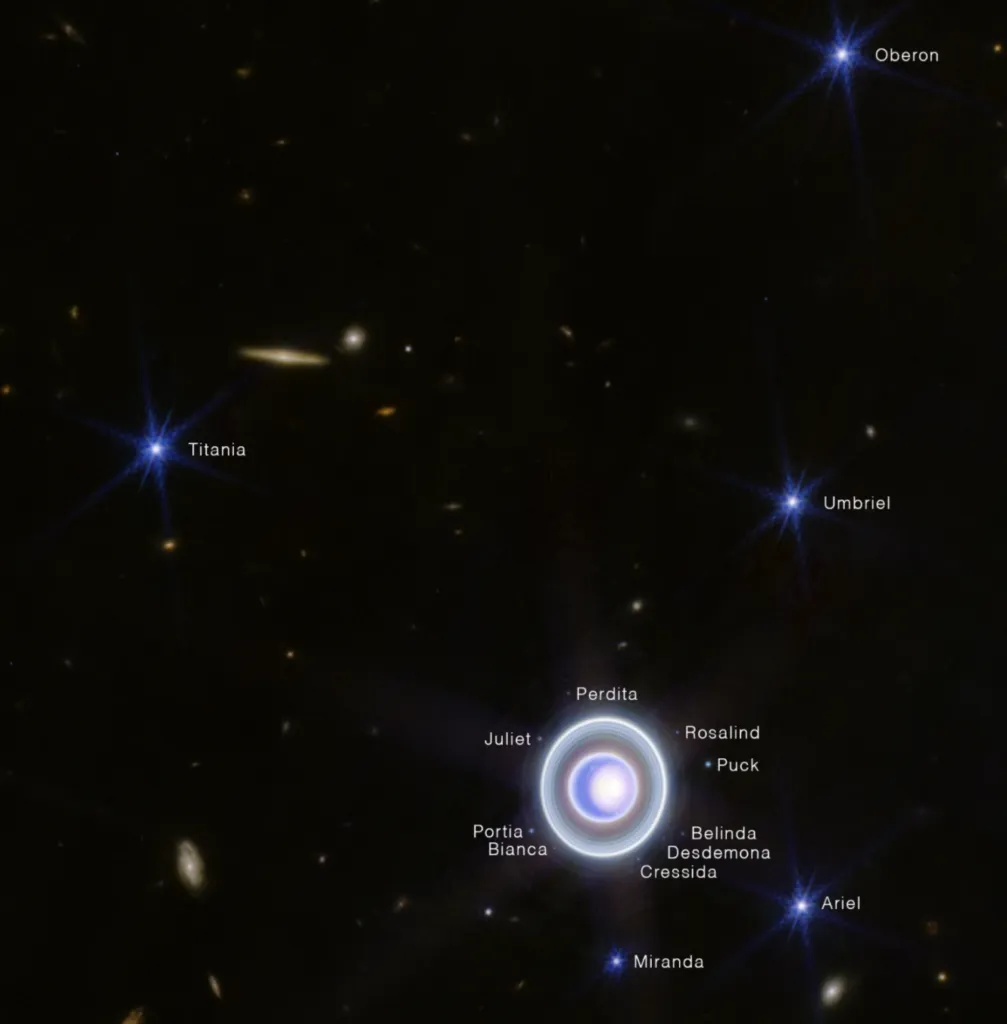
Uranus is one of the strangest planets in the solar system, if only for the way it lies on its side. Its rotation axis is tilted almost 98 degrees relative to its orbital plane, while most other planets tilt by only a few tens of degrees at most. For years, the most popular explanation was a giant impact: some massive object struck Uranus early in the solar system's history and literally knocked the planet over.
This idea is appealing because it also explains the origin of Uranus' five major moons — Miranda, Ariel, Umbriel, Titania, and Oberon. All of them orbit exactly in the planet's equatorial plane, sharing that same 98-degree tilt relative to Uranus' path around the Sun. That means the moons must have formed, or moved into their current orbits, after whatever event tilted the planet. It was natural to suppose that debris from the very impact that tipped Uranus over later coalesced into its moons. Earlier computer simulations even showed this scenario is physically possible if the impactor was rocky and struck at just the right angle.
Testing where the ice came from
Both Uranus and its moons contain large amounts of water ice. At first glance, this fits the impact story: a collision blasts water out of Uranus' interior, which then condenses into moons. But not all water is identical. In any sample, a small fraction of molecules carry deuterium instead of ordinary hydrogen — an isotope with an extra neutron in its nucleus. Water containing one deuterium atom is called semiheavy water, or HDO. If the moons' ice truly came from Uranus itself, the ratio of deuterium to hydrogen (D/H) in the moons should roughly match the planet's own ratio.
The authors of the new study measured this ratio for the surface ice of all five major moons using the NIRSpec instrument on the James Webb Space Telescope. HDO molecules absorb light at a wavelength of 4.14 micrometers, exciting the bond between deuterium and oxygen. The more HDO present in a sample, the weaker its reflection at that wavelength. By comparing the moons' spectra to laboratory reference samples of ice with known deuterium content, the team converted the strength of this absorption feature into a specific D/H value for each moon.
Ice with a foreign signature
The result was unexpected: the moons' D/H ratio turned out to be roughly five times higher than that of Uranus itself. Instead, it closely matches typical values seen in icy comets from the outer solar system — bodies that formed far from the Sun, under very different conditions than Uranus' atmosphere.
This is a strong argument against the simple picture of "impact blasts water out of Uranus, water becomes moons." If the moons' ice truly originated from the planet's own material, its isotopic composition should match Uranus', not differ by a factor of five. Instead, its resemblance to comets points to a completely different source of material — bodies from much colder, more distant regions of the solar system.
Two new scenarios
The authors propose two alternative scenarios that could explain both Uranus' tilt and the origin of its moons without directly turning the planet's own material into satellites. In the first, Uranus may have tidally disrupted an icy outer solar system body that passed too close. The debris from that body would have formed a disk in the planet's equatorial plane, from which the moons later assembled — already carrying a "cometary" isotopic signature.
In the second scenario, a giant impact did occur and did tilt Uranus' axis, but the moons already existed beforehand, having formed earlier from icy material in the outer solar system. Debris from the impact then simply helped realign their orbits into the new equatorial plane matching the planet's altered tilt.
In either case, an impact could still have played a role in tilting Uranus, consistent with earlier research. But based on the ice's isotopic makeup, such an impact likely did not directly create the planet's current moons. The study is a reminder that the simplest, most elegant explanation is not always the correct one — even when it neatly accounts for several facts at once.