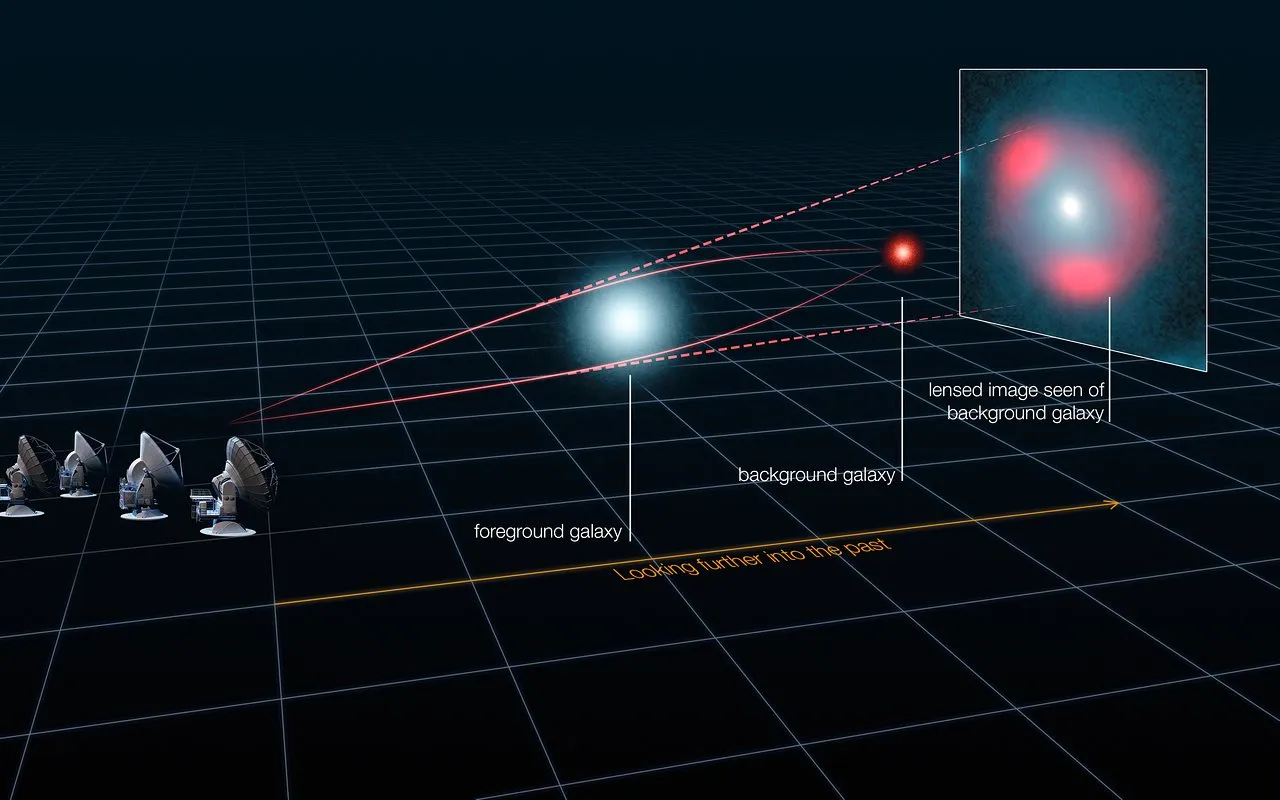
A gravitational lens forms when a massive galaxy or cluster bends the space around it with its own gravity. Light from objects lying farther behind gets deflected along this curved space and reaches us distorted — stretched into arcs or split into multiple images. For astronomers, this is a natural telescope: the lens magnifies light from faint, distant objects, bringing into view things that would otherwise remain beyond the reach of even the most powerful instruments.
The AGEL survey (ASTRO 3D Galaxy Evolution with Lenses) runs a systematic search for and confirmation of such systems. Its second catalog adds new material to the 68 lenses published in the first data release, bringing the total number of confirmed systems to 139. For 167 of them, images from the Hubble Space Telescope are already available, obtained through three observing programs, one of which is still ongoing.
A Neural Network Scans Millions of Images
Manually searching for lens candidates among millions of galaxies is simply not feasible for a research team. That is why AGEL relies on a convolutional neural network trained to recognize the characteristic distortions and arcs in images from the Dark Energy Camera Legacy Survey (DECaLS).
The network flags candidates, but final confirmation requires spectroscopy — measuring the light's spectrum to determine redshift and verify that two objects at different distances are truly involved, rather than a chance alignment of shapes. Follow-up spectroscopy relied in part on the XSHOOTER instrument at the VLT in Chile.
The outcome exceeded expectations: among the candidates that received spectroscopic follow-up, 96% were confirmed. This is an exceptionally high rate for searches of this kind, where false positives are a common problem. The team specifically examines the most frequent causes of false candidates and proposes strategies to reduce their share in future, much larger lens searches.
Einstein Rings and Galaxies That Stopped Forming Stars
The AGEL catalog spans a wide range of systems, from distortions produced by single galaxies to lensing by entire groups and clusters. Among the finds are rare objects: Einstein rings, where the lens and the source align so precisely that the source's image is stretched into a nearly complete ring of light around the lens.
Another rare category is lensed quiescent galaxies — galaxies that have essentially stopped forming new stars. Detecting them at large distances is difficult because they are faint, and gravitational magnification is what makes it possible.
Compared with other spectroscopic lens samples, AGEL systems tend to have higher redshifts for both the deflecting galaxies and the background sources. That means the survey reaches objects located farther away and earlier in cosmic history than most comparable catalogs.
Double Lenses Help Measure Cosmic Expansion
Systems where a single lens simultaneously bends light from two separate sources at different distances carry particular value. The new catalog includes six such double-source-plane systems: five confirmed strong lenses and one probable one.
The geometry of this triple alignment — a lens with two background sources at different distances — allows independent tests of cosmological parameters, including the rate at which the Universe is expanding. Each additional source plane effectively adds an independent distance scale to the calculations, making these rare systems a valuable tool for cosmology.
AGEL Paves the Way for Euclid and LSST
The number of known gravitational lenses is set to grow by orders of magnitude in the coming years. The Euclid space telescope, the Vera C. Rubin Observatory's Legacy Survey of Space and Time, the Keck Observatory's KAPA program, and the 4MOST spectrograph's 4SLSLS survey are all capable of flagging thousands of new lens candidates.
The catch is that spectroscopically verifying every single candidate will be impossible — the sheer volume of data won't allow it. Reliable methods for automated selection and prioritization are needed now: deciding which candidates deserve costly follow-up observations and which can be set aside.
This is where AGEL serves as a pathfinder. The survey not only expands the catalog of confirmed lenses but also refines the very methods of searching for and filtering out false candidates — groundwork that will underpin the far larger datasets of the next generation of telescopes.