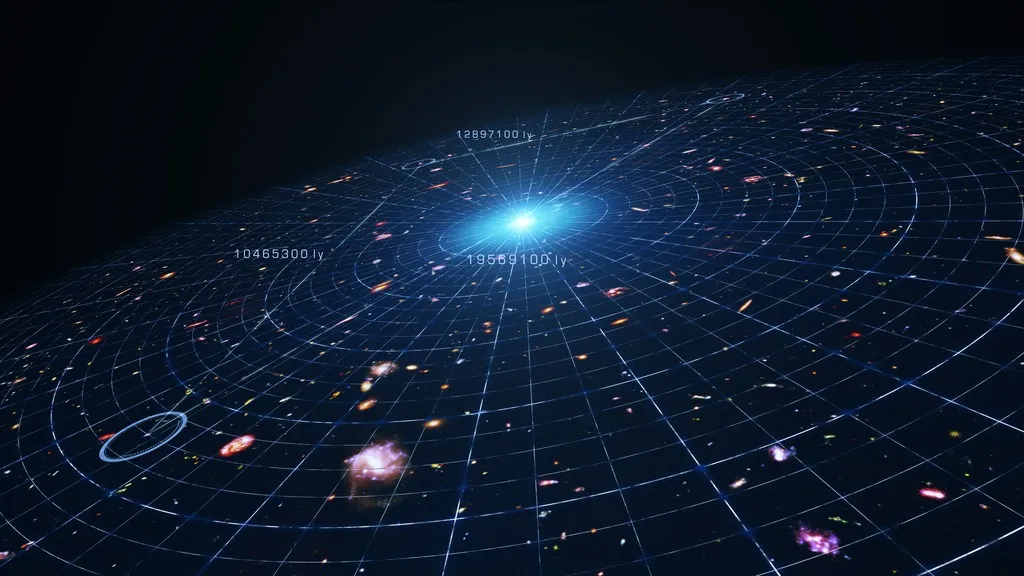
Dark energy accounts for roughly 68% of the universe's energy density, yet the physical nature of the force driving cosmic acceleration remains unknown. The simplest model — the cosmological constant — assumes dark energy stays the same throughout cosmic history. But recent data from DESI (Dark Energy Spectroscopic Instrument) hint that its density may have evolved over time. That pushes cosmologists to search for new equations of state: mathematical descriptions of how dark energy's pressure relates to its density.
A team of researchers from Brazil and other countries decided to automate part of that search using a large language model. The work, posted on arXiv on June 17, 2026, describes a framework in which the AI doesn't just fit parameters to a predefined formula — it proposes entirely new equations along with physical justification.
A propose-and-critique loop instead of parameter fitting
The system runs iteratively, in a cycle resembling a scientific back-and-forth between two researchers. A first language model generates a dark energy equation of state, drawing on retrieval from the scientific literature, and pairs it with a physical rationale explaining why that particular form makes sense.
Each candidate is immediately embedded into a cosmological model and tested against real observational data through Bayesian likelihood analysis. An independent AI critic then scores the proposal on five criteria: physical motivation, novelty, clarity, stability, and implementation validity.
The critic's feedback flows back into the system, and the next generation of equations builds on it — both the mathematical structure and the physical reasoning evolve together. It's a process closer to an evolutionary algorithm with a layer of reasoning than a simple parameter search.
Testing against three independent observational datasets
To make sure the equations weren't just elegant math with no grounding, each one was tested against real cosmological data: Pantheon+ supernovae (standard candles used to measure cosmic distances), baryon acoustic oscillations from DESI DR2 (a kind of "cosmic ruler" imprinted in the distribution of galaxies), and the full Planck 2018 temperature, polarization, and lensing likelihoods from the cosmic microwave background.
The best equation the system found showed higher Bayesian evidence than traditional dark energy parameterizations, by more than one unit. On the scale typically used in Bayesian model comparison, a gap of that size counts as substantial — not statistical noise, but a real advantage of the new equation's form over established alternatives on this data.
Two new parameterizations absent from prior literature
According to the authors, the system identified two dark energy equation-of-state parameterizations that, to the best of their knowledge, had never been explored before. Both proved competitive against established forms that have been used in cosmology for decades.
Crucially, these aren't "black box" outputs — a set of coefficients with no physical meaning. Each equation comes with an interpretable rationale that can be examined and debated just like a hypothesis proposed by a human researcher.
The authors stress that the language model isn't replacing the theoretical physicist here — it's expanding the space of hypotheses. Human reasoning tends to stay within familiar models, while an AI can surface options a researcher might never reach simply because of habitual ways of thinking. Combined with DESI's data, which have already cast doubt on the constancy of dark energy, tools like this could become part of cosmologists' standard toolkit in the coming years.