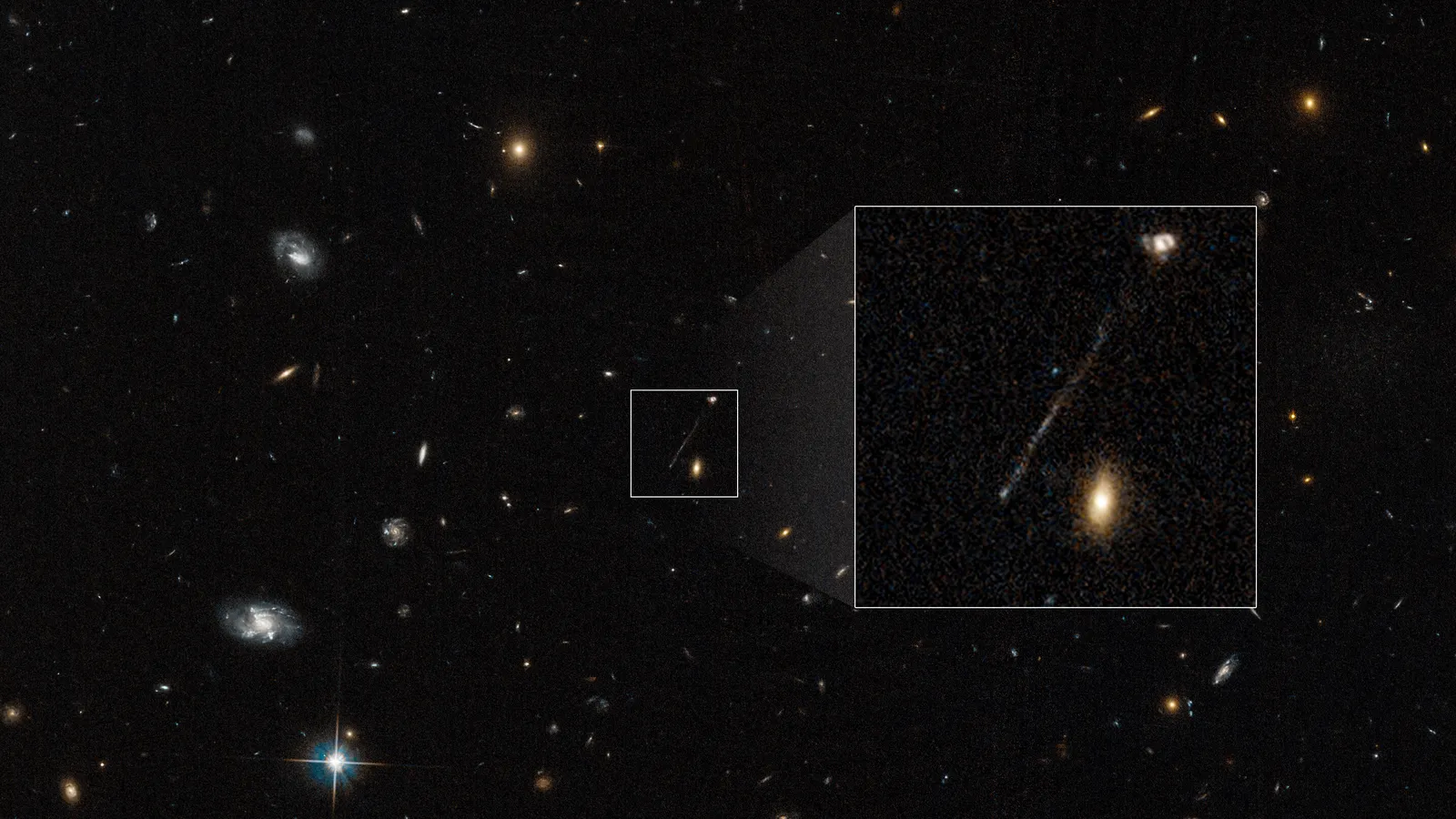
The supermassive black hole RBH-1 is the first confirmed runaway black hole — an object ejected from its host galaxy and now speeding through intergalactic space. JWST images revealed something unexpected trailing behind it: a tail of cold gas stretching 62 kiloparsecs, or over 200,000 light-years, longer than the diameter of the Milky Way itself. The black hole is plowing through the hot circumgalactic medium at roughly 950 km/s, and by conventional physics such a cold trail should have dispersed almost instantly.
A new preprint by Ish Kaul and S. Peng Oh (arXiv:2604.13155), now published in Monthly Notices of the Royal Astronomical Society, uses this system as a stress test for one of the central theoretical frameworks in cold-gas astrophysics: radiative turbulent mixing layers.
Why the cold gas shouldn't have survived
The tail glows in hydrogen Hα and doubly ionized oxygen [O III], signatures of gas orders of magnitude cooler than its surroundings. When a cold cloud moves through a hotter flow, turbulence at its boundary should mix and heat the cold material, tearing the structure apart within a short time.
Yet JWST data show something different: a coherent velocity gradient of about 200 km/s runs along the entire length of the tail. Rather than shredding chaotically, the gas behaves as a single structure, with velocity changing smoothly from the leading edge to the far end. That coherence is exactly what made RBH-1 a candidate for testing the theory quantitatively.
The mechanism: mixing layers that cool faster than they heat
Radiative turbulent mixing layers have long been proposed to explain cold-gas survival, but quantitative dynamical tests have been rare. The idea is that turbulence at the interface between cold and hot gas mixes the two phases, and within this transitional layer radiative cooling can act fast enough to counteract heating. When cooling wins, the layer doesn't dissipate — instead, the cold structure grows, pulling in and accreting mass from the surrounding hot medium.
Kaul and Oh built 3D hydrodynamic simulations of this process and compared them directly to RBH-1's observed tail. The key result: the observed downstream deceleration is well reproduced by drag caused by this accretion-driven mixing-layer process. When the researchers removed radiative cooling from the model entirely, no coherent tail formed at all — the gas simply shredded, matching the naive expectation.
A direct, testable prediction
Beyond reproducing the overall picture, the authors derived an analytical relationship linking the tail's deceleration to its cooling luminosity — the energy the gas radiates away within the mixing layers. This isn't just a qualitative match; it's a specific quantitative prediction.
In practice, this means future observations capable of measuring the cooling luminosity profile along RBH-1's tail could directly test whether this predicted relationship holds. A match would strengthen the case for radiative mixing-layer physics not just in this one object, but across the broader class of astrophysical systems where cold gas moves through hot surroundings.
Why RBH-1 is a rare kind of laboratory
Tests of turbulent mixing-layer theory usually rely on static snapshots — brightness or composition maps captured at a single moment. RBH-1 offers something considerably rarer: a dynamical test, where the actual deceleration of a real structure can be compared against a model's predictions.
The combination of the black hole's extreme speed, the tail's length, and its clean velocity gradient makes this system close to a unique natural experiment. Future observations aimed specifically at measuring the cooling luminosity profile will show how far this model can be trusted — and may help settle a long-standing question about how cold gas survives inside hot cosmic flows.