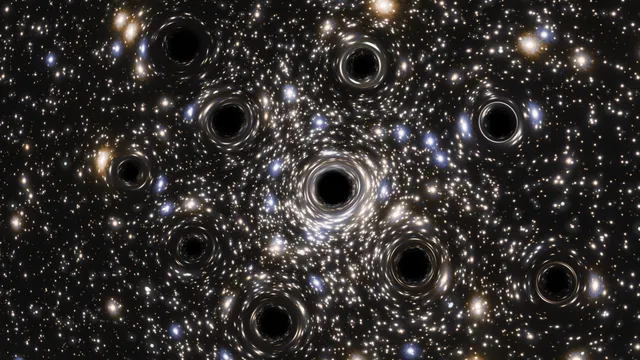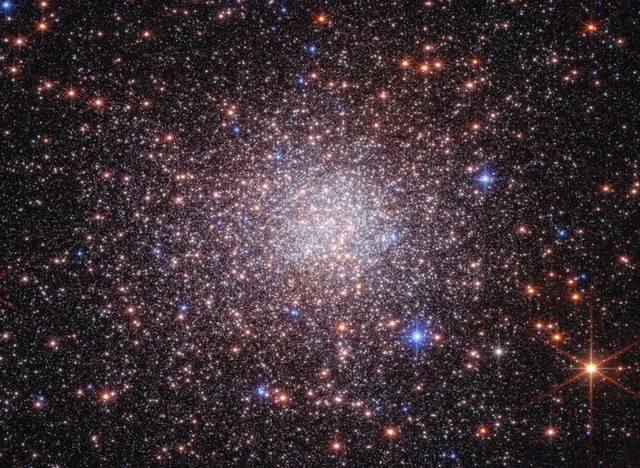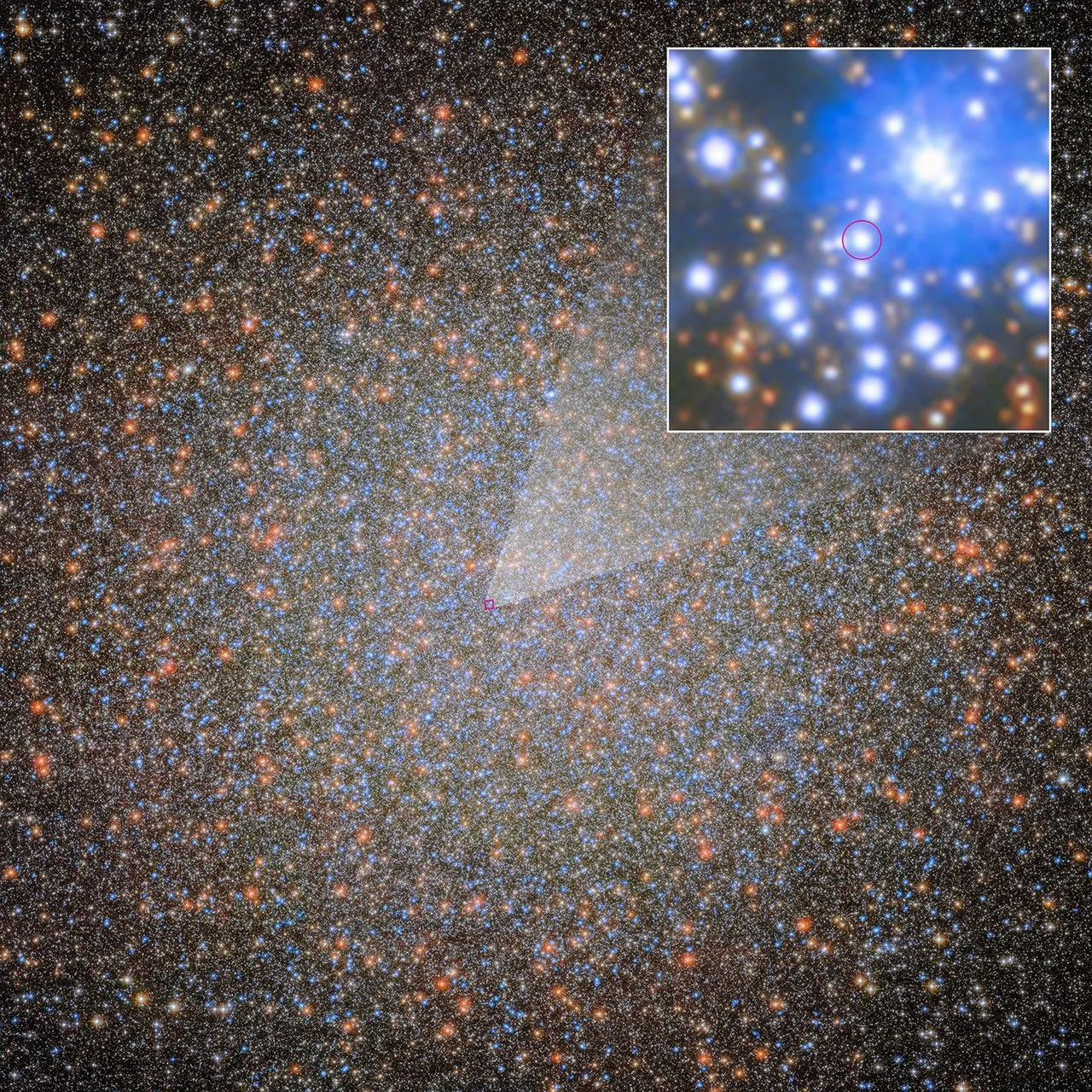
The globular cluster Omega Centauri has puzzled astronomers for decades. It holds about 10 million gravitationally bound stars, and models predict it should contain roughly 10,000 stellar-mass black holes — remnants of exploded stars. Yet none of them had been directly confirmed.
That changed after a team analyzed archival images from the Hubble Space Telescope alongside fresh observations from James Webb. Led by Matthew Whitaker of the University of Utah, the researchers found a star orbiting an invisible massive object. The results appeared in The Astrophysical Journal Letters.
Why earlier methods came up empty
Previous searches for black holes in Omega Centauri relied on the radial velocity method (measuring shifts in a star's spectral lines) or on detecting X-ray and radio emission from matter falling onto a black hole. Neither approach turned up any of the cluster's stellar-mass black holes.
This time the team used astrometry — tracking extremely small shifts in a star's position on the sky over time. The method demands extraordinary precision: researchers followed the star's motion down to a fraction of a pixel on the Hubble and Webb detectors. That required more than 20 years of Hubble archival data, spanning 2002 to 2023, combined with near-infrared Webb observations to sharpen the measurements.
oMEGACat BH-2: a lighter mass than expected
The object was named oMEGACat BH-2. It lies about 18,000 light-years away, embedded in the cluster's dense environment. An earlier study by a different team had suggested the star's unseen companion might be a neutron star.
The new data ruled that out. The visible star has a mass of 0.78 solar masses, while its invisible companion weighs 4.46 solar masses — too heavy for a neutron star, leaving a black hole as the only explanation.
At the same time, the black hole's mass turned out lower than expected for a metal-poor environment like Omega Centauri.
While we already knew that the star was 0.78 solar masses, we can now calculate the black hole's mass, which is 4.46 solar masses and therefore too heavy to be a neutron star. However, its mass is much lower than would be expected in a metal-poor environment like Omega Centauri. This is surprising and exciting.Anil Seth, University of Utah
According to the researcher, this shows that even a star poor in heavy elements can produce a black hole like this one, and how that happens still needs to be worked out.
The longest orbit among known black hole binaries
Using more than two decades of observations, the team traced the visible star's path, including its closest approach to the black hole, when it moved fastest across the sky. The star orbits oMEGACat BH-2 once every 94 years — the longest orbital period among all known black hole binary systems.
Such a long period hints at how the pair likely formed. It was probably assembled dynamically: the star and the black hole did not originate together but encountered each other later within the cluster's dense environment.
Calculations show a system like this would survive less than a billion years before encounters with neighboring stars tear it apart — far shorter than the cluster's age, estimated at roughly 12 billion years.
What it means for gravitational wave events
Understanding how black holes form in globular clusters and pair up into binaries matters for interpreting gravitational wave events caused by black hole mergers. Dense environments like Omega Centauri are thought to be among the primary places where such pairs eventually merge.
The team plans to keep searching for similar systems in other clusters using Hubble and Webb. Particular hopes rest on the upcoming Nancy Grace Roman Space Telescope, which will be able to regularly image crowded stellar regions, including the galactic center, at Hubble-like resolution but with a much wider field of view. The regular cadence of its observations should help uncover more black hole binary systems like this one.