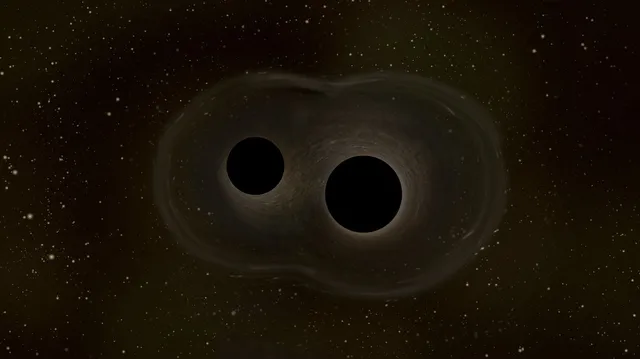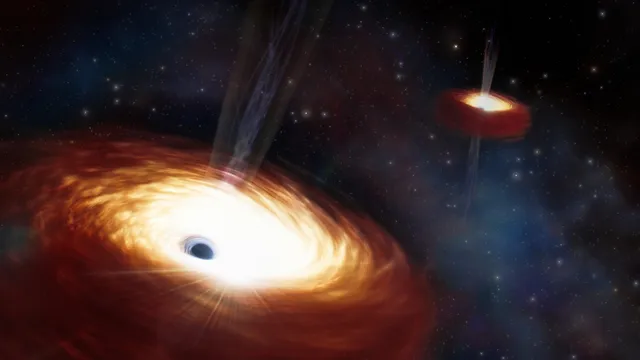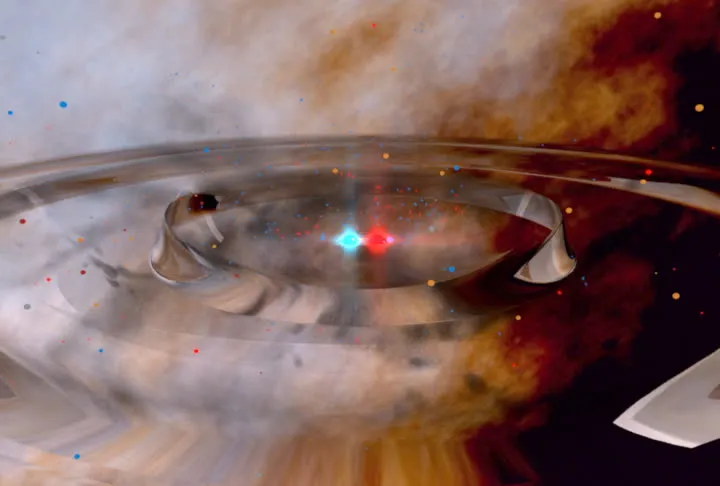
Two supermassive black holes, each weighing millions or billions of solar masses, orbit each other at the center of a merging galaxy. Over millions of years the orbit tightens, the speed increases, and eventually the two objects merge into one even more massive black hole. The process radiates gravitational waves — ripples in the fabric of spacetime itself, traveling at the speed of light.
Detecting such waves from Earth is currently impossible. Ground-based detectors like LIGO are sensitive to much faster, lighter events — mergers of stellar-mass black holes. Signals from supermassive pairs require an instrument tuned to a different frequency range. That instrument will be LISA.
LISA listens for the slowest gravitational waves
LISA, the Laser Interferometer Space Antenna, is a future space-based gravitational wave observatory. It will consist of three spacecraft forming a triangle in space, measuring tiny changes in the distance between them using laser beams.
Such a triangle is sensitive to gravitational waves at much lower frequencies than ground detectors can catch. That is precisely the range where signals from merging supermassive black holes, sitting at galactic centers, are born.
A team led by Francesco Nobili has developed an algorithm that can spot an approaching merger long before it happens. According to the authors, many such pairs will be detectable hours to weeks before the actual collision.
How the algorithm reads a signal before merger
At the core of the method is a search for excess power in signal spectrograms built with a short-time Fourier transform — a standard way to show how a signal's frequency changes over time.
A signal from an approaching black hole pair has a distinctive shape: its frequency gradually rises, forming what's known as a chirp. The algorithm tiles the time-frequency plane with slices shaped according to the expected frequency evolution of quadrupole radiation, and evaluates how strongly the signal in each tile stands out against instrumental noise and the Galactic foreground — background radiation from Milky Way stars.
Individual detections, or triggers, are then grouped by a coherence tracker, which links triggers that appear over time to belong to the same physical signal. This allows the algorithm to progressively refine two key quantities: the chirp mass (a combination of both black holes' masses that shapes the signal) and the exact coalescence time.
The closer the system gets to merger, the more data the algorithm has accumulated — and the sharper these estimates become.
Testing on the Sangria dataset
The method was validated on the Sangria dataset, a test set built to simulate real LISA observations. It contains 15 injected signals from supermassive black hole pairs.
The algorithm detected all 15. For 14 of them, warning came hours or even weeks before the actual merger. One signal was only identified after the fact, once the merger had already happened.
For high signal-to-noise sources, the chirp mass estimation error stayed below 3%. Coalescence time uncertainty for individual sources was as low as a few hours.
Computational cost turned out to be surprisingly low: processing a ten-day data segment on a single processor core takes less than a second.
What this means for real-time observations
Speed is the key detail here. It makes the method suitable for generating real-time alerts: if a merger is expected within hours or days, observatories on Earth and in space have time to point their instruments at the right patch of sky in advance.
This opens the possibility of observing supermassive black hole mergers simultaneously in gravitational waves and across the electromagnetic spectrum — X-ray, optical, radio. Such simultaneous observations have long been considered one of astrophysics' most valuable tools, though so far they have mostly applied to neutron star collisions.
Beyond triggering telescopes, the algorithm's early estimates of mass and merger time can also serve as informative priors for a fuller Bayesian analysis of the system's parameters once all the data on the event has been collected.