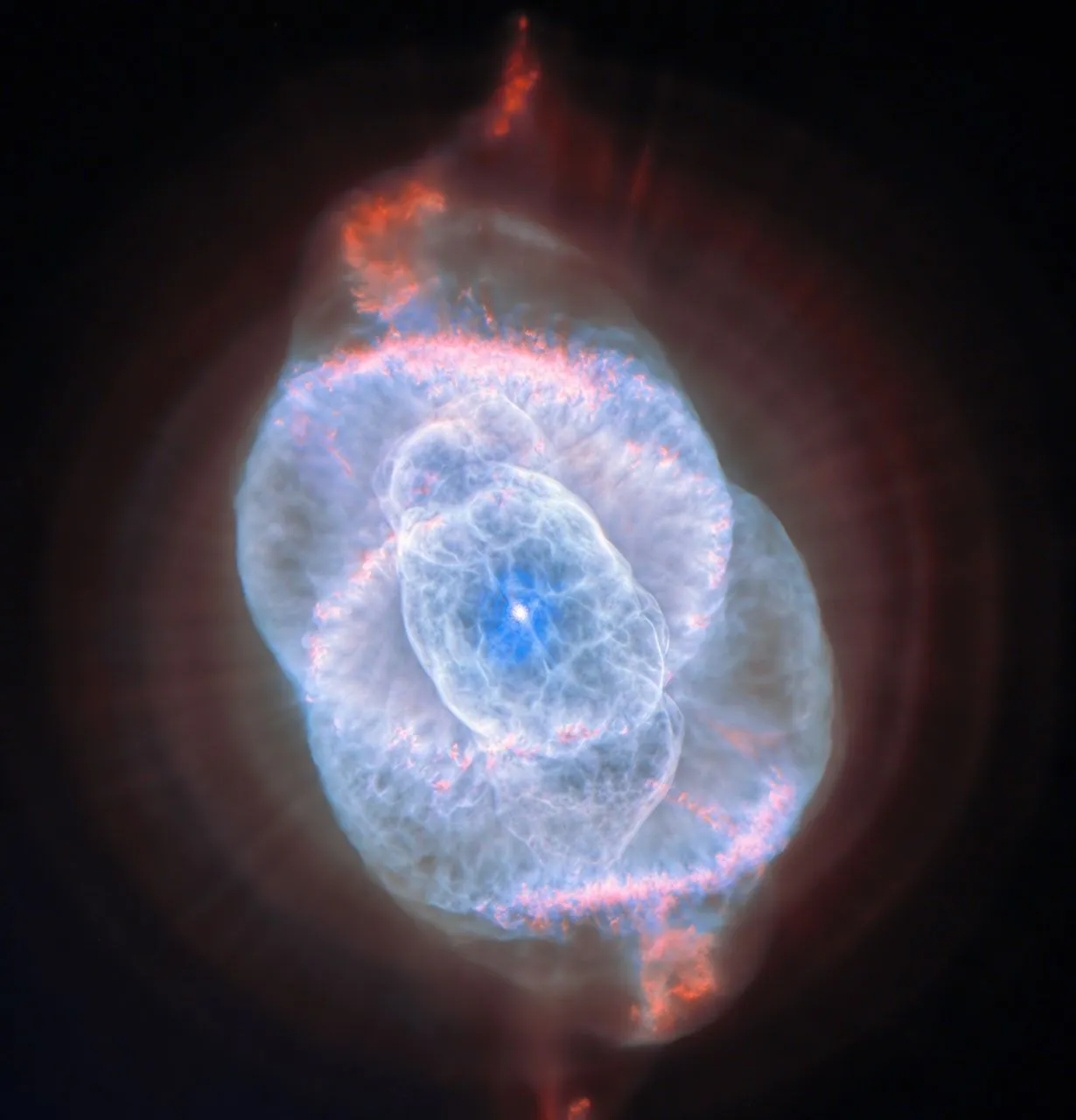
In the constellation Draco, 4,300 light-years from Earth — a distance established through observations by ESA's Gaia mission — a star is dying. What remains of it is the Cat's Eye Nebula, NGC 6543, one of the most visually intricate objects ever photographed by a telescope.
A new image combines the capabilities of two ESA space observatories, Hubble and Euclid. Each looks at the nebula differently: one zooms into the fine detail of its core, the other reveals what surrounds this scene of stellar death. Together they produce a picture neither telescope could capture alone.
A star shedding its outer layers
Planetary nebulae got their name almost by accident — through early telescopes, their round shape resembled planetary discs, though they have nothing to do with planets.
In reality, they are expanding clouds of gas thrown off by stars in the final stages of their evolution. When a star exhausts the fuel in its core, its outer layers detach and drift into space, while what remains of the core lights up this gas from within.
The Cat's Eye Nebula is one of the most striking examples of this process. Its elaborate, multilayered structure has captivated astronomers for decades precisely because it lets them trace, in detail, how a star loses its mass.
The 1864 discovery: gas, not a star
It was NGC 6543 that, in 1864, provided the first proof that planetary nebulae are not stars or galaxies but hot, expanding gas.
The key was spectroscopy. Examining the spectrum of the nebula's light revealed emission from individual molecules — a signature characteristic of gas rather than a solid stellar disc. The discovery separated two classes of objects that had previously been confused with one another and laid the groundwork for understanding how medium-mass stars end their lives.
Hubble's fossil record at the nebula's core
Hubble photographed the nebula's very core in high-resolution visible light. The image shows concentric shells of gas, jets of high-speed material, and dense knots sculpted by shock waves.
These structures are regarded as a kind of cosmic fossil record — a trace of individual episodes of mass loss from the dying star. Each shell likely corresponds to a distinct period when the central star shed another layer of its material.
Euclid's wide view: a halo and thousands of galaxies
Euclid, a mission designed primarily to map the distant Universe, captured the Cat's Eye Nebula as part of its deep imaging surveys. In its wide field of view, spanning visible and near-infrared light, the bright central region of the nebula sits within a halo — arcs of gas ejected from the star at an earlier stage, before the central structure had even formed.
Beyond that halo lies the background: thousands of distant galaxies caught in the same frame.
Combining Hubble's and Euclid's images highlights not only the nebula's exquisite structure but also its broader context. A local process of stellar death appears set against the farthest reaches of the cosmos that Euclid explores. It is a rare instance where a detailed portrait of a single object and a map of the deep Universe end up in the same shot.