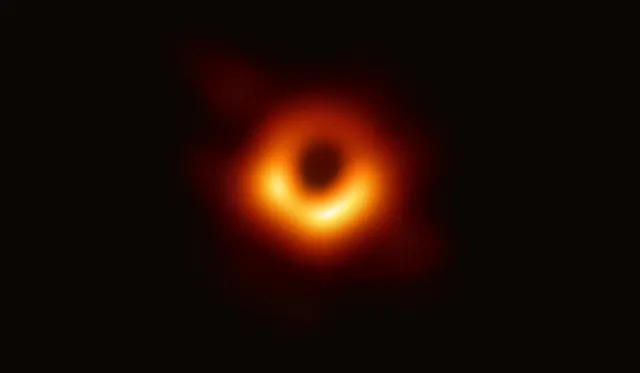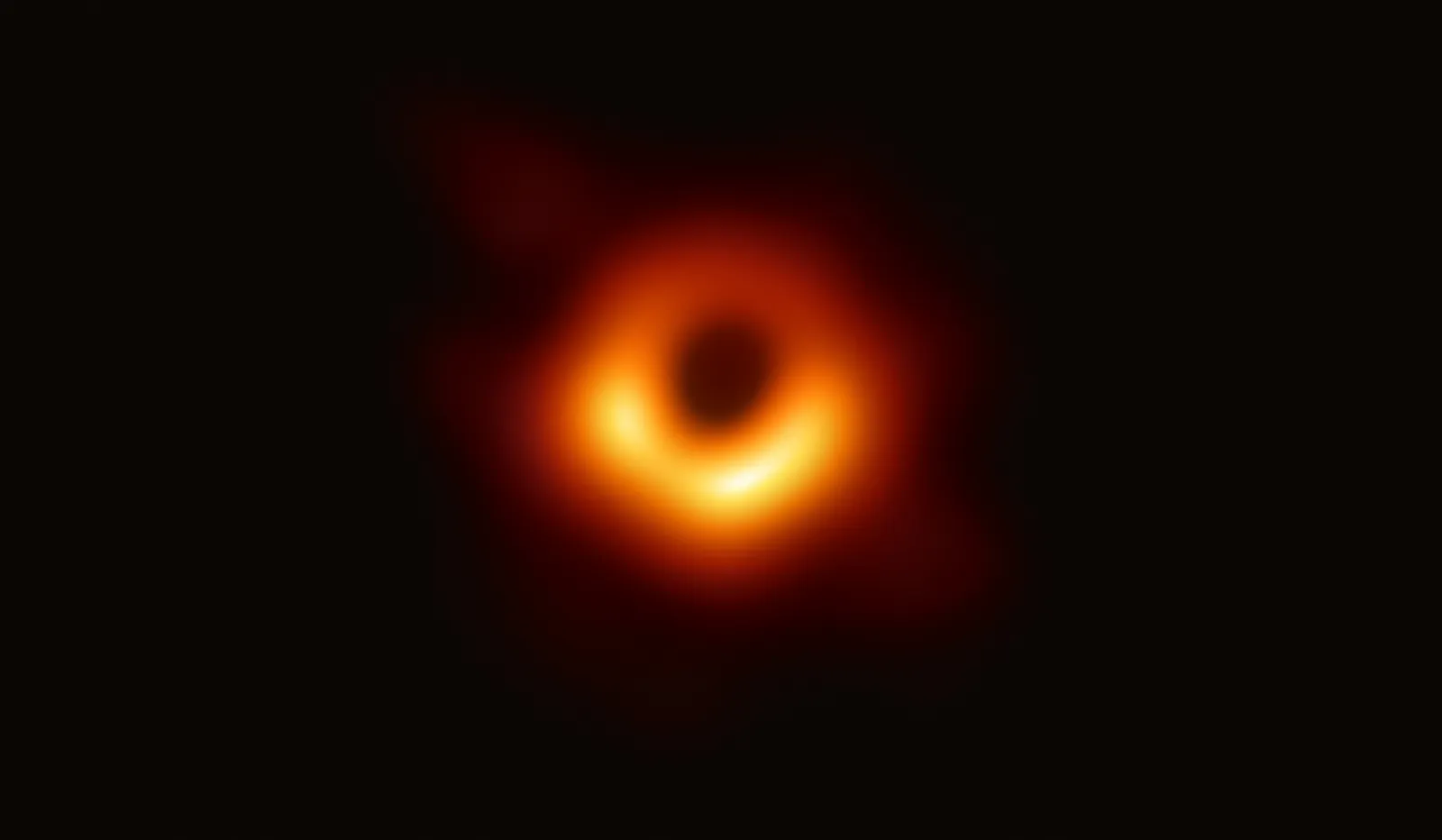
In April 2019, the world saw the first-ever image of a black hole's shadow: a bright ring of light around a dark region at the center of the galaxy M87. That picture was built from data collected in 2017. Since then, the Event Horizon Telescope (EHT) — a global network of radio telescopes — has observed the same black hole, known as M87*, twice more: in 2018 and 2021. Researchers have now published the first direct comparison of all three observing campaigns, showing what a black hole's life looks like on a timescale of years rather than a single snapshot.
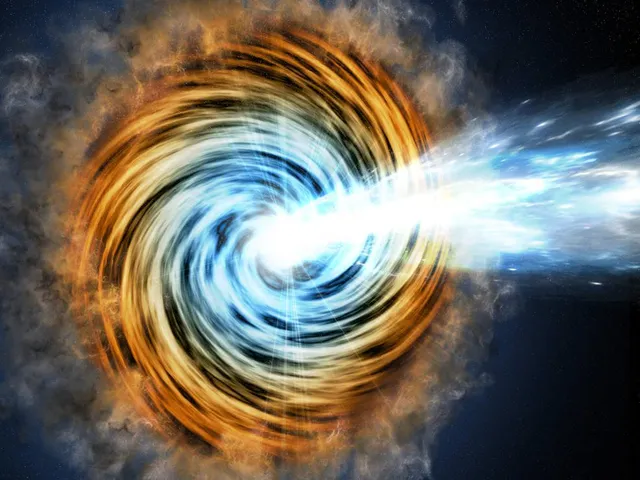
M87* sits at the center of the giant elliptical galaxy M87 and has a mass of 6.5 billion Suns. The glowing ring in the images isn't the black hole itself, but superheated gas swirling around it, radiating through synchrotron emission — light produced by charged particles spiraling along magnetic field lines. The black hole's gravity bends this light so it appears to wrap around the dark shadow, the region from which nothing can escape.
The ring stays put, the light does not
Across all three epochs, the ring's size barely changed: its diameter measures 43.9 ± 0.6 microarcseconds, a value so small it's comparable to spotting an orange on the surface of the Moon from Earth. That stability matches what general relativity predicts for the shadow of a supermassive black hole.
The distribution of brightness around the ring, however, shifts from year to year. That's consistent with a turbulent, stochastic accretion flow — matter falling onto the black hole moves chaotically, so brighter patches appear and fade unpredictably along the ring.
A 2018 gamma-ray flare left no visible mark
A gamma-ray flare erupted in M87 almost simultaneously with the 2018 observations. It would be reasonable to expect some imprint of that event on the structure of light closest to the black hole.
Instead, the 2018 and 2021 images turned out remarkably similar to each other — far more similar than either is to the 2017 image. That suggests the link between galaxy-scale flares and the near-horizon structure of the ring isn't as direct as it might seem.
Polarization dropped by a factor of three in a single year
The most striking difference concerns polarization — a property of light that reveals the structure of magnetic fields near the black hole. In 2017, the linear polarization fraction in the ring peaked at roughly 15%, while in both 2018 and 2021 it peaked at only about 5%.
The spiral pattern of polarization on the ring also changes from year to year. That points to a magnetic environment around M87* that isn't frozen in place but constantly reorganizes — field lines twist, weaken, and strengthen again on timescales of years rather than millions of years.
Kitt Peak and NOEMA reveal the jet's base
In 2021, two new telescopes joined the EHT network: the 12-meter Kitt Peak Telescope in Arizona and the NOEMA array in France. Their addition significantly improved the baseline coverage — the number and length of the "lines of sight" between telescopes used to reconstruct the image.
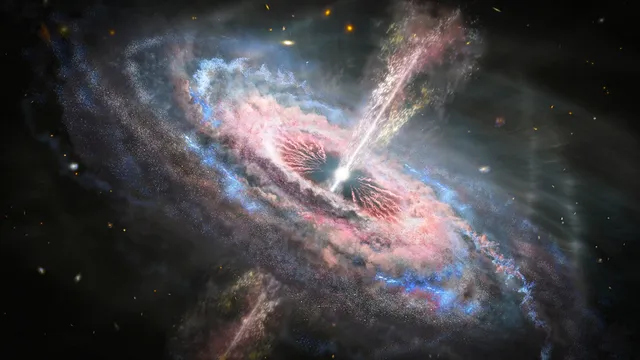
For the first time, this made it possible to see not just the ring, but the base of M87*'s jet — the enormous stream of plasma the black hole launches into space, extending far beyond the galaxy itself. Comparing the ring's structure to the jet's base within a single observation opens a path to directly testing how the accretion disk and the jet are physically connected.
Ongoing monitoring of M87* turns the single iconic image from 2019 into a series of frames, something close to a slow-motion film of a supermassive black hole's life. Future EHT campaigns should reveal whether these changes follow any pattern at all, or whether the black hole will remain as unpredictable as it has been over its first three years of observation.