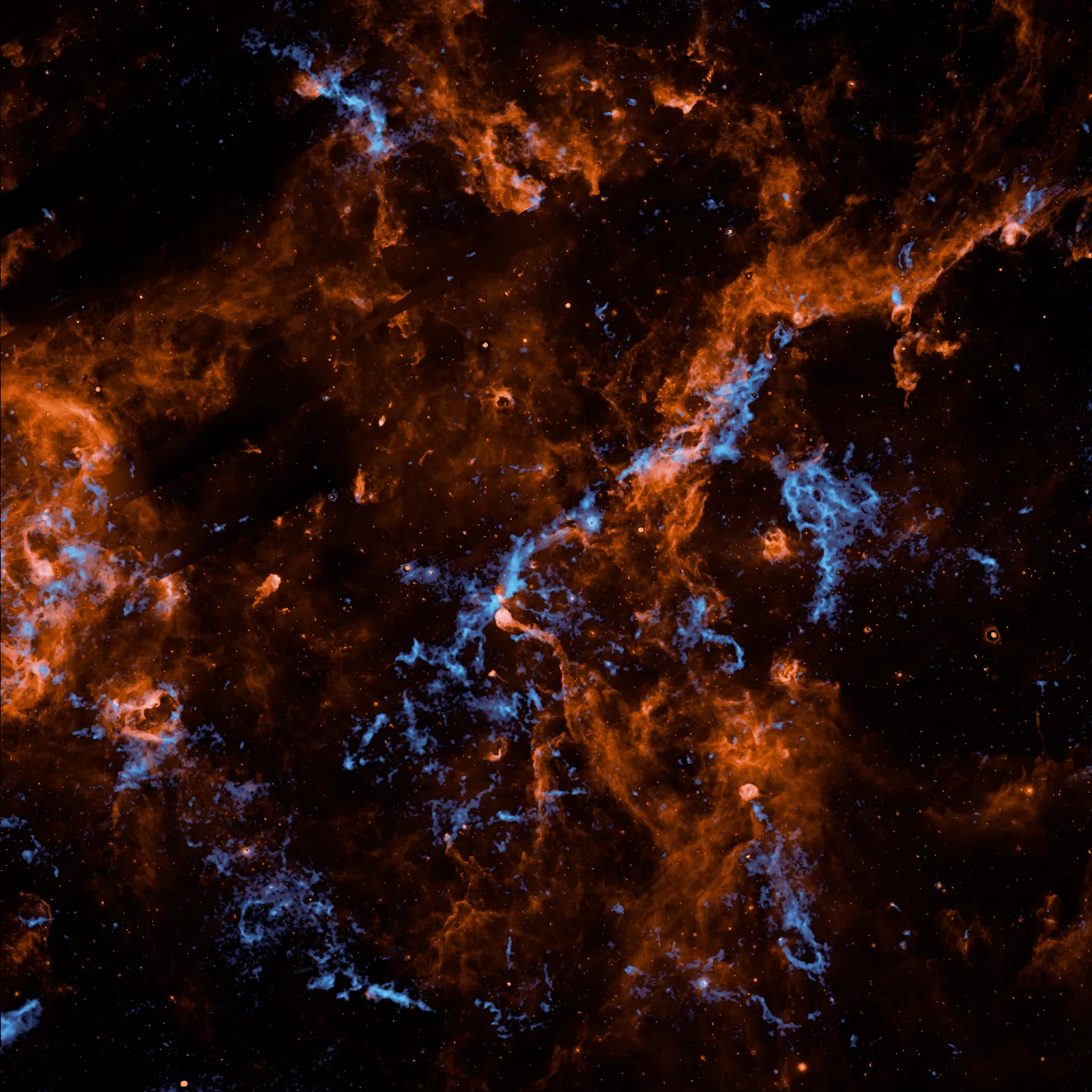
The molecular clouds of the Milky Way hold something like frozen archives — reservoirs of water, carbon dioxide, and carbon monoxide ice accumulated over millions of years. NASA's SPHEREx mission has now mapped these reservoirs not at isolated points, but across an area spanning more than 600 light-years. The findings appeared in The Astrophysical Journal.
SPHEREx is the first infrared mission specifically designed to search for such ice across the entire sky. Earlier telescopes — the James Webb Space Telescope and the now-retired Spitzer — detected the same molecules before, but only along the line of sight toward individual bright stars. SPHEREx instead reveals how the ice is distributed spatially, in continuous formations that align with the densest dust regions.
Where the universe's water is born
Giant molecular clouds are vast regions of gas and dust where dense clumps of matter collapse under their own gravity, giving birth to new stars. Researchers believe this is where most of the universe's water forms and is stored.
The ice attaches to the surface of dust particles so tiny they are comparable in size to particles found in candle smoke. Dense clouds of dust shield this ice from the harsh ultraviolet radiation of young, massive stars, which would otherwise evaporate it.
Scientists believe the water in Earth's oceans, along with the ice found in comets and on other planets and moons in the solar system, originates from exactly these kinds of regions.
These vast frozen complexes are like 'interstellar glaciers' that could deliver a massive water supply to new solar systems that will be born in the region. It's a profound idea that we are looking at a map of material that could rain on nascent planets and potentially support future lifePhil Korngut, SPHEREx instrument scientist, Caltech
How an infrared eye sees through dust
SPHEREx's key capability is seeing the sky in 102 colors of infrared light. Each wavelength carries distinct information about galaxies, stars, or planet-forming regions.
The method relies on the fact that different types of ice absorb specific wavelengths of infrared light. If a cloud consisted of dust alone, that light would pass through it almost unhindered. But where ice is present, certain parts of the spectrum are dimmed — and it is this absorption dip that lets SPHEREx detect the ice's presence and density.
Previously, this approach was applied only to individual stars, whose light acted like a spotlight illuminating any ice along its path. SPHEREx instead analyzes diffuse background light shining through entire clouds along the galactic plane — where most of the galaxy's stars, gas, and dust are concentrated. This made it possible, for the first time, to see the spatial distribution of ice in fine detail.
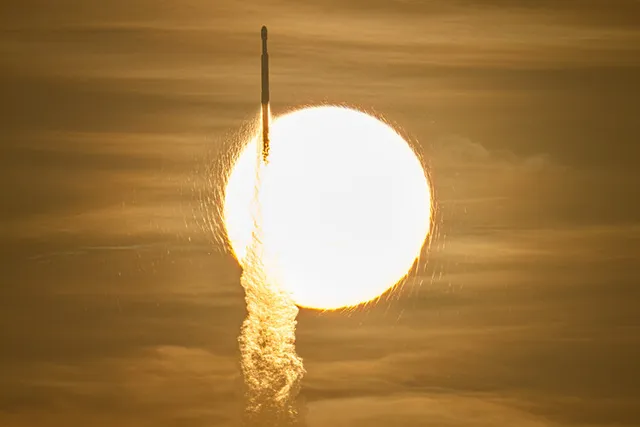
The telescope launched on March 11, 2025. By late 2025, it had completed the first of four planned all-sky surveys, which chart the positions of hundreds of millions of galaxies in three dimensions.
Cygnus X and the North American Nebula
The first targets of detailed analysis were the Cygnus X region and the North American Nebula. Researchers compared ice maps with dust maps at different wavelengths — and ice density matched precisely with the dark dust lanes in these regions.
This supports the hypothesis that ice forms directly on the surface of the smallest dust grains, and that the densest dust regions are simultaneously the best-shielded from ultraviolet radiation.
Not all ice types behave the same way, though. Water and carbon dioxide respond differently to environmental conditions: the intensity of ultraviolet light from nearby massive young stars, and the heating of dust grains by that radiation, shift the balance between different ice species within a cloud.
The study's authors note that it is precisely this large-scale, "big picture" view from SPHEREx that provides information unavailable when studying small individual patches of sky.
What comes next
Three more all-sky surveys lie ahead. The mission team plans to determine which environmental factors drive different ice formation rates across various regions of the Galaxy.
The central question remains open: how do the molecules essential for life's chemistry travel from interstellar clouds onto newly formed planets. SPHEREx data are freely available to scientists and the public alike.