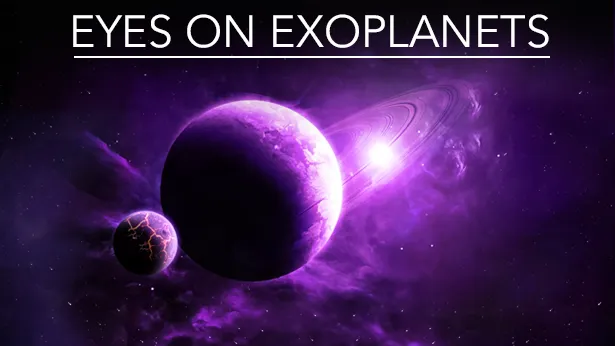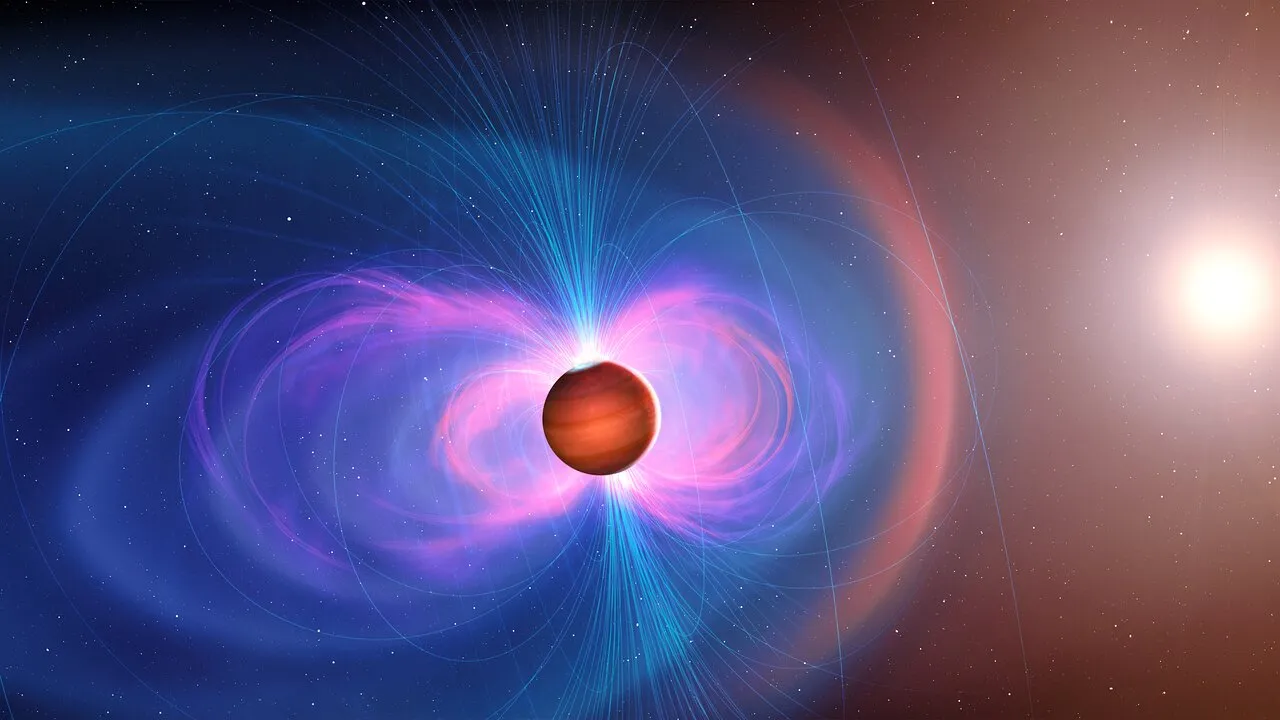
The planets in this study never show their host star a night side. They orbit so close to their suns that tidal forces have locked their rotation to their orbit — the same way the Moon always keeps one face toward Earth. The result is a world with permanent day on one hemisphere and permanent night on the other, separated by a temperature gap of hundreds to thousands of degrees.
It was on seven such "ultra-hot Jupiters" that a team led by Julia Seidel of the Observatoire de la Côte d'Azur (France) measured atmospheric wind speeds. The original goal was purely meteorological — understanding gas circulation in extreme atmospheres. But the data led to a discovery no one had set out to find: the first solid hints of magnetic fields on worlds beyond the Solar System.
Measuring wind across thousands of light-years
Measuring wind speed on a planet that cannot even be seen directly is no trivial task. The team relied on two high-resolution spectrographs: MAROON-X on the Gemini North telescope in Hawai'i and ESPRESSO on ESO's Very Large Telescope in Chile.
These instruments detect the light signature of specific chemical elements in a planet's atmosphere — and how that signature shifts as the planet moves through its orbital phases. The shift betrays the motion of gas, much like a change in pitch reveals the speed and direction of a passing ambulance siren.
The method delivered striking results. Measured wind speeds ranged from 7,200 to over 25,000 km/h. For comparison, the fastest winds ever recorded on Jupiter in our own Solar System reach only about 1,500 km/h. The explanation lies in the nature of ultra-hot Jupiters themselves: the extreme temperature contrast between the scorching day side and the frozen night side drives gas through the atmosphere at supersonic speeds.
Hotter planets, slower winds
This is where the anomaly appeared. Researchers compared wind speed against each planet's temperature — and found a relationship running opposite to expectations.
This is totally counterintuitive because, all things being equal, hot planets have more energy to accelerate the winds. Something must happen that slows down the wind speeds for hotter objectsVivien Parmentier, Laboratoire Lagrange, Université Côte d'Azur
More heat should mean a stronger pressure gradient and therefore faster wind. Instead, the hottest planets in the sample showed the slowest winds. The team needed an explanation that worked in the opposite direction — one that brakes gas motion more strongly as temperature rises.
A magnetic brake on charged gas
The explanation most consistent with the data is the presence of a planet-wide magnetic field. In the atmospheres of ultra-hot Jupiters, gas is partially ionized: extreme heat strips electrons from atoms, turning part of the atmosphere into plasma. A magnetic field acts on these charged particles as a brake, slowing their motion.
The hotter the planet, the stronger the ionization — and the stronger the magnetic braking effect. This matches the observed pattern and allowed the team, for the first time, to estimate the magnetic field strength of planets beyond the Solar System, inferred not from a direct measurement of the field itself but from its effect on gas motion.
The resulting values turned out to be comparable to those of gas giants in our own Solar System: roughly four times stronger than Saturn's field and about half the strength of Jupiter's.
Why a magnetic field decides an atmosphere's fate
Earth's magnetic field is not an abstraction from a physics textbook — it is a shield that deflects the stream of charged particles from the Sun and prevents it from stripping away the atmosphere. Without that shield, a planet gradually loses its air and water to space.
This breakthrough opens a completely new window on exoplanet research. It's the first time we can compare the magnetic environments of other worlds — a key step toward ultimately understanding which planets can stay alive, keep their water, and perhaps even, one day, host life as we know itJulia Seidel, Laboratoire Lagrange, Observatoire de la Côte d'Azur
The researchers also note that such strong magnetic fields could produce more than just wind patterns — they could drive auroras, likely far more dramatic than Earth's, since charged particles there interact with an extremely hot, heavily ionized atmosphere.
The results are published in Nature Astronomy. This marks the first time astronomers have been able to indirectly estimate the magnetic field strength of planets outside the Solar System — a method that opens the door to systematically studying which worlds can hold onto an atmosphere and water long enough to remain potentially habitable.