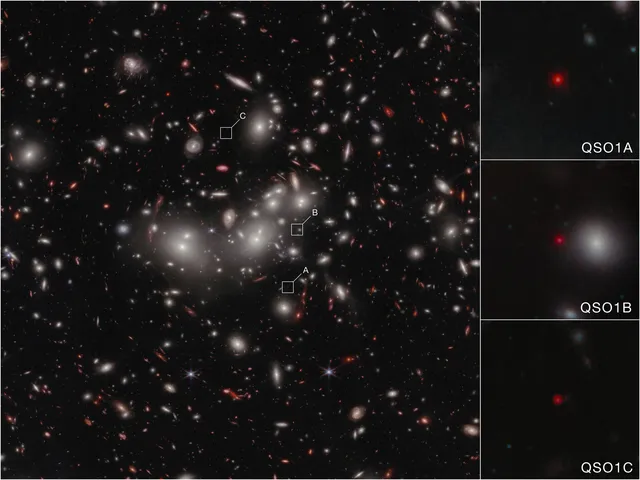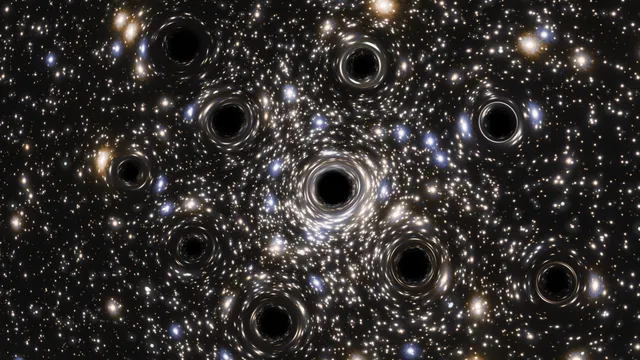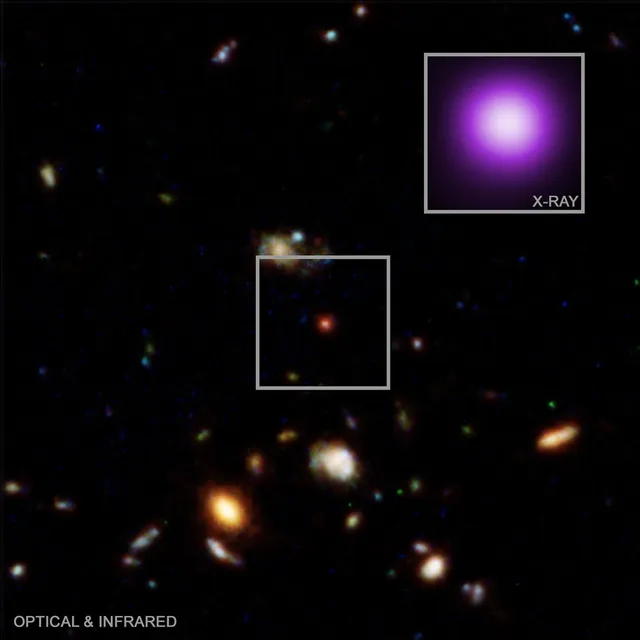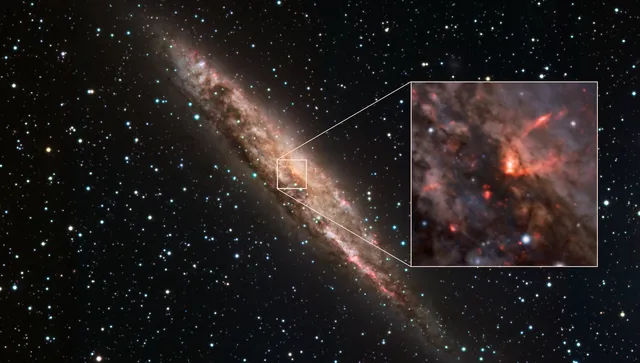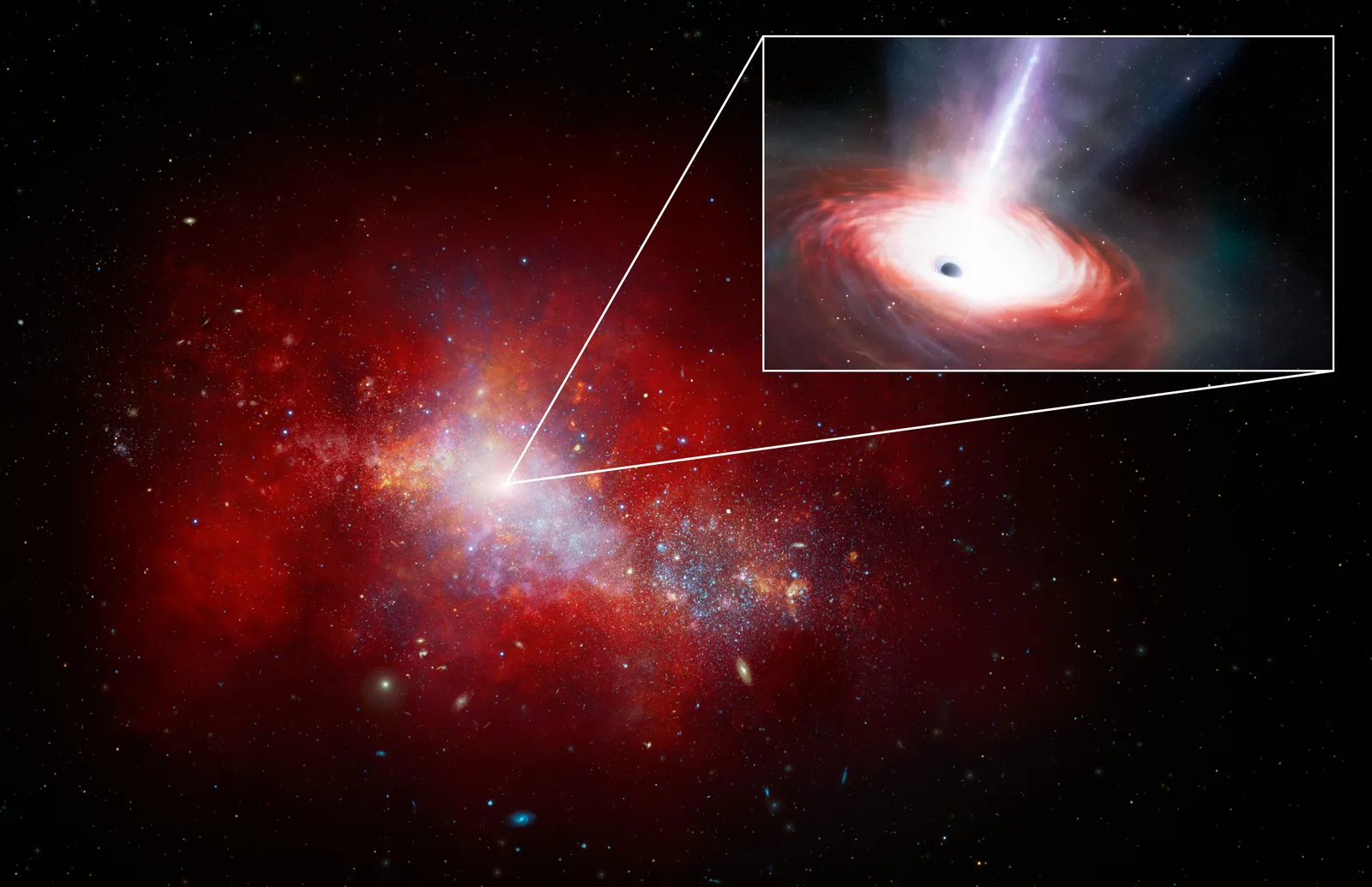
Supermassive black holes weighing billions of solar masses already existed when the universe was less than a billion years old. How they managed to grow so large in so little time remains one of the open problems in astrophysics. A new study by the SHELLQs team offers what is so far the most statistically complete snapshot of black hole masses and growth rates among quasars at redshifts 6 to 7.
How to weigh a black hole at the edge of the observable universe
SHELLQs (Subaru High-z Exploration of Low-Luminosity Quasars) is a project that has spent years finding faint and intermediate-luminosity quasars in the early universe using the Subaru Telescope. In this new work, researchers took 21 such quasars at redshifts between 6.07 and 6.90 and obtained near-infrared spectra for them: some with the NIRSpec instrument on the James Webb Space Telescope, others with the MOIRCS instrument on Subaru.
The method for determining black hole mass here is the standard one for quasars — so-called virial mass estimates. Researchers look for a broad emission line (in this study, hydrogen Balmer lines and the magnesium ion MgII at a wavelength of 2798 angstroms) emitted by gas orbiting close to the black hole. The more massive the black hole, the faster the gas moves, and the broader the line appears in the spectrum. Combining the line width with the brightness of the surrounding continuum allows an estimate of the central object's mass.
The sample objects have absolute magnitudes between -25 and -22 — an intermediate group between the brightest quasars known from ground-based sky surveys and the faint active galactic nuclei recently uncovered specifically by James Webb thanks to its sensitivity. Such intermediate-luminosity objects at such large distances were previously poorly studied simply due to a lack of spectroscopic data of sufficient quality.
What the measured masses and growth rates reveal
By adding the new data to previous SHELLQs mass estimates, the researchers assembled a sample of 27 quasars with reliable black hole mass estimates in the redshift range 6–7. The masses span a wide range — from 10^7.2 to 10^9.4 solar masses, or roughly 16 million to 2.5 billion solar masses. The accretion rate, expressed as the ratio of bolometric luminosity to the Eddington limit (the maximum luminosity an object can sustain without radiation pressure halting infalling matter), ranges from 0.05 to 2.5 relative to that limit.
Comparison with a sample of similarly bright quasars at redshift z ~1.3, when the universe was already about 4.5 billion years old, yielded two consistent findings. First, the early black holes are on average lighter — a median offset of -0.4 dex, meaning they are roughly 2.5 times less massive than their later counterparts of the same brightness. Second, the accretion rate in the early sample is higher — by 0.2 dex in the median. In other words, to reach the same luminosity, early quasars use less mass but accrete more intensely.
The most notable result concerns the fraction of objects growing at the physical limit. In the baseline approach, 11% of quasars in the sample are accreting at or above the Eddington limit. The authors also checked the result using an alternative calibration of virial masses that accounts for dependence on accretion rate — under this approach, the fraction of super-Eddington quasars rises to 22%. This difference shows how sensitive such estimates are to methodological details, while also underscoring that a substantial fraction of early black holes genuinely go through a phase of extremely rapid growth.
Why this supports the "anti-hierarchical" growth scenario
These results are consistent with the so-called anti-hierarchical scenario of supermassive black hole formation: black holes first go through a short but very intense phase of mass buildup, after which their growth slows down. At the same time, the authors emphasize that growth in this intermediate-luminosity population is not as extreme as in the brightest known quasars of the early universe, where super-Eddington accretion occurs much more frequently.
This study matters because it provides, for the first time, a statistically representative picture of black hole growth for a typical — rather than the most extreme — population of quasars at redshift 6–7. The next step will likely be expanding the sample and refining mass measurement calibrations, in particular clarifying how strongly different calibration approaches affect the estimated fraction of super-Eddington objects in the early universe.