NASA Announces Artemis II Launch Date
NASA has set a target launch date of no earlier than April 1 for Artemis II, with a two-hour launch window opening at 6:24 p.m. Eastern time and backup opportunities through April 6. The Space Launch System rocket will lift off from Launch Pad 39B at Kennedy Space Center in Florida, following crew quarantine, media briefings, and final prelaunch checks in the days beforehand.
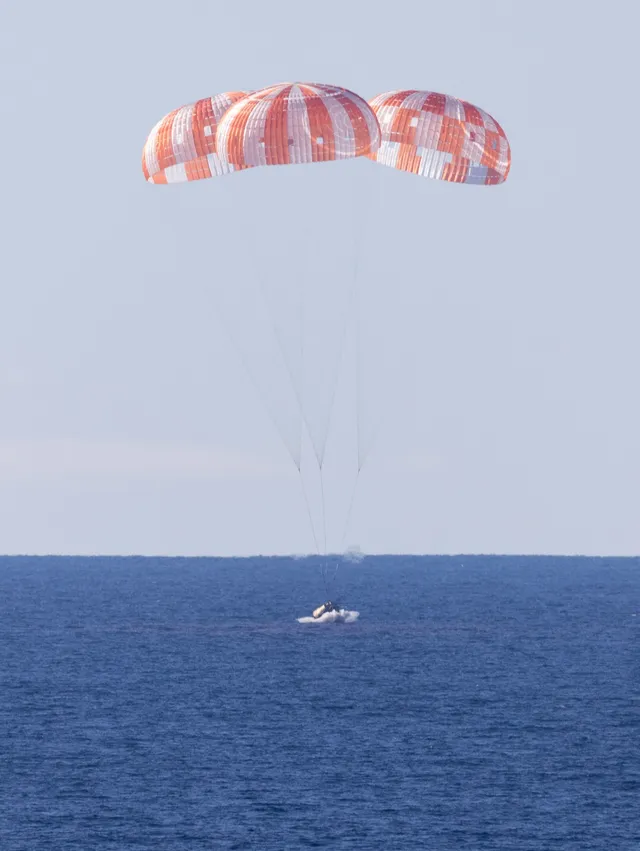
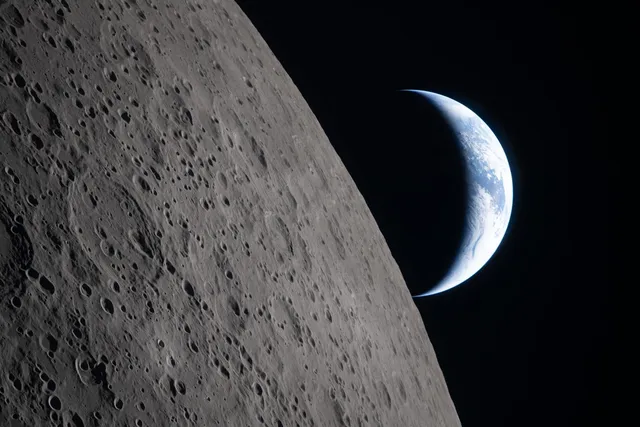
Over roughly ten days, astronauts Reid Wiseman, Victor Glover, Christina Koch, and Jeremy Hansen will loop around the Moon and return to Earth, testing Orion's life support systems with a crew aboard for the first time. A successful flight would pave the way for future Artemis missions, including a crewed lunar landing.
XRISM Telescope Measures the Hot Wind of Galaxy M82
The XRISM X-ray telescope has made the first direct measurement of the temperature and velocity of hot gas in the nuclear starburst of M82, a textbook example of a starburst galaxy. The gas reaches 23 million Kelvin, with a total mass of around 600,000 solar masses, thanks to the instrument's high spectral resolution, which resolved fine details in the X-ray emission.
The measured velocities match a freely expanding wind moving faster than the galaxy's escape velocity. This confirms a long-standing hypothesis that thermal pressure from the hot gas alone can drive a multiphase galactic wind, carrying matter and energy into intergalactic space and shaping the galaxy's future evolution.
Superluminous Supernovae: A Magnetar Behind the Record Brightness
Researchers have modeled a scenario in which superluminous supernovae — explosions 10 to 100 times brighter than ordinary ones — are powered by the energy of a newly born millisecond magnetar. The model tracks the evolution of the magnetar-wind-nebula-ejecta system and calculates thermal and non-thermal emission as well as neutrino output. For the nearest known superluminous supernova, SN 2017egm, the predicted high-energy gamma rays matched a recent detection by the Fermi LAT telescope.
This marks the first direct confirmation of the magnetar scenario using real high-energy observational data. The authors also predict that once the Vera C. Rubin Observatory is operating, a stacking analysis of data from upcoming neutrino observatories over a decade could detect a signal from a population of such supernovae at 3-sigma significance.
GravNet: A Global Network to Hunt High-Frequency Gravitational Waves
An international team of physicists has presented GravNet, a conceptual global detector network designed to search for gravitational waves in the megahertz-to-gigahertz range. This frequency window is inaccessible to ground-based interferometers like LIGO, even though sources at these frequencies may be linked to some of the most pressing open questions in cosmology, including processes in the early universe. The approach relies on cavities operating in strong magnetic fields, and a first demonstration experiment with a non-superconducting cavity has already been carried out.
The network's key idea is synchronized signal measurements at geographically separated locations around the globe. Analyzing correlations between signals from multiple detectors substantially boosts detection confidence, helping distinguish genuine events from instrumental or environmental noise while also enabling studies of the nature and origin of the detected waves.
April 2026 Skywatching Highlights
April 2026 offers skywatchers several notable events. On April 3, Mercury reaches its greatest elongation — the best chance to spot the planet all year, low above the eastern horizon before sunrise, just above Mars. The Lyrid meteor shower, seeded by debris from Comet Thatcher, peaks overnight from April 21 to 22, with the best viewing starting around 10 p.m. on April 21 near the bright star Vega in the constellation Lyra.
The month's highlight is Comet C/2025 R3, which some experts consider a candidate for the brightest comet of the year. April 17 may offer the best viewing opportunity, while the comet makes its closest approach to Earth, roughly 71 million kilometers away, on April 27. At an expected magnitude of about 8, it will require binoculars or a small telescope, and can be found in the predawn sky in the constellations Pegasus and Pisces.