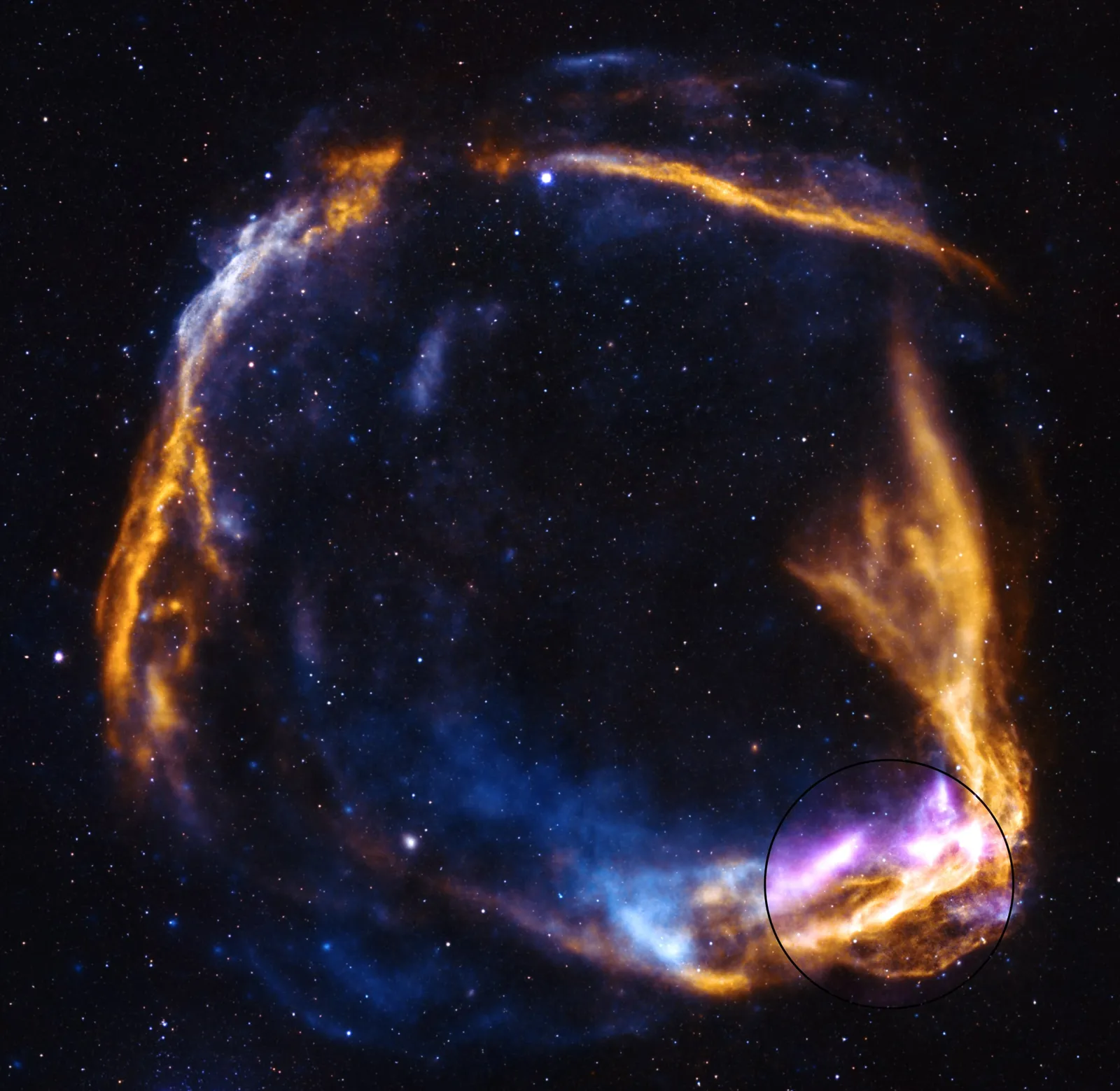
About 2,000 years ago, people watching the night sky could have seen a bright new star appear. It faded within months, but left behind what astronomers now call RCW 86 — an expanding cloud of hot gas and particles that is still moving through space. NASA's IXPE (Imaging X-ray Polarimetry Explorer) has captured new data on the outer edge of this remnant, adding a detail to a picture built up over years by other X-ray observatories.
The new observation does not rewrite the story of RCW 86 from scratch. It fills in something that was missing before: the place where the remnant's expansion appears to have run into an obstacle.
A cavity that shaped the remnant
Before IXPE's involvement, NASA's Chandra X-ray Observatory had already found a large region of low density surrounding RCW 86 — a kind of cavity in the surrounding environment. This cavity likely allowed material ejected by the explosion to expand faster than standard models of supernova remnant evolution would predict.
The same cavity probably also explains RCW 86's unusual, uneven shape. Where the surrounding density was lower, the shock wave could push outward more freely and travel farther. Where it met denser gas, it slowed down.
IXPE's data captures exactly the moment in this story when the expansion reached the edge of that cavity. There, a so-called reflected shock formed — a front that appears when expansion suddenly slows upon meeting denser material. On the combined image, this region is highlighted in purple.
What the X-ray image reveals
The final image of RCW 86 combines data from several instruments. Yellow represents the low-energy X-rays detected by IXPE. Blue marks the high-energy X-rays recorded earlier by Chandra and the European Space Agency's XMM-Newton telescope. The starfield in the background comes from optical observations by the National Science Foundation's National Optical-Infrared Astronomy Research Laboratory (NOIRLab).
Combining data from different telescopes and different energy ranges makes it possible to see the structure of a supernova remnant more fully than any single observation could. IXPE plays a distinct role here: the mission is built not simply to detect X-rays, but to measure their polarization — the direction in which the X-ray waves oscillate. This provides information about magnetic field structure and how particles are accelerated in shock waves, details that ordinary X-ray images cannot capture.
A mission beyond a single object
IXPE is a joint mission between NASA and the Italian Space Agency, with partners and science collaborators in 12 countries. It is led by NASA's Marshall Space Flight Center in Huntsville, Alabama. Spacecraft operations are managed jointly by BAE Systems, Inc. and the University of Colorado's Laboratory for Atmospheric and Space Physics in Boulder.
The observation of RCW 86 is not IXPE's only result. The telescope has been steadily gathering data on the universe's most energetic objects, from supernova remnants to neutron stars and black holes, each time adding a dimension that earlier X-ray images lacked — information about the polarization of X-ray light. Thanks to this instrument, the story of a 2,000-year-old explosion once witnessed by human eyes continues to be refined today.