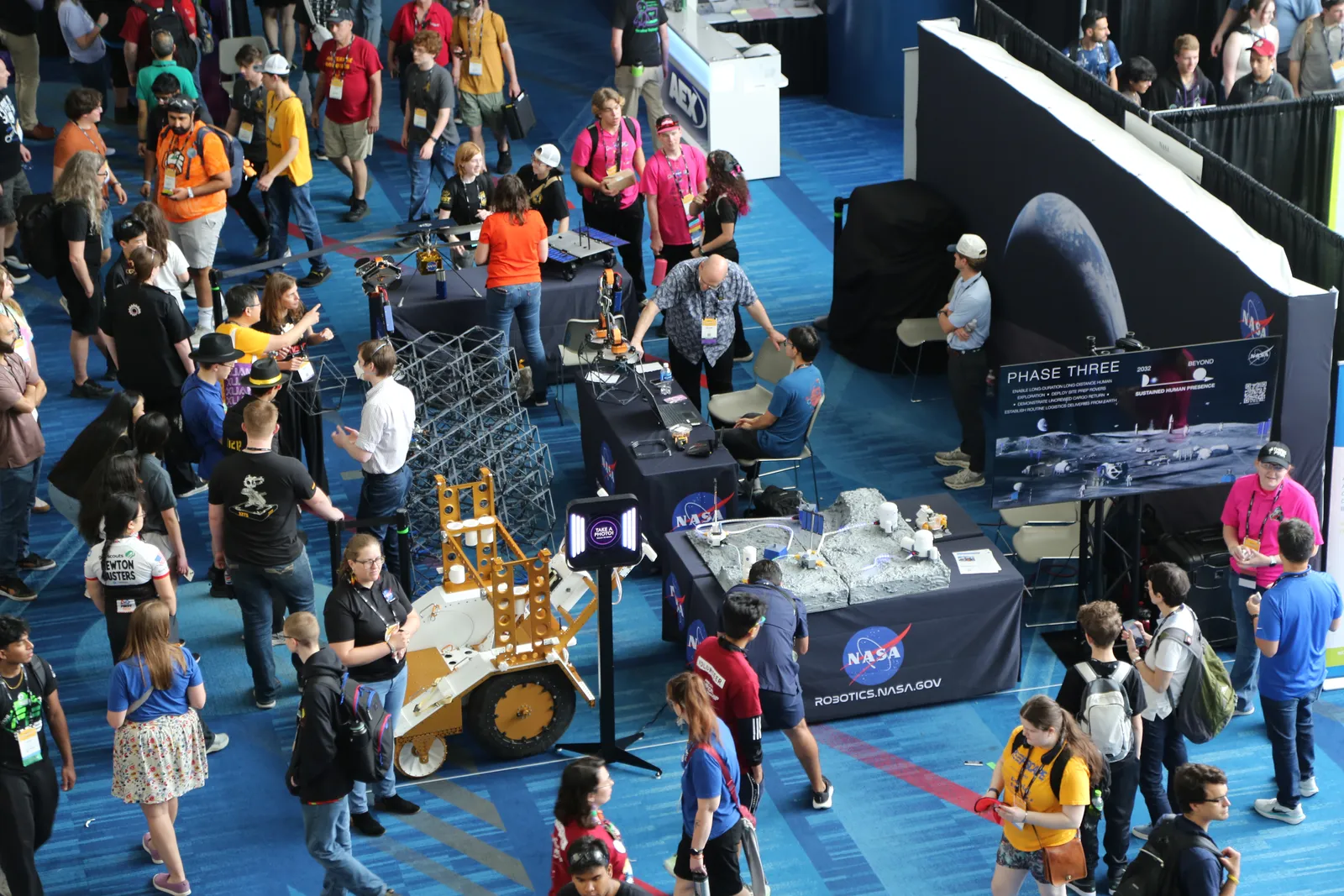
More than 1,000 student teams from around the world gathered at the George R. Brown Convention Center in Houston from April 29 to May 2, 2026, for the FIRST Robotics World Championship, one of the largest robotics competitions for students. NASA used the event not just to showcase its technology but as a platform to talk with future engineers about its plan to build a permanent outpost on the Moon.
The agency engaged directly with more than 51,000 students, parents, and mentors through interactive exhibits and discussions. The centerpiece of NASA's booth was a model of Moon Base, a planned permanent lunar outpost meant to serve as a hub for exploring the Moon, conducting scientific research, and testing technologies ahead of future missions to Mars.
Phase 1: scouting ahead of Artemis
The Moon Base plan is broken into phases. The first centers on a rapid series of robotic and uncrewed missions meant to scout terrain, run experiments, and prepare conditions for crewed landings under the Artemis program.
A key piece of this phase is an accelerated cadence of CLPS (Commercial Lunar Payload Services) flights. NASA is targeting up to 30 robotic lunar landings in 2027. Each mission is meant to deliver science and technology payloads: rovers, hoppers — vehicles that move by leaping across the surface — and drones.
The idea is to gather as much data as possible about the lunar surface and conditions before humans arrive. The more robotic missions fly ahead of time, the fewer surprises await crewed missions.
Three technologies for orbit and the lunar surface
NASA's exhibit highlighted three technologies meant to underpin future missions.
ARMADAS (Automated Reconfigurable Mission Adaptive Digital Assembly Systems) is a modular construction system of small robots and smart algorithms capable of autonomously assembling large-scale infrastructure directly in space: solar power arrays, communications systems, habitat modules. This reduces the need to launch fully assembled hardware from Earth, a significant factor for sustained deep space exploration.
CADRE (Cooperative Autonomous Distributed Robotic Exploration) is a trio of small lunar rovers designed to explore the surface together and autonomously, without constant operator input. Working as a team lets them collect data no single rover could gather alone. Success here could open the door to multirobot missions that help define science objectives, navigate hazardous terrain, and support astronaut activities.
SkyFall are Mars helicopters, successors to Ingenuity, which completed 72 flights in Jezero Crater. SkyFall helicopters would serve as aerial scouts for scientists and mission planners, paving the way for future crewed exploration of the Red Planet.
Ten NASA centers, one exhibit floor
Ten NASA centers took part in the event: Johnson Space Center in Houston, Kennedy Space Center in Florida, Langley Research Center in Virginia, Ames Research Center in California, Michoud Assembly Facility in New Orleans, Armstrong Flight Research Center in Edwards, California, Glenn Research Center in Cleveland, Goddard Space Flight Center in Maryland, White Sands Test Facility in New Mexico, and Wallops Flight Facility in Virginia.
Each center brought its own technologies and expertise, turning NASA's booth into a cross-section of the whole agency — from rocket engine development to testing materials for extreme conditions.
A mobile machine shop and 30 years backing FIRST Robotics
NASA has supported FIRST Robotics since 1996. This season the agency sponsored more than 160 teams, of which 50 had NASA mentors. Johnson Space Center directly mentored six teams, two of which made it all the way to the championship.
A NASA mobile machine shop drew particular attention. Teams could bring in broken robot parts, and NASA machinists helped with repairs. Over the course of the championship, the shop completed more than 600 repair jobs.
NASA's presence at competitions like this is more than a showcase for ambitious plans. For the agency, it is a way to show students that working on near-impossible problems is a real career path, not just a topic for popular science articles.