The James Webb Space Telescope has pushed back the limit to which the growth of supermassive black holes can be traced. Researchers report an object, MoM-BL-z10, at redshift z = 9.9837 ± 0.0009. Its spectrum shows signs of a broad hydrogen emission line, a typical marker of an active galactic nucleus. If the interpretation holds, it is the most distant black hole with broad lines known.
The work is a preprint on arXiv and has not yet been peer reviewed.
How MoM-BL-z10 was found
Webb has uncovered a previously unknown population of faint active galactic nuclei (AGNs) in the early Universe. These are the central regions of galaxies where a supermassive black hole swallows gas and shines brightly. The authors set out to search for such objects systematically. They took public NIRSpec PRISM spectra gathered in the DAWN JWST Archive and selected sources at z ≥ 6.
In the spectrum of MoM-BL-z10, at a wavelength of 5.35 microns, the hydrogen Hβ line has a broad component. Gas close to the black hole moves so fast that the Doppler effect broadens the line. A model with narrow and broad Gaussian components gave the broad component a width (FWHM, full width at half maximum) of 3,480 km/s, with asymmetric uncertainties of −950 and +2,040. The signal-to-noise ratio of this component is 3.87. The luminosity of the broad Hβ line is about 1.25 × 10⁴² erg/s.
Additional signs of an active nucleus
A broad line with this significance does not settle the case by itself. So the authors point to indirect signs as well. The spectrum shows the [Ne III] λ3870 line and high [Ne III]/[O II] and [O III]/Hβ ratios. These support the active-nucleus interpretation.
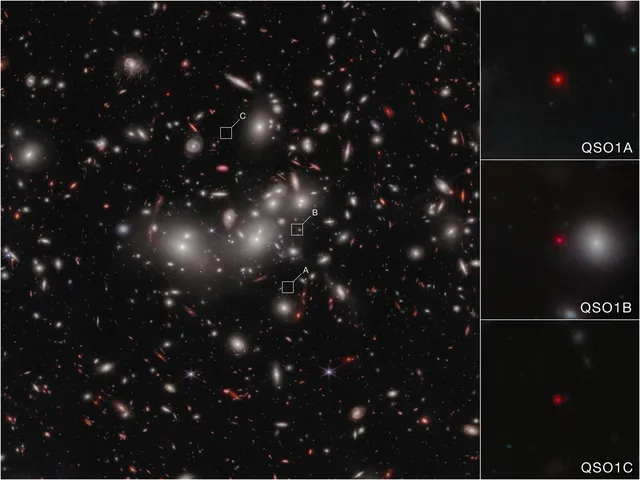
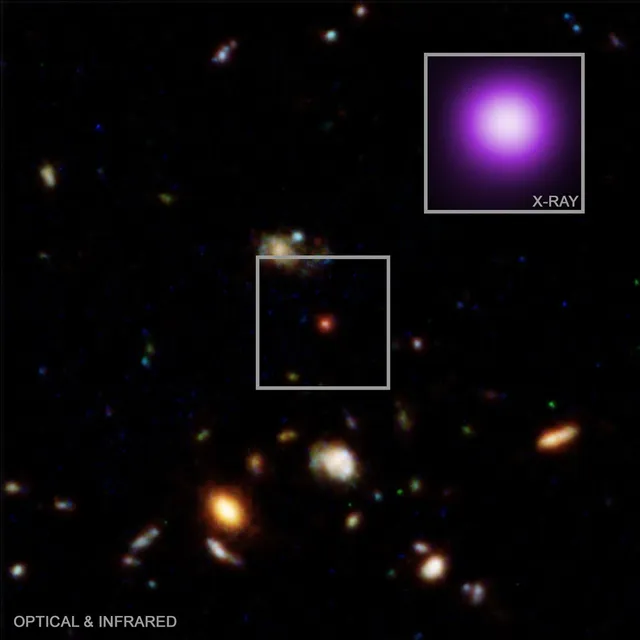
There is also a resemblance to Little Red Dots (LRDs), compact red sources that Webb has found in large numbers. In MoM-BL-z10 the ultraviolet and optical continuum slopes and the compact NIRCam morphology are similar to those of such objects. There is also a tentative detection in the MIRI F770W filter.
What the black hole mass is
A broad line allows a mass estimate by the virial method. The speed of the gas and the size of the region where it moves are linked to the mass of the central body. The standard single-epoch calibration is used for this. This is the first such estimate at z ≈ 10.
With the standard calibration and a quasar bolometric correction, the mass is 3.6 × 10⁷ solar masses, about 36 million, with a range from 1.9 to 9.4 million solar masses at one end and up to 42 million at the other. The accretion rate in this case is 0.11 of the Eddington limit, where radiation pressure balances gravity.
The authors also considered an alternative. If one adopts the LRD-specific bolometric correction and assumes the black hole grows exactly at the Eddington limit, the mass becomes 2.1 × 10⁶ solar masses, about 2.1 million.
How solid is the result
The conclusion has several limits. The significance of the broad component is modest: S/N = 3.87. The uncertainty on the line width is large, and the mass depends on that width. The estimate shifts by nearly a factor of twenty depending on the assumptions: from 2.1 to 36 million solar masses. The MIRI detection is described as tentative. The result is best treated as a strong candidate that needs confirmation with deeper observations.
Why it matters
The age of the Universe at this redshift is only 470 million years. In that time the black hole had to reach at least a few million solar masses, and by the standard estimate tens of millions. The authors stress that in both scenarios rapid growth is hard to explain. It requires either super-Eddington accretion onto a stellar-mass seed, or a more massive initial seed.
MoM-BL-z10 becomes a benchmark for models of the early growth of supermassive black holes. Deeper, higher-resolution spectra are needed next. They would show whether the broad component is real and how wide it is. That would refine the mass and help establish whether such objects resemble Little Red Dots.