Giant Shell Found Around Supergiant VX Sgr
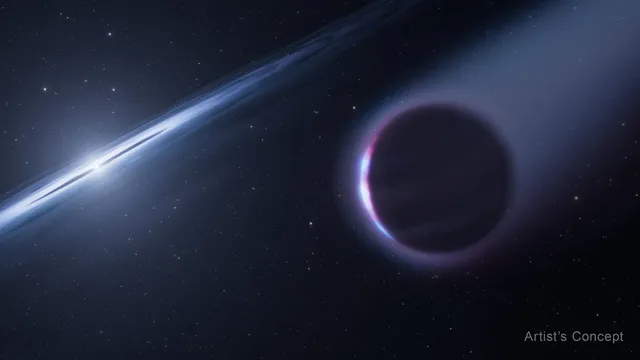
Astronomers have found a thin, arc-shaped shell around VX Sagittarii, a red supergiant whose true nature is still debated. At about 0.59 parsecs from the star, it is the largest circumstellar shell known around a red supergiant. The ionized gas holds roughly 0.1 solar masses. The star's slow 12 km/s motion through space and the arc's lack of far-infrared emission rule out a bow shock. More likely it is stellar wind or ejecta lit up by a nearby O- or B-type star.
From the shell's geometry and emission measure, the mass-loss rate comes out near 4×10⁻⁵ solar masses per year. The age of the Sgr OB1 association disfavors a super-AGB origin for VX Sgr, and a proposed spectroscopic test of the arc could tell an ordinary supergiant from a hypothetical Thorne–Żytkow object, a giant with a neutron star core.
Blue Companions Dance With Little Red Dots
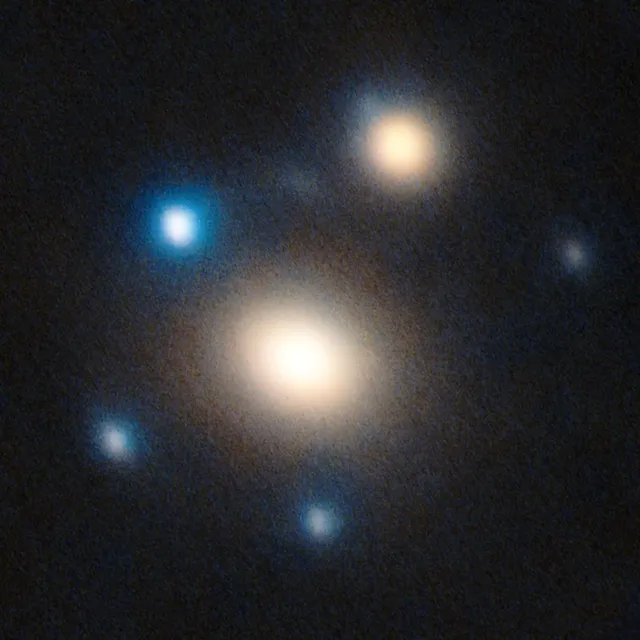
Little Red Dots are compact red sources at redshifts of roughly 4 to 9, likely powered by massive black holes. Blue companions had been spotted near them in photometry, but never confirmed with spectra. Now two pairs have spectra for both members: 'Waltz' at z = 3.9 and 'Tango' at z = 5.5, with projected separations of 3.6 and 2.5 kiloparsecs.
The companions are young starbursts under 50 million years old, with 0.2 solar metallicity and no dust, yet as bright in the ultraviolet as the dots themselves. Waltz's black hole weighs about 3 million solar masses. Orbital modeling finds Tango bound in 81% of allowed orbits, and both companions should merge with their dots within a few hundred million years, matching what heavy black hole seeding predicts.
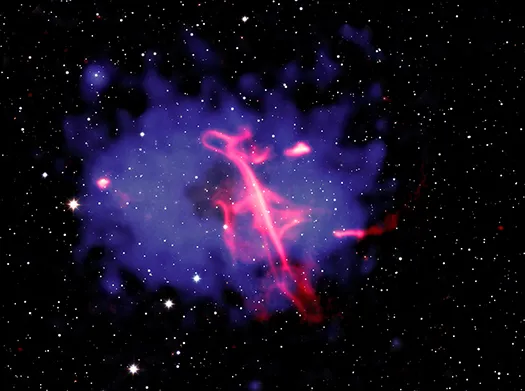
Chandra Decodes the 'Treble Clef' Cluster Collision
Using NASA's Chandra X-ray Observatory and the eROSITA telescope, astronomers have worked out the origin of an unusual radio structure nicknamed the 'Treble Clef' for its resemblance to the musical symbol. It was hard to study because it lies almost directly behind the plane of the Milky Way, where stars, gas, and dust block the view. X-ray data revealed hot gas from a galaxy cluster, which turned out to be two clusters in the process of merging.
According to the team led by Andrea Botteon of INAF, an outburst from a supermassive black hole first drove clouds of particles and magnetic fields away at nearly the speed of light, and their radio glow faded. The cluster collision later compressed or re-energized the cloud, making it bright again. The direct collision likely happened a few hundred million years ago, and the clusters are now moving apart.
Why Globular Clusters Lose Their Binaries
About a third of Milky Way stars are in binary or multiple systems, but only 1–10% of stars in globular clusters have a companion. A team led by Christopher O'Connor at Northwestern University asked whether clusters started with fewer binaries or lost them later. Their analytical model shows that if clusters began with the same binary distribution as the solar neighborhood, the dissolution of soft, loosely bound binaries is enough to explain today's scarcity.
The agent is 'black hole burning': black holes in binaries transfer energy to passing stars and push soft binaries toward disruption. Cluster Monte Carlo simulations confirmed that this process dominates in low- and moderate-density clusters, while stellar collisions add to the losses in denser ones. The results support a universal initial binary distribution.
Dark Matter-Free Galaxies Challenge Modified Gravity
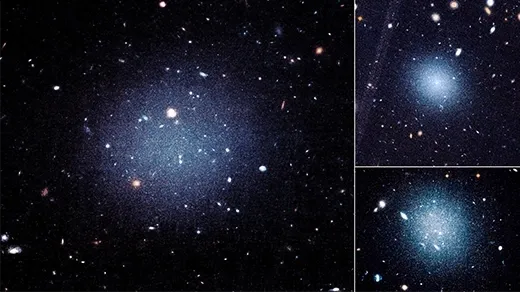
The diffuse galaxies DF2, DF4, and DF9, about 65 million light-years from Earth, look pale and ghostly. Mass estimates based on the motions of their stars show they contain very little dark matter, although nearly all galaxies are dominated by it. A paper in The Astrophysical Journal (June 2026) offers an explanation: two ordinary galaxies once collided, their gas and dust clumped together, and the dark matter passed straight through.
The wreckage formed three new galaxies without dark matter, which struggle to form stars, exactly as observed. According to Yale's Michael Keim, an author of the study, this shows dark matter is not just a modification of gravity but a physical substance. That puts alternative theories such as MOND under even greater pressure.