In September 2021, the IceCube Neutrino Observatory in Antarctica detected a high-energy neutrino arriving from the direction of the constellation Eridanus — an event named IC 210922A. Neutrinos carry no electric charge, have almost no mass, and barely interact with matter, which makes tracing a single particle back to its source one of the hardest problems in modern astronomy.
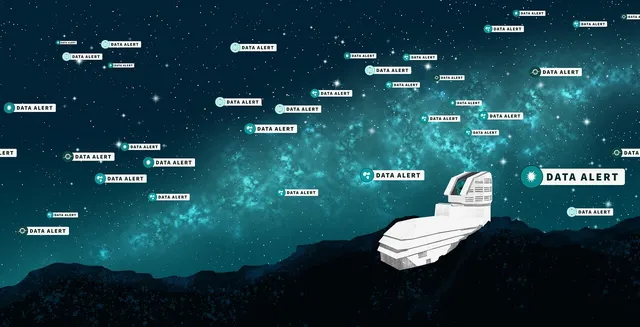
IceCube's alert went out to dozens of observatories worldwide within hours. Searches for a gamma-ray burst, an X-ray source, or a supernova in the relevant patch of sky came up empty. Only a few days later did a team led by Yuji Urata of MITOS Science Co., LTD. in Taiwan find a lead — an extraordinarily bright, distant galaxy nicknamed "Shadow Blaster."
Chasing a source after the IC 210922A alert
Several independent teams searched for an optical, X-ray, or gamma-ray counterpart in the neutrino's error region. None found a convincing candidate — no gamma-ray burst, no supernova, no tidal disruption event.
Two days after the alert, Urata's team began observations with the JCMT and SMA telescopes in Hawai'i. That search turned up galaxy JCMT0402−0424, better known by its nickname, Shadow Blaster. Its position and remarkable brightness made it the leading candidate for the neutrino's source.
A gravitational lens exposes Shadow Blaster's structure
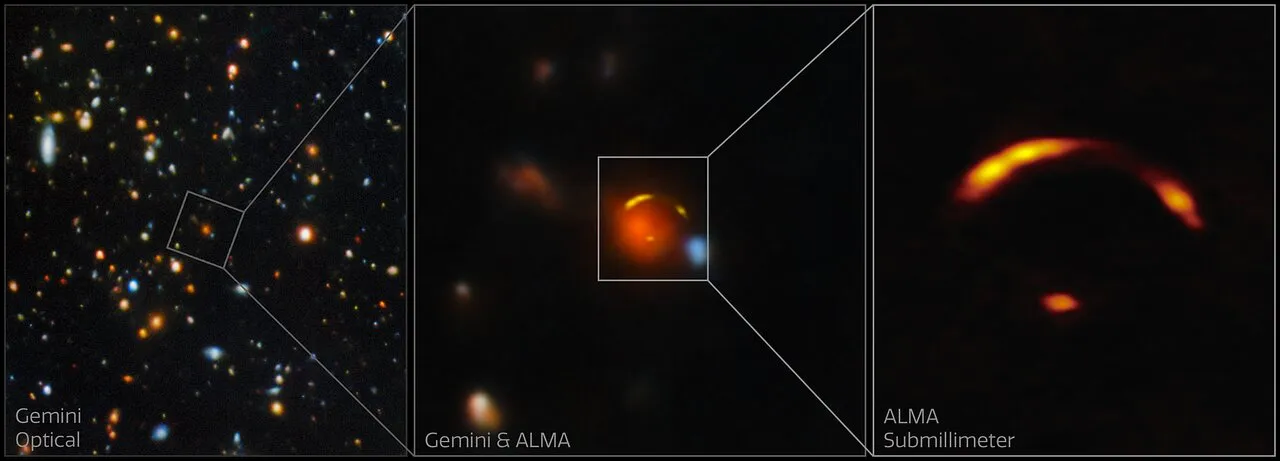
Follow-up observations with the ALMA radio telescope revealed that Shadow Blaster sits behind a powerful gravitational lens. A massive elliptical galaxy in the foreground bends spacetime and magnifies the light from the distant object behind it.
To properly account for the lensing effect, the team first needed to determine the distance and mass of the foreground galaxy. They used two instruments on Gemini North — the GMOS and GNIRS spectrographs — to build a model of the lens and estimate how much it amplified the signal.
Thanks to that magnification, a galaxy that would otherwise be too faint and distant to study in detail came into sharp focus. Shadow Blaster lies roughly 11 billion light-years away. The lens boosted its apparent infrared luminosity from 2.7 to 33 trillion times that of the Sun.
Star formation stands in for a black hole
Combining the lens model with ALMA imaging, the team found an ultra-compact core at the galaxy's center — a region tightly packed with gas and dust, forming new stars at an intense rate.
Theoretical models have long predicted that such an extreme environment can act as a natural particle accelerator, where energetic particles repeatedly collide with gas and produce neutrinos. Notably, Shadow Blaster shows no sign of an active black hole — previously, black hole jets were considered the main source of high-energy cosmic neutrinos.
This breakthrough shows how particle detectors and telescopes become far more impactful when they work together, opening a powerful multi-messenger window on the UniverseMartin Still, Program Director, NSF Office of Research Infrastructure
If confirmed, Shadow Blaster would be the first individual dusty star-forming galaxy directly linked to a high-energy neutrino event.
What this piece of the puzzle changes
About 10 billion years ago, the Universe was populated with galaxies like Shadow Blaster that were actively forming stars and, theoretically, generating large numbers of cosmic rays — high-energy particle streams capable of producing neutrinos.
Linking a specific neutrino event to such a distant galaxy has been extraordinarily difficult, since these galaxies are usually too far away and buried under thick layers of dust. Shadow Blaster's chance position behind a gravitational lens made finding this evidence much easier.
Compact star-forming galaxies of this kind may be common throughout the Universe. According to Urata's team, this population could contribute up to 20% of the diffuse cosmic neutrino background measured by IceCube.