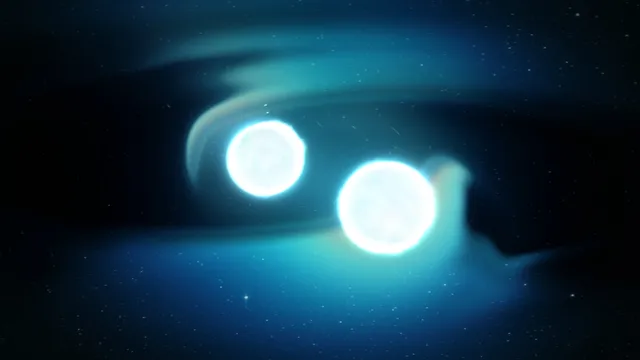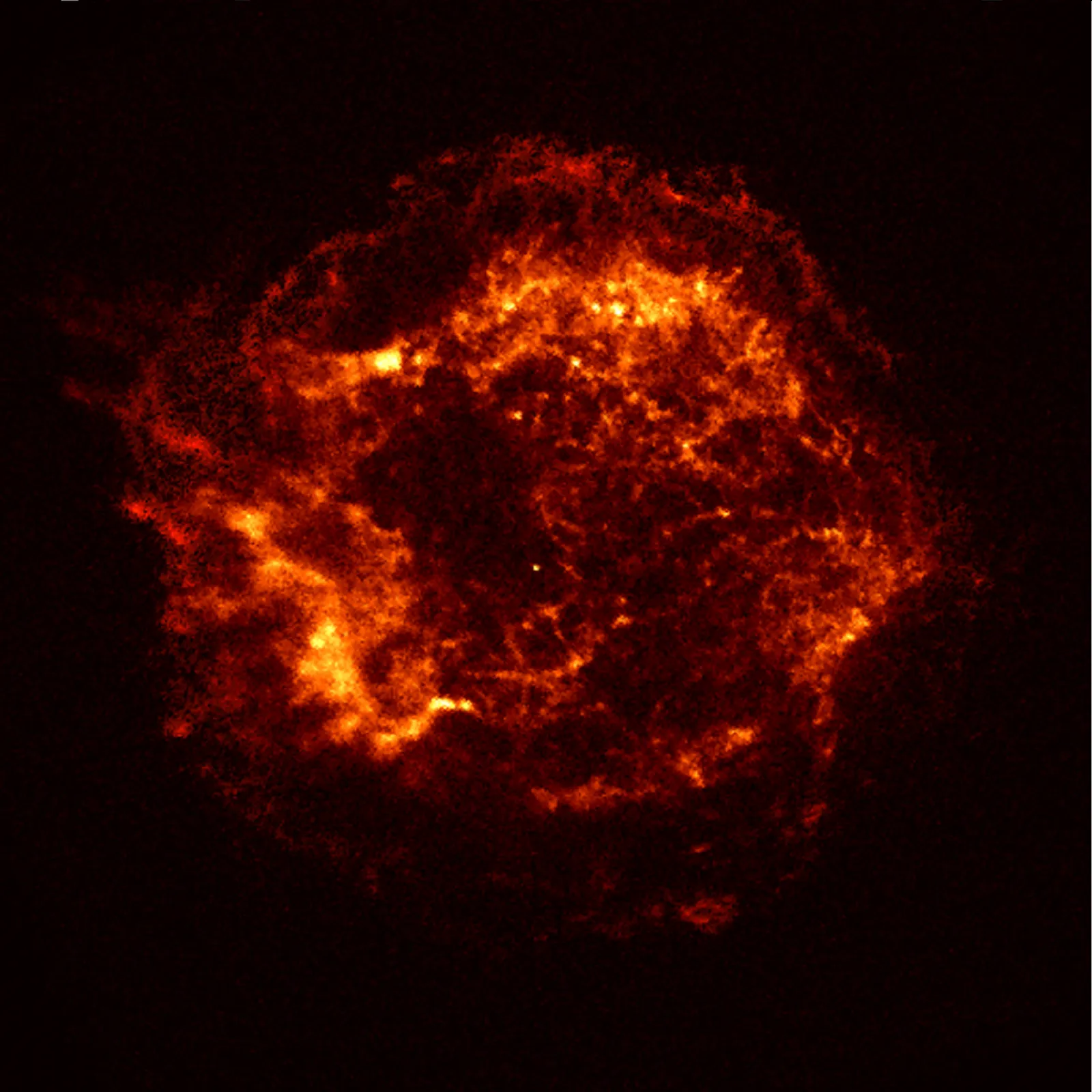
Gravitational waves are usually associated with mergers of black holes or neutron stars — short, powerful bursts that detectors like LIGO and Virgo have already learned to catch individually. But the Universe constantly generates another kind of signal too: a continuous, combined hum from millions of sources that are each too faint to detect on their own. This stochastic gravitational wave background (SGWB) carries information not about a single event, but about the collective history of an entire class of processes across the Universe. A new study focuses on one such background — the one produced by core-collapse supernovae.
Modeling the Supernova Background
The authors used an extensive collection of three-dimensional, multi-second computer simulations of stellar core collapse — some of the most detailed models of supernova explosions available today. Unlike simplified one-dimensional models, three-dimensional simulations capture turbulence, convection, and asymmetries in the flow of matter and neutrinos inside the collapsing star. These very asymmetries are what generate gravitational waves.
By summing the contribution from every supernova that has occurred or will occur throughout the observable Universe, the researchers derived the expected characteristics of the background signal — its spectrum, meaning the distribution of energy across frequencies.
Two Sources of the Signal: Neutrinos and Matter
It turns out the supernova background consists of two distinct components, arising from different physical processes.
The first component lies at low frequencies, roughly 0.01–1 Hz. Its source is anisotropic neutrino emission during the explosion. When a star's core collapses, an enormous number of neutrinos are released into the surrounding space, but their flow isn't uniform in all directions. This asymmetry produces what's known as gravitational wave memory: after the wave passes, spacetime's geometry doesn't fully return to its original state — it retains a slight permanent shift, "remembering" the asymmetric neutrino burst.
The second component sits at much higher frequencies, above 100 Hz, and arises from matter dynamics near the newly formed core — turbulent motion, convection, and instabilities in the hot layer of matter surrounding the freshly born neutron star or black hole.
Why the Memory Component Matters
Of the two components, the low-frequency "neutrino" one offers the best detection prospects. Its characteristic peak falls around 0.1 Hz — precisely the range where future space-based gravitational wave detectors are expected to operate (successors to ground-based instruments like LIGO and Virgo, which are sensitive to higher frequencies).
The most intriguing result concerns the amplitude of this signal. At its peak, the energy density of the supernova background could be comparable to that of other hypothetical gravitational wave backgrounds — ones predicted by models of slow-roll inflation in the earliest moments of the Universe, or backgrounds from possible cosmological relics dating back to very early epochs.
The memory component offers the best prospects of detection, as its characteristic peak at f∼0.1 Hz is within the reach of future space-born detectors
This means the supernova background could potentially mask or distort the search for far more fundamental signals — ones that might reveal physics of the early Universe. The authors explicitly note that this needs to be accounted for in future searches for such cosmological signals.
What Comes Next
The study shows that before drawing conclusions about the origin of any faint background signal near 0.1 Hz, researchers will need to account for and subtract the contribution from supernovae. This resembles the situation in direct dark matter detection, where neutrino signals create a so-called "neutrino fog" — background noise that can't be fully eliminated and through which experiments must "see" to find their actual target. It seems a similar "fog" is now emerging in gravitational wave astronomy as well — and future space observatories will need to learn to see through it.