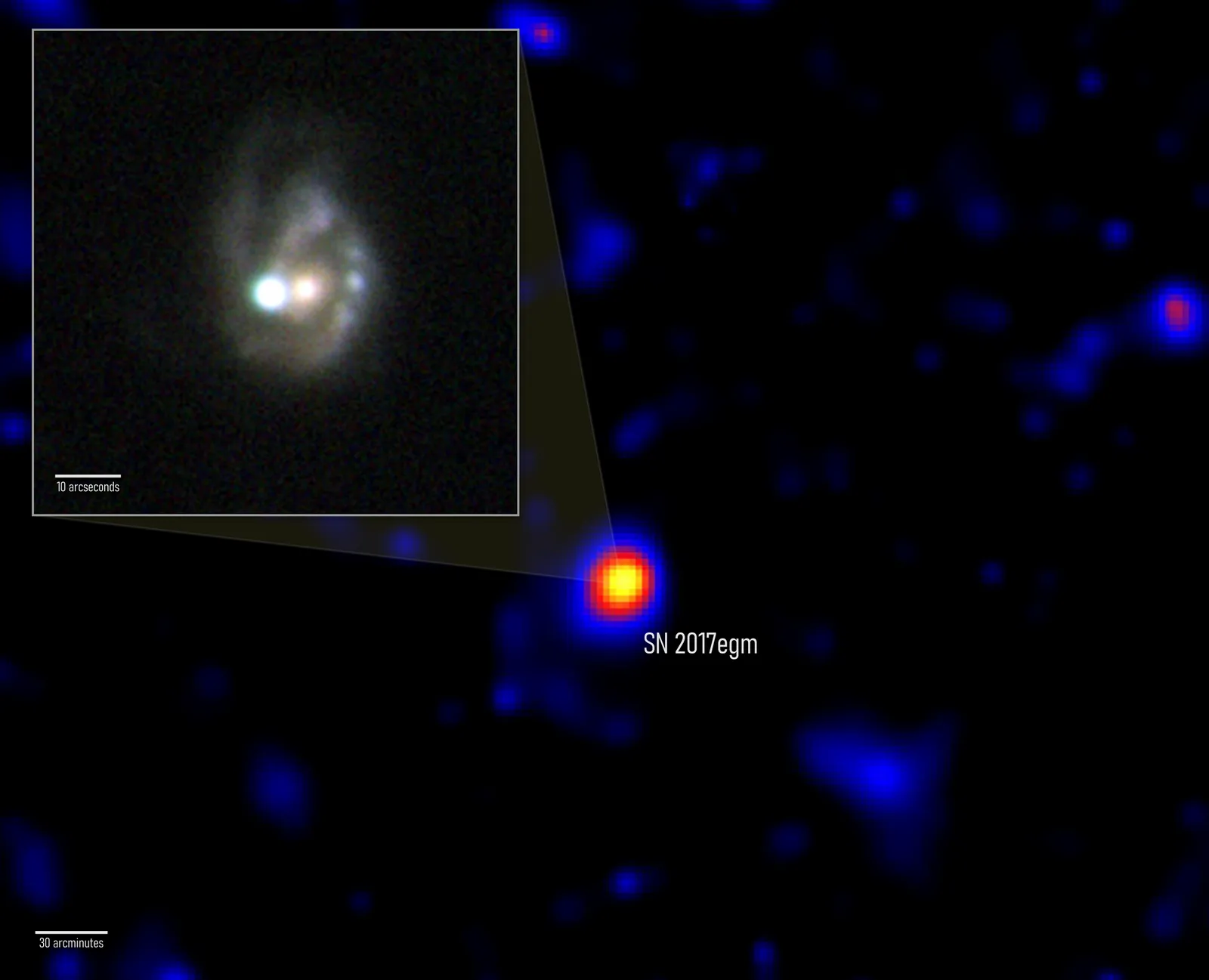
For nearly two decades, NASA's Fermi Gamma-ray Space Telescope has been scanning the sky for gamma-ray signals from supernovae. Astronomers checked thousands of these explosions, and only occasionally found hints that didn't hold up under closer scrutiny.
Now an international team led by Fabio Acero at the French National Centre for Scientific Research (CNRS) and the University of Paris-Saclay reports the first definitive detection. It comes from SN 2017egm, a rare explosion that shone tens of times brighter than a typical supernova. The findings are published in Astronomy & Astrophysics.
The nearest superluminous explosion on record
SN 2017egm was discovered by the European Space Agency's Gaia mission on May 23, 2017. The explosion occurred in NGC 3191, a massive barred spiral galaxy in the constellation Ursa Major, located about 440 million light-years from Earth.
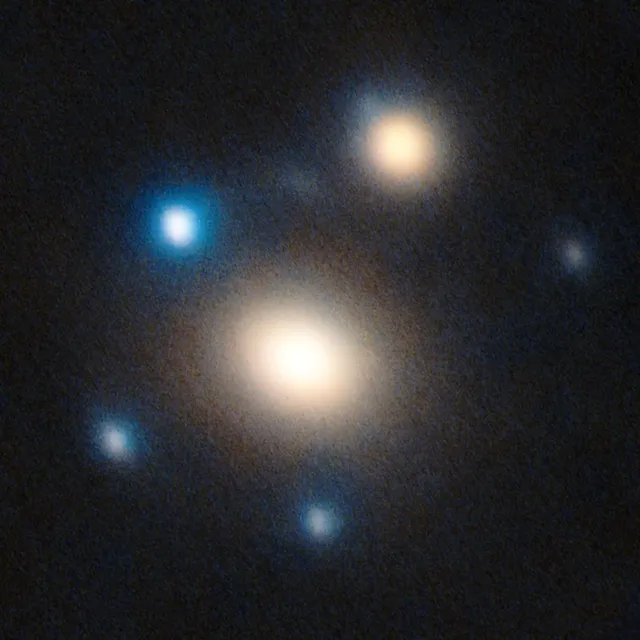
An image taken just weeks after the outburst shows the supernova outshining its entire host galaxy. That's a hallmark of the category astronomers call superluminous supernovae — explosions that produce 10 or more times the visible light of a normal stellar collapse.
Roughly 400 such events have been catalogued over the past two decades. SN 2017egm remains one of the closest, which made it possible to study its gamma-ray emission in detail. Back in 2024, a study led by Li Shang at Anhui University in Hefei, China, first flagged possible gamma-ray hints from this supernova in Fermi data.
The new work goes further. Researchers searched for gamma rays from the six nearest superluminous supernovae observed during the first 16 years of the Fermi mission. Only SN 2017egm showed evidence of gamma-ray emission with sufficient statistical confidence.
"This confirms earlier hints that some supernovae can be as luminous in gamma rays as they are in visible light. This opens up a new window for studying these fascinating events," said Guillem Martí-Devesa, a researcher at the Institute of Space Sciences in Barcelona, previously at the University of Trieste.
Tracking a magnetar beneath the debris
The central puzzle of superluminous supernovae is where their extra energy comes from. The leading hypothesis points to the birth of a magnetar — a neutron star with an extraordinarily powerful magnetic field.
Magnetars carry fields roughly 1,000 times stronger than those of typical neutron stars, and 10 trillion times stronger than a refrigerator magnet. A newborn magnetar spins hundreds of times per second, and that rapid rotation drives a powerful outflow of electrons and positrons, the antimatter counterpart of electrons.
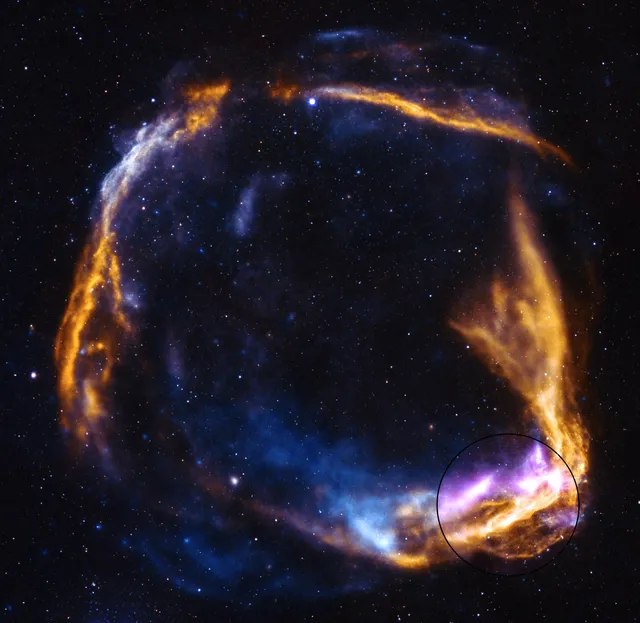
These particles form a cloud around the star known as a magnetar wind nebula. A similar structure exists in the Crab Nebula, where a pulsar born in a supernova observed in 1054 spins about 30 times per second and powers particle outflows visible in images from the Chandra and Webb telescopes.
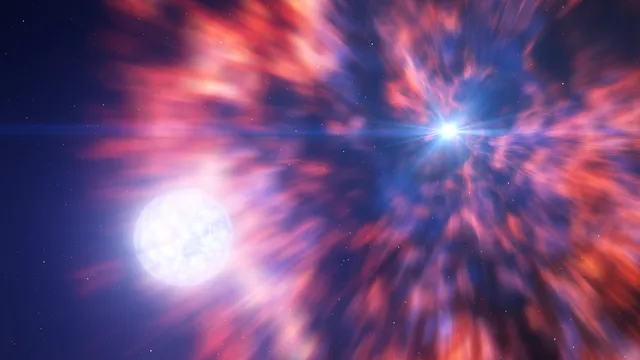
Inside such a nebula, gamma rays repeatedly interact with particles and supernova debris: an electron and a positron can annihilate into a pair of gamma-ray photons, and two gamma rays can collide to produce a new particle pair. Through these processes, the radiation can't escape directly — it gets reprocessed into lower-energy visible light, giving the supernova its extra luminosity boost.
The team compared SN 2017egm's observed optical and gamma-ray features with a model developed by Indrek Vurm at the University of Tartu in Estonia and Brian Metzger at Columbia University in New York. The model traces how light and particles from a newborn magnetar move outward through the expanding debris.
"About three months after the collapse, as the supernova debris expands and cools, the gamma rays can begin to leak out," Acero explained. That's exactly the signal Fermi detected between July 5 and October 25, 2017 — from 43 to 155 days after the supernova's discovery.
According to the researchers, the magnetar model reproduces the supernova's luminosity and the timing of its gamma rays well during the first months, but struggles to explain the irregular fading of visible light at later stages. The team suggests additional processes may have contributed, including debris falling back onto the magnetar and the blast wave colliding with material the star had shed centuries before its collapse.
What the Cherenkov Telescope Array could reveal
The researchers also assessed how well a new ground-based facility, the Cherenkov Telescope Array Observatory, could detect events like SN 2017egm. With about 50 hours of observing time, it should be able to spot similar explosions out to roughly 500 million light-years.
That reach would extend well beyond what's currently practical for space-based gamma-ray telescopes and could significantly expand the sample of such rare events.
The magnetar central engine mechanism discussed in this paper builds upon a lot of observational and theoretical advances in magnetars over the last 20 years. Observing gamma rays from supernovae will give us a new way to explore their inner workings.Judy Racusin, deputy project scientist for the Fermi mission, NASA Goddard Space Flight Center
Combining data from ground-based facilities like CTA with NASA's fleet of space observatories monitoring rapid changes across the universe should give astronomers a clearer picture of what actually happens inside a supernova in the moments after a neutron star is born.