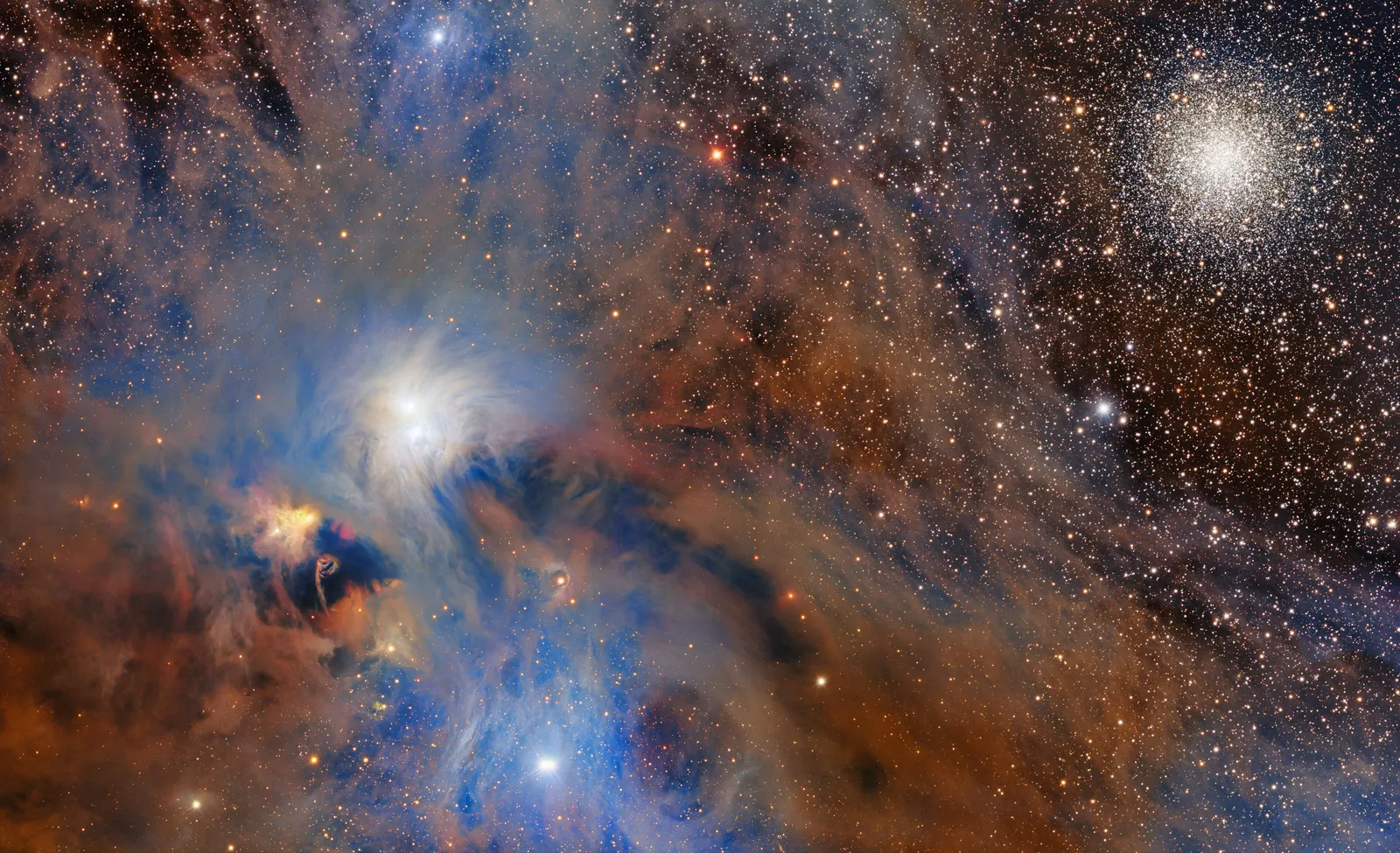
In the constellation Corona Australis, low on the horizon for observers at mid-northern latitudes, lies a patch of sky that astronomers liken to a Van Gogh canvas. A young stellar nursery, a dual nebula, and a distant globular cluster all appear together in one frame, captured by the Dark Energy Camera (DECam) mounted on the 4-meter Víctor M. Blanco Telescope in Chile.
Corona Australis is Latin for "Southern Crown." Within its borders lies one of the closest active star-forming regions to the Sun — the Corona Australis Molecular Cloud, roughly 430 light-years away.
DECam: 570 megapixels built to hunt dark energy
DECam wasn't designed for pretty pictures — it was built for the Dark Energy Survey, a large-scale sky survey aimed at studying dark energy. The instrument was constructed and tested at Fermilab, funded by the U.S. Department of Energy.
Its specifications make extremely detailed imaging possible: 570 megapixels, 74 detectors, and a lens nearly a meter across (3.3 feet). The camera sits on the 4-meter Blanco Telescope at Cerro Tololo Inter-American Observatory (CTIO) in Chile, operated by NOIRLab. That resolution is what let a single frame capture both a relatively nearby nebula and a star cluster tens of thousands of times farther away.
A binary star in an orange cloud shapes NGC 6729
Tucked inside a small glowing orange cloud at the edge of the frame is the binary system R Coronae Australis. Its two stars orbit each other every 43 to 47 years.
The primary is a pre-main-sequence star — it has gathered almost all of its mass but hasn't yet begun fusing hydrogen in its core, roughly the stellar equivalent of adolescence. In 2019, its companion was identified as a red dwarf, the least massive yet most common type of hydrogen-fusing star, known for burning cooler and living far longer than hotter, more massive stars like the Sun.
The young star is hot and bright. Its light reflects off surrounding clouds of material, creating what astronomers call reflection nebulae, while its ultraviolet radiation ionizes the surrounding gas, producing an emission nebula. Together these two components form the dual nebula NGC 6729, whose brightness and shape shift as the binary system moves within it.
Tracing the cloud further up and to the right reveals the reflection nebulae NGC 6726 and NGC 6727 — swirls of blue gas glowing from embedded newborn stars. These extend down to another reflection nebula, IC 4812.
Cluster NGC 6723 only looks like a neighbor
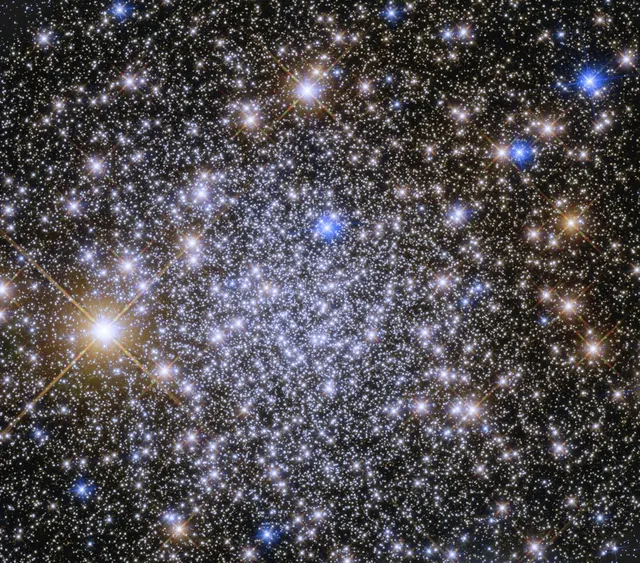
In the upper right of the frame glows the globular cluster NGC 6723, nicknamed the "Chandelier Cluster." It's a gravitationally bound sphere of tens of thousands to millions of stars, notable for its unusually large share of younger members.
At first glance it appears to sit right next to the molecular cloud. In reality it lies much farther away — about 29,000 light-years from Earth, more than 60 times the distance to the cloud itself. The apparent closeness is simply a trick of projection on the sky.
Because of its position, Corona Australis skirts the southern horizon during summer for mid-northern observers and is far better placed from more southerly latitudes. That's part of why both the molecular cloud and the Chandelier Cluster remain favorites among astrophotographers, who wait for the season when this stretch of sky climbs high enough to shoot.