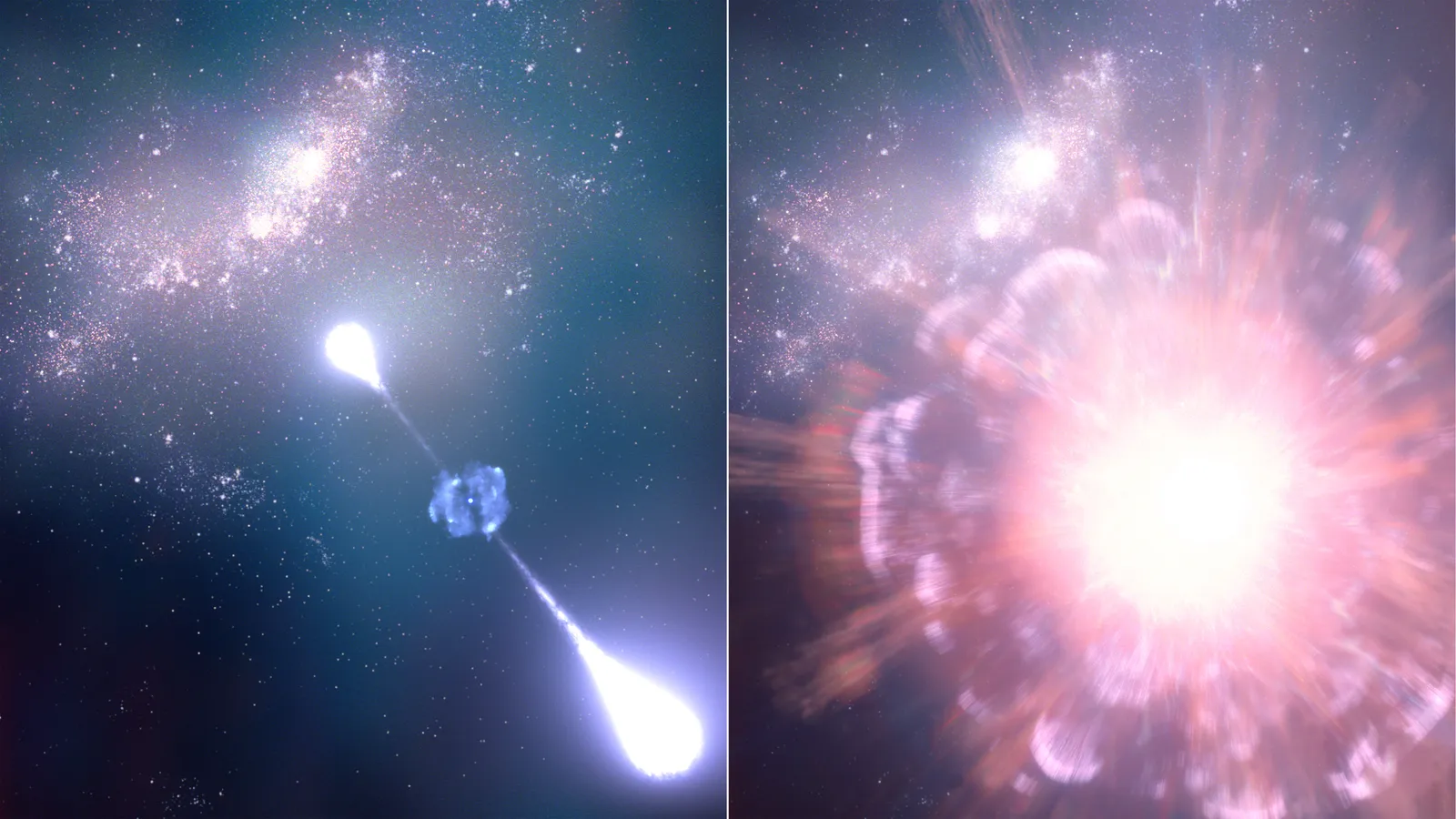
Gamma-ray bursts rank among the brightest events in the universe, releasing in a fraction of a second as much energy as the Sun emits over billions of years. Most long-duration bursts, lasting more than two seconds, are thought to result from the collapse of massive stars that leave behind a black hole or neutron star. Direct evidence for this connection comes from detecting a supernova at the burst site days or weeks later. A team led by Andrew Levan has now captured exactly such an event at a record distance.
The burst, designated GRB 250314A, was first detected by SVOM (Space-based multi-band astronomical Variable Objects Monitor), a French-Chinese satellite built specifically to hunt for these brief flashes. Follow-up spectroscopy pinned down its redshift precisely at z ≃ 7.3. That places the event roughly 700 million years after the Big Bang, deep within the epoch of reionization, when the first generations of stars and galaxies were clearing away the fog of neutral hydrogen that filled the early cosmos.
Separating the galaxy from the afterglow
Observations with the NIRCam instrument aboard the James Webb Space Telescope revealed two components at the burst location: a faint blue host galaxy and the fading light of the explosion itself. The galaxy's blue color is typical of systems at z ∼ 7 — young, compact, actively forming stars.
Disentangling the galaxy's contribution from the supernova's is no small task, since both sources appear as barely resolved points of light at such distances. The team modeled the observed data as a combination of two components and found it matched well with a faint host galaxy plus a supernova with luminosity comparable to SN 1998bw, the benchmark object for GRB-associated supernovae.
The researchers also drew on ground-based follow-up, including the HAWK-I instrument on ESO's Very Large Telescope at Paranal Observatory, to cross-check the results and reduce uncertainty in separating the two components.
Why the afterglow's color rules out brighter scenarios
One key piece of evidence is the color of the burst's afterglow. It came out blue, indicating low dust extinction along the line of sight. This matters because dust can significantly distort an object's measured brightness — heavy extinction could hide a supernova that is actually much brighter than it appears.
Because the extinction was low, the team could rule out a supernova substantially brighter than SN 1998bw. At the same time, they cannot exclude the possibility that the actual supernova was somewhat fainter than the benchmark, if the host galaxy contributes more to the total light than assumed in the model.
What this means for stars in the early universe
The study's central conclusion concerns not the supernova itself but the star that produced it. By the team's estimate, the progenitor of GRB 250314A was likely not much more massive than GRB progenitors observed in much closer, local galaxies.
That is a striking result. Conditions in the early universe — a chemical composition nearly devoid of heavy elements, a different pace of star formation — were fundamentally different from those today. Yet the mechanism behind a massive star's collapse and explosion appears to have remained remarkably consistent across billions of years of cosmic history.
The findings were published in Astronomy & Astrophysics. Detections at such extreme distances remain rare, requiring a fortunate combination of JWST's sensitivity, rapid burst detection by satellites like SVOM, and precise spectroscopic redshift measurement. Each such case offers a test of how universal the physics governing the death of massive stars truly is, across vastly different epochs of the universe.