The Rapid Burster (MXB 1730−335) stands out among neutron stars. It is the only known neutron star that produces both Type I and Type II X-ray bursts. That makes it a key system for understanding how matter falls onto such objects.
Yet for nearly five decades one important piece was missing: its optical and infrared counterpart remained unidentified. New work based on observations with the James Webb Space Telescope and its NIRCam camera changes that. The paper is currently available as a preprint on arXiv. The source material does not mention peer review or a journal.
Where the Rapid Burster hides
The Rapid Burster resides in Liller 1, a dense stellar system rich in metals, meaning elements heavier than helium. Its core is crowded: many stars are packed into a small volume, and their light overlaps with that of the object being sought.
The second obstacle is dust. Interstellar extinction dims visible light toward Liller 1 by about 11 magnitudes. The magnitude scale is logarithmic: a difference of 5 magnitudes corresponds to a factor of 100 in brightness. So 11 magnitudes means dimming by roughly a factor of 25,000. In visible light, such an object is practically impossible to tell apart from its neighbours.
According to the authors, these two circumstances kept the Rapid Burster's counterpart hidden for almost fifty years.
What the NIRCam observations show
Dust blocks infrared light less than visible light, so an infrared telescope suits this task. NIRCam on JWST images the near-infrared range. The authors used images of Liller 1 and, for the first time, obtained an unambiguous counterpart to the Rapid Burster.
The object was caught in an X-ray active state, and its brightness varied strongly. In the F200W filter (wavelengths 1.755–2.227 μm) it faded by about 2.5 magnitudes, a drop in flux of roughly a factor of 10. The brightness also showed strong fluctuations on timescales of minutes.
What's new
Until now the Rapid Burster was well known in X-rays but lacked a reliable link to an optical or infrared source. Now there is one. The authors call it an "infrared anchor": it is clear which source in a crowded field corresponds to the Rapid Burster, and new measurements can start from it.
It also matters that the counterpart turned out to be variable. Rapid changes on minute timescales show that the system is active in the infrared.
What it means
At this stage researchers have the brightness and its changes. Little can be said yet about the donor star, which supplies matter to the neutron star. The source states explicitly that its spectral type remains to be determined.
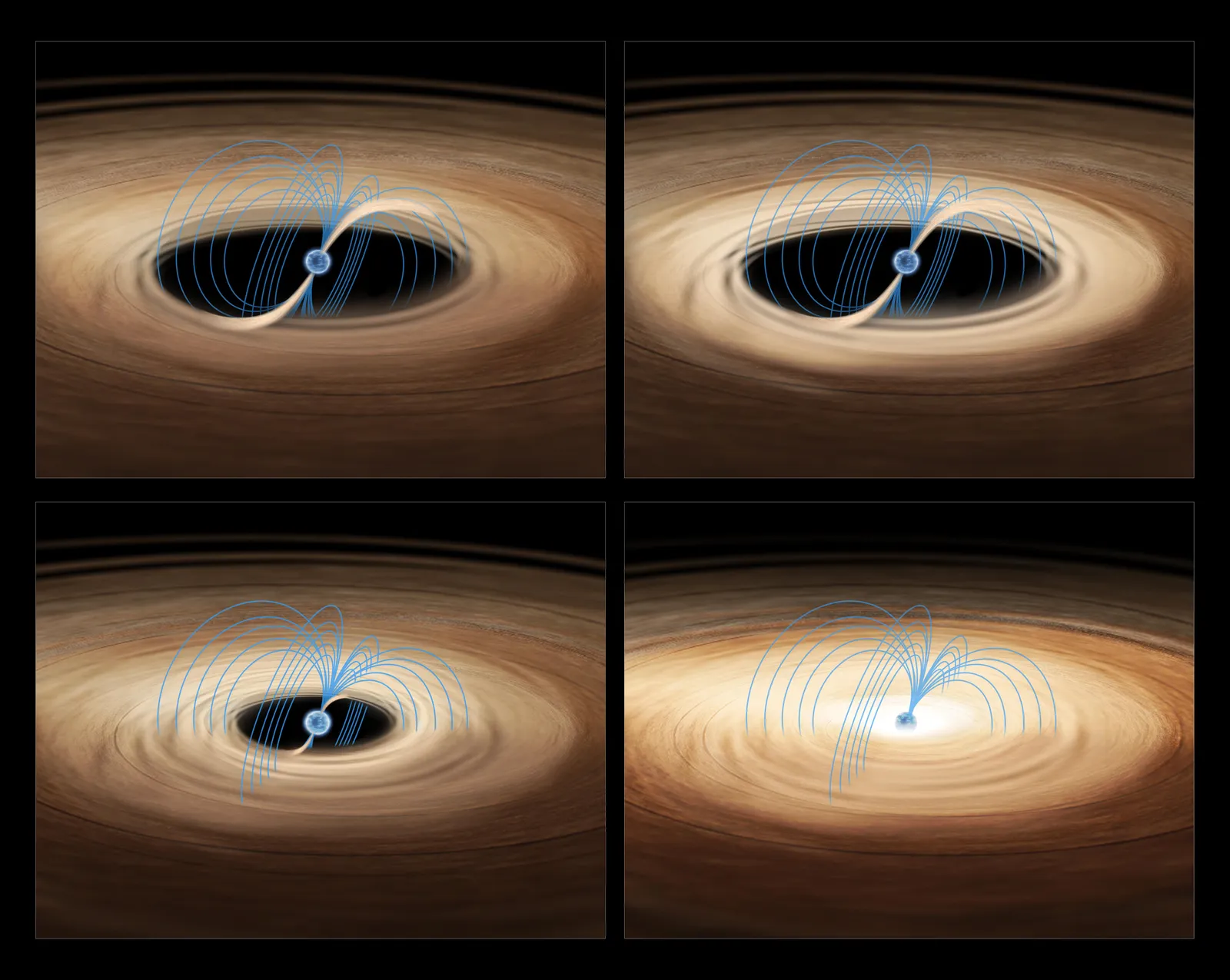
The authors point to two directions. The first is spectroscopy: splitting the light by wavelength should constrain the donor's spectral type. The second is simultaneous infrared and X-ray monitoring. Comparing how brightness changes in both bands at the same time should help clarify the physics of accretion, the fall of matter onto the neutron star.
So the result opens the way for new measurements rather than closing the question. But after nearly fifty years of searching, the Rapid Burster finally has a securely identified infrared counterpart.