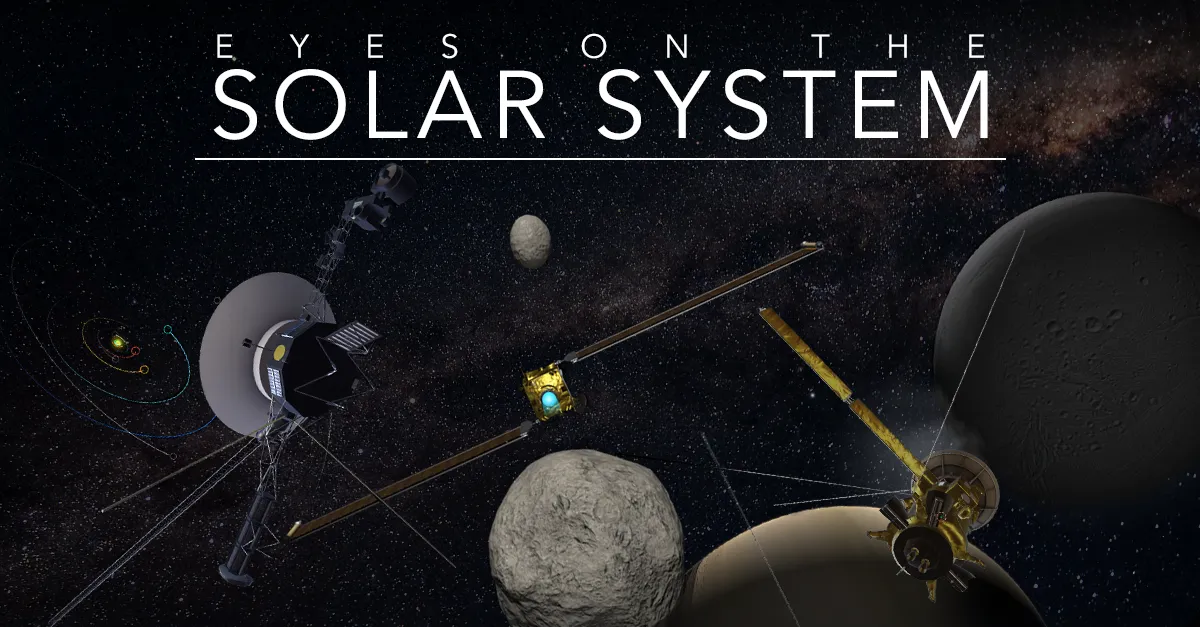
Eyes on the Solar System by NASA puts the entire Solar System in your browser: planets, moons, comets, asteroids and over 120 NASA missions, each moving along its real trajectory. The key instrument here is a time machine — a slider from 1949 to 2049. So instead of browsing menus, let's take a trip. Four stops.
Stop one: humanity's most distant object
Search for Voyager 1. It's the farthest human-made object: roughly 25 billion kilometers from Earth — a radio signal takes almost a full day to reach us. Now rewind to September 1977 and watch how it all began: launch from Earth, a gravity assist at Jupiter, a farewell flyby of Saturn — and an endless straight line out of the Solar System.
Stop two: July 14, 2015 — Pluto
Set the date to July 14, 2015 and find New Horizons. Nine and a half years of flight for a few hours with Pluto. You can inspect the spacecraft in detail and slow the animation down to seconds. These are the hours when humanity first saw Pluto's icy heart.
Stop three: Cassini's final day
Now September 15, 2017, Saturn. Cassini ends its twenty-year mission with a controlled plunge into the planet's atmosphere — so it could never accidentally seed Enceladus, with its ocean hidden under ice, with Earth microbes. Before the finale, rewind a little and watch the flight through the icy geysers of Enceladus — one of the boldest maneuvers in the history of spaceflight.
Stop four: the future
The slider works forward too. Set April 2030 and find Europa Clipper — a spacecraft already on its way to Jupiter, due to arrive right then. Its target is Europa, another ice world with a subsurface ocean. You can trace its whole trajectory: gravity assists at Mars and Earth, then the long arc to Jupiter.
Instead of a summary
Every trajectory here is not an artist's animation but real navigation data — the same math used at JPL. Runs in the browser, free, nothing to install.