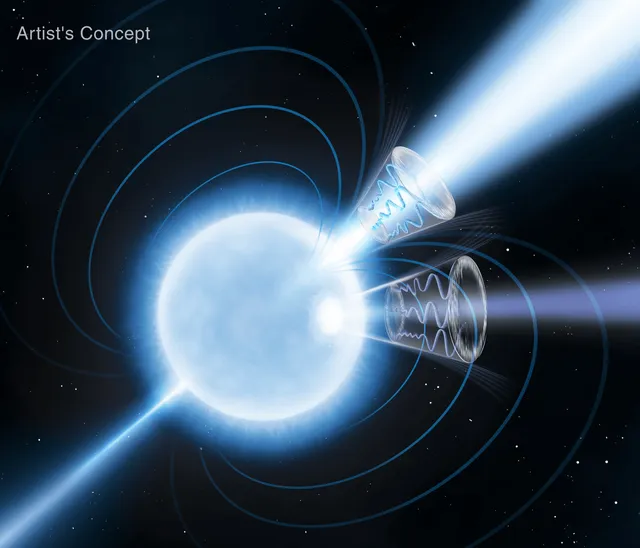
Millisecond pulsars are rapidly spinning neutron stars that complete hundreds of rotations per second. They don't reach this extreme spin rate on their own — a once-slow pulsar gets "spun up" by material pulled from a companion star in a binary system, a process astronomers call recycling. When the mass transfer ends, the companion typically becomes a white dwarf — the burnt-out remnant of a star stripped of its outer layers.
The trouble is that the moment right after recycling ends — an extremely brief phase of evolution — has rarely been observed directly. Most known pulsar companions are already "mature" white dwarfs that have had time to cool and stabilize. A newly identified object, NGC362D, offers a rare glimpse into exactly this transitional stage.
Hubble Observations and the Discovery of NGC362D
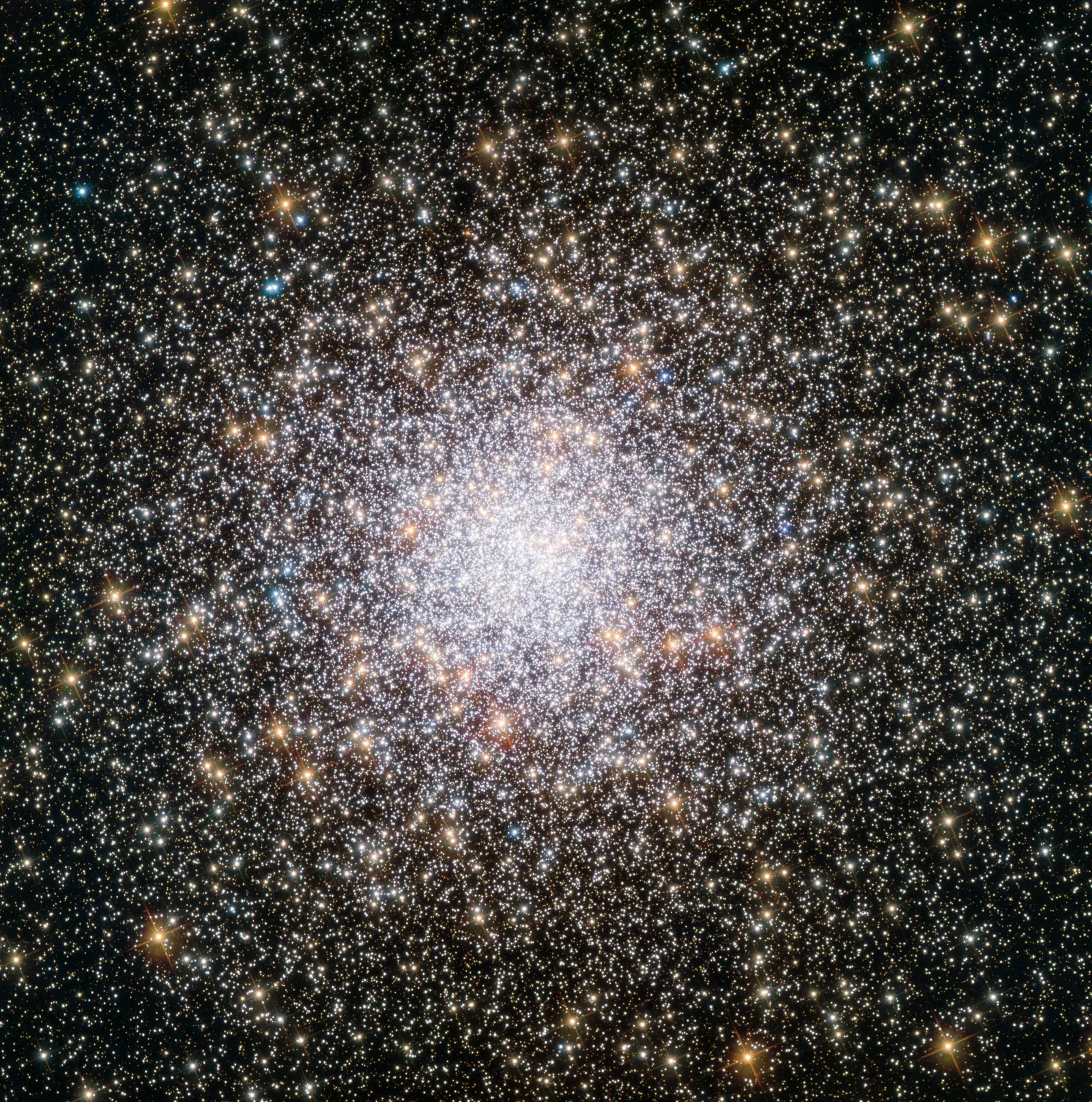
Researchers used deep, multi-band, multi-epoch images from the Hubble Space Telescope to locate the optical counterpart of a recently discovered millisecond pulsar in the globular cluster NGC 362 — a dense, ancient stellar grouping in our Galaxy. The multi-epoch observations allowed the team to track not only the object's position and color, but also how its brightness behaves over time and across different wavelengths.
Careful analysis of the photometric data — brightness measurements in different color filters — allowed the team to confidently determine the object's nature: it's a very low-mass helium white dwarf, roughly 0.18 solar masses. This is typical for companions of millisecond pulsars, which form from stars that lost nearly all their outer envelope to the pulsar.
The Youngest White Dwarf: Numbers and Physics
What makes this object especially notable isn't just its mass, but how young it is. White dwarfs normally follow a long cooling track, and their age can be estimated from temperature and luminosity. In the case of NGC362D, researchers found the object is still in a pre-cooling phase — meaning it hasn't yet begun the classical heat-loss process characteristic of mature white dwarfs.
Comparing the observational data with updated binary evolution models yielded a concrete estimate: the mass-transfer phase between the companion progenitor and the neutron star ended only about 0.6 billion years ago. For comparison, most known millisecond pulsar companions are billions of years old. This makes NGC362D the youngest white dwarf companion to a millisecond pulsar studied to date.
Leftover Material and the Risk of Misclassification
The most surprising finding is another one: the photometric properties of NGC362D show significant wavelength-dependent brightness variations — something never before documented in this class of object. The most likely explanation is that residual circumstellar material still surrounds the young white dwarf, not yet fully dispersed after the mass-transfer episode ended.
Residual material can produce radio and optical signatures that mimic those of systems with non-degenerate companions, potentially leading to the misclassification of young MSPs
This is an important methodological takeaway. If some millisecond pulsars in the early post-recycling stage are surrounded by leftover material, they could mimic the signatures of entirely different systems — for example, ones where the companion hasn't yet become a compact object. This means some cataloged systems might actually be similarly young pulsar–white dwarf pairs, simply misclassified due to misleading observational signatures.
NGC362D thus becomes a kind of benchmark case — a rare opportunity to directly trace what happens to a pulsar's companion right after the spin-up process ends, and to refine models of the early evolution of proto-white dwarfs.