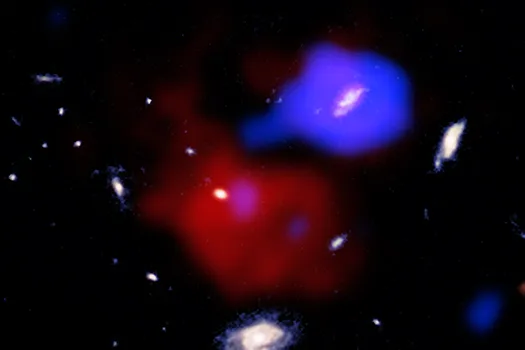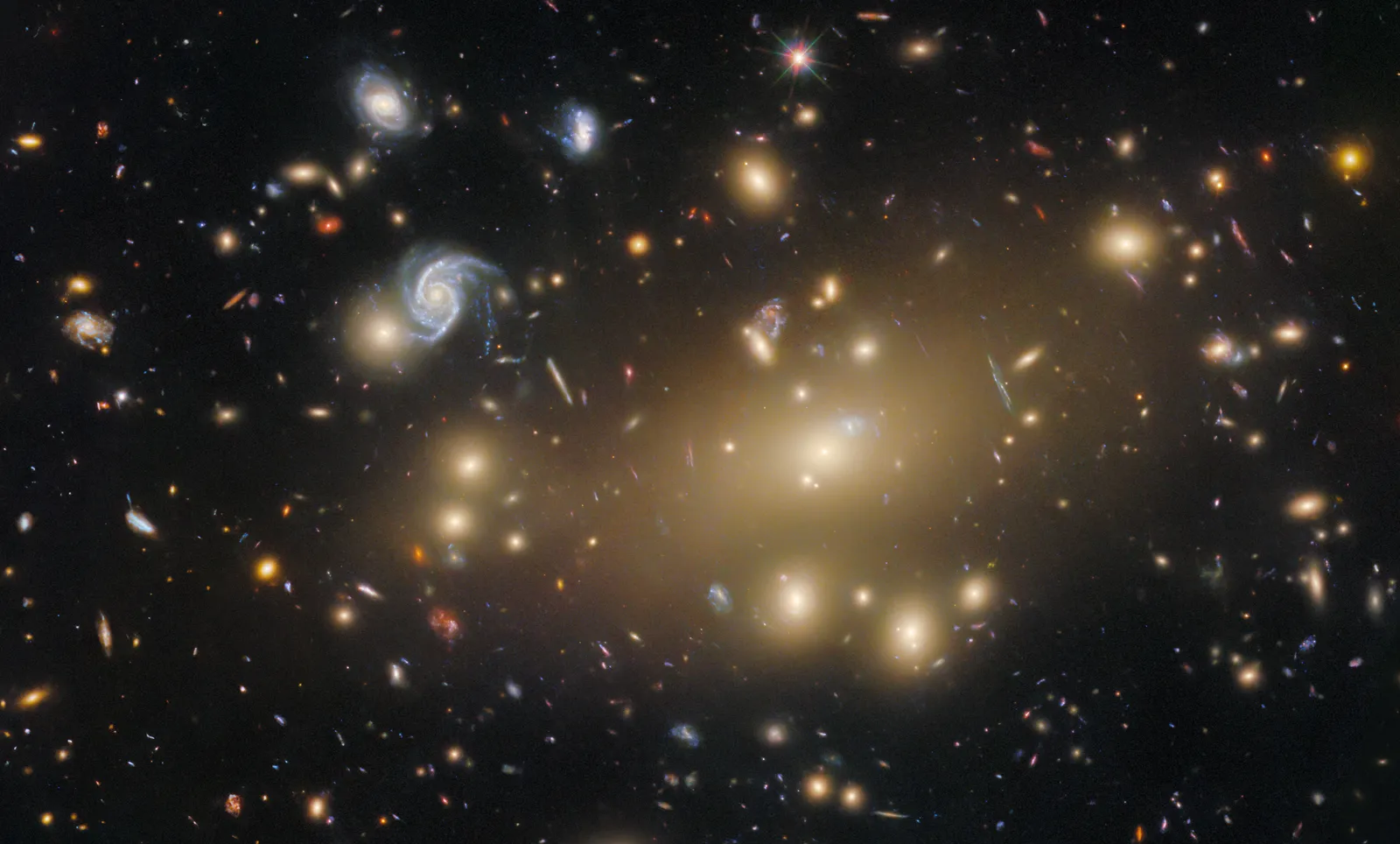
The XRISM X-ray observatory has caught unusually strong motions in hot gas near a quasar at the center of a galaxy cluster — a trace of how radiation from a black hole stirs up surrounding matter across tens of thousands of light-years.
H1821+643 is the nearest galaxy cluster hosting an active central quasar (the cluster sits at redshift z = 0.297). Such a pairing is rare: quasars and galaxy clusters are usually studied separately, but here astronomers had a direct chance to see how a black hole's radiation affects the gas around it.
High-resolution XRISM spectroscopy revealed strongly broadened iron emission lines (Fe XXV) in the cluster's hot gas. The velocity dispersion of the gas motion is roughly 300 km/s, far exceeding values seen in the cores of other nearby clusters. These motions trace back to radii of 20 to 100 kiloparsecs from the center — well beyond the boundaries of the quasar's host galaxy.
Assuming the turbulence stems from a quasar-driven shock, the energy injected into the gas beyond galactic scales amounts to 1-10% of the quasar's radiative energy. That is orders of magnitude higher than previous estimates from other methods (below 0.01%), and it matches the levels required by the latest cosmological simulations.
If this effect holds up in other objects, it would mean the impact of quasars on galaxy and cluster evolution in the early universe has been underestimated. For now it's a single case — but a well-chosen and telling one.