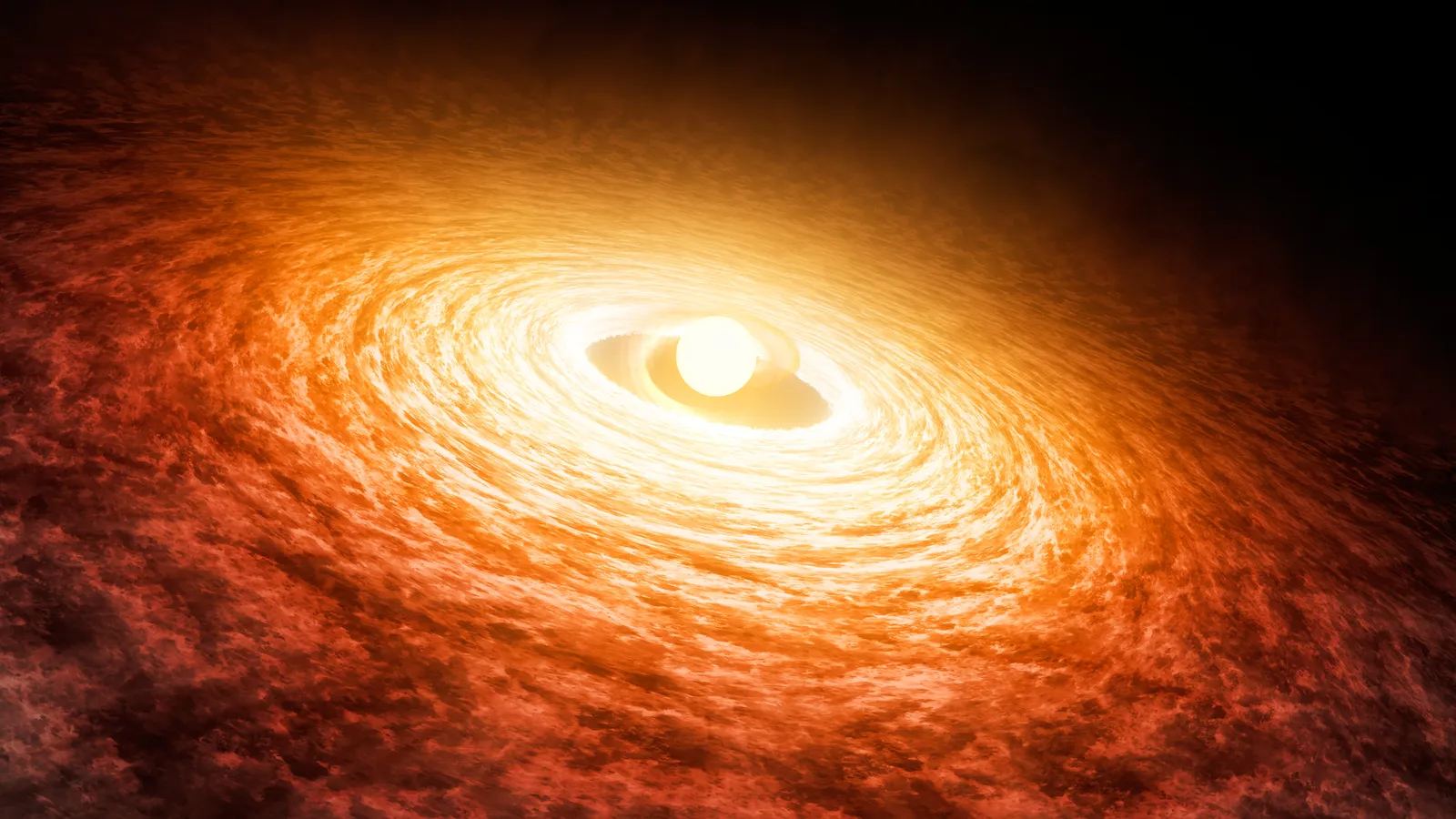
In a region where young stars are still forming, astronomers have found an object behaving with unusual regularity for such a young age. Gaia24ccy flared in 2019, faded, and then repeated almost the exact same sequence five years later. For researchers trying to understand why young stars suddenly brighten, that kind of repeatability is a rare gift.
The study, accepted for publication in The Astrophysical Journal, describes the system in detail — from the light curve to infrared colors and spectral emission lines. Twenty-seven authors from observatories around the world combined their data to move beyond simply recording the outburst and toward explaining its physics.
Two stars instead of one
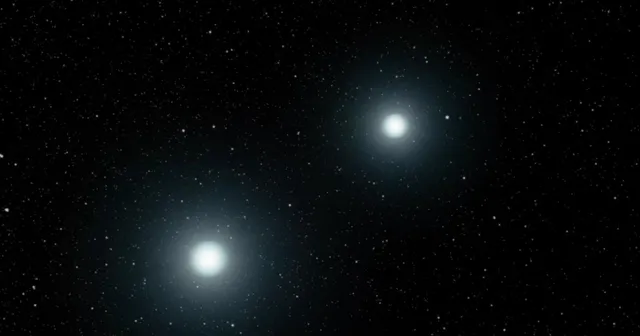
At first glance, Gaia24ccy looked like a single young star. In reality, it is a tight binary — two young stars orbiting so close together that no telescope can resolve them as separate points of light.
Both stars spin on their own axes extremely fast. Gaia24ccy A completes one rotation in 1.14 days, Gaia24ccy B in 1.79 days. Such rapid rotation is typical of young stars that haven't yet had time to slow down.
Data collected right before both outbursts began point to a specific culprit. Periodic brightness variations preceding each event match the rotation period of Star B. That makes B the source of both energy releases.
An outburst profile that repeated itself
The system's brightness rose by Δg ≈ 3.8 magnitudes — meaning the star became dozens of times brighter in visible light. Such a jump isn't unique among young stars of the EXor class, named after the prototype EX Lupi.
What stood out wasn't the outburst itself, but how precisely its profile repeated. Both times, brightness climbed at the same rate over the first 15 days. After that peak came a series of smaller sub-bursts — brief flare-ups against the overall decline — spaced 10 to 20 days apart.
The overall duration of the two episodes differed somewhat: the first lasted 145 to 255 days, the second stretched to 367 days. But the initial two weeks — the shape of the brightness rise — turned out nearly identical both times. Such precise repetition of an outburst profile has never been documented in this class of objects before.
Where the energy comes from
The outbursts are driven by accretion — material from the protostellar disk falling onto the star's surface. The disk is made of leftover gas and dust from the star's formation, and it continues to feed its growth.
Researchers estimated the region of the system where the instability triggering the outburst originates: roughly 0.019 to 0.047 astronomical units from the star, or 5 to 12.3 stellar radii. For scale, one astronomical unit is the average Earth-Sun distance, so this region is dozens of times smaller.
Each outburst delivers roughly 10⁻⁵ solar masses of material onto the star — an amount that a compact reservoir in the disk's inner region could plausibly supply between episodes.
The authors propose a hybrid trigger model. The timescales of the brightness rise and decay, along with the evolving mid-infrared color, point to a thermal-viscous instability in a hot inner disk. At the same time, the appearance of rich emission-line spectra during the outburst suggests simultaneous compression of the star's magnetosphere. Both mechanisms, in other words, appear to be operating together rather than separately.
The reddening of the mid-infrared color during the outburst is explained as competition between emission from the viscous disk and emission from the star's own photosphere. Why the second episode mirrored the first so closely remains an open question — and it's exactly what makes Gaia24ccy a priority target for future observations.