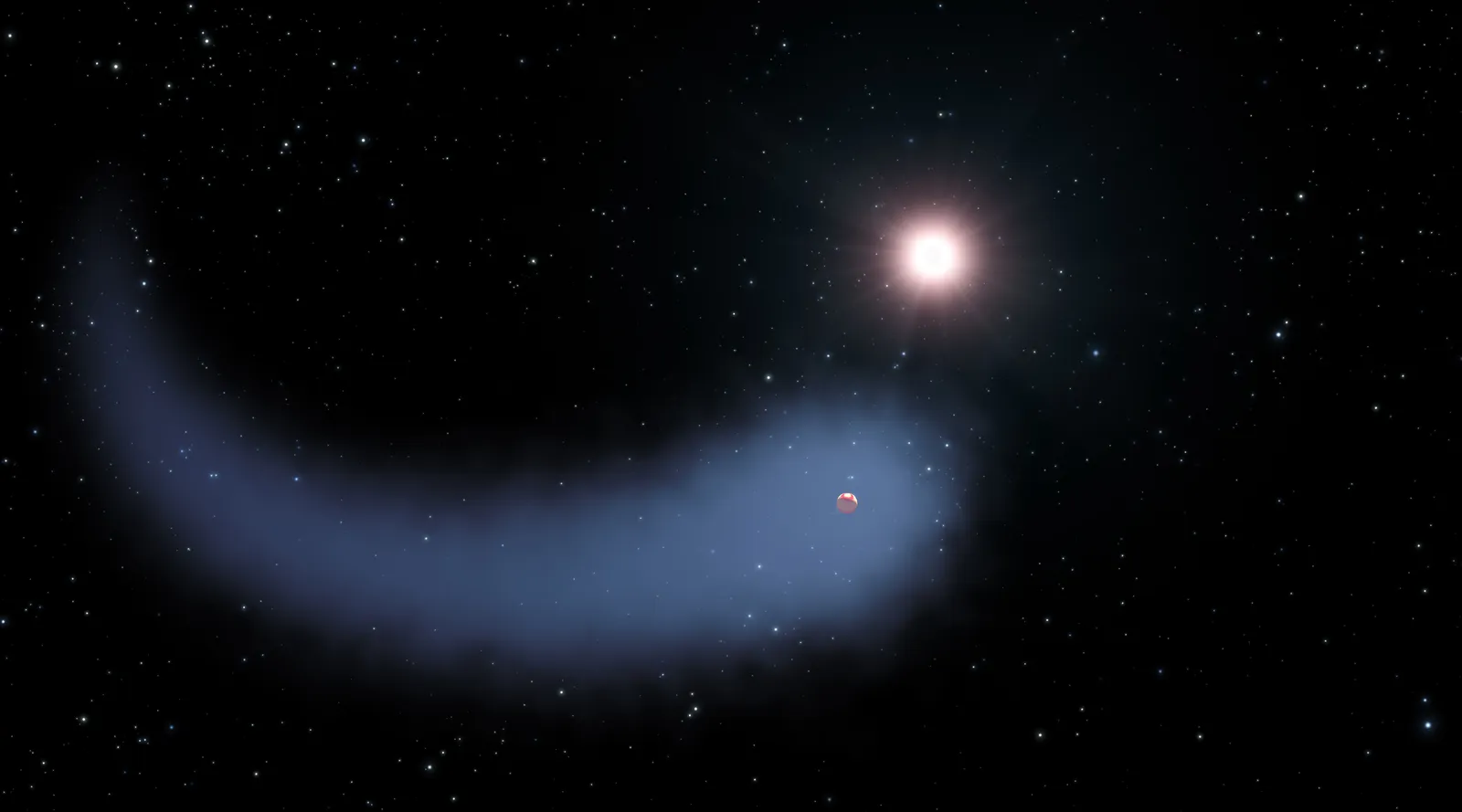
GJ 436 b orbits a red dwarf star 33 light-years from Earth, in the constellation Leo. The planet is close in size to Neptune, but far hotter: its equilibrium temperature is around 670 kelvin (roughly 400°C). It has been studied for over a decade, and until recently its atmosphere seemed reasonably well understood.
New observations from the Keck II telescope in Hawaii are forcing a reassessment. A team of astronomers detected a faint but statistically meaningful signal from the planet's atmosphere — and it looks nothing like what previous studies had found.
A fiber against the background noise
The main obstacle in observing exoplanet atmospheres is background signal — from the sky, Earth's atmosphere, and the telescope itself. In the infrared, this noise can easily drown out the faint light of a distant planet.
The researchers used the KPIC instrument on Keck II. Its key feature is a single-mode optical fiber that starlight passes through before reaching the spectrometer. This filters out most of the sky background: in the L band (wavelengths of 2.91 to 3.85 micrometers), the team reduced the background by a factor of roughly 100.
That gain in sensitivity produced a signal from GJ 436 b with a signal-to-noise ratio of 3 to 4 — a tentative but workable cross-correlation detection against an atmospheric model.
A stratosphere where none was expected
The most surprising result is that the best-fitting model shows a thermal inversion: temperature rises with altitude instead of falling, as it typically does in the lower layers of planetary atmospheres. That is the signature of a genuine stratosphere, similar in principle to the one on Earth.
Careful analysis of the spectrum also points to the presence of water vapor, and possibly methane, appearing in emission rather than absorption.
This directly contradicts earlier results from JWST and from high-resolution transmission spectroscopy of the same planet, where these molecules showed up in absorption instead.
What the continuum is hiding
There is another puzzling detail. The maximum-likelihood model implies a continuum brightness for the planet that is substantially higher than expected, both from GJ 436 b's equilibrium temperature and from earlier low-resolution observations.
The authors attribute this to a quirk of the method itself: processing high-resolution spectra strips out most information about the absolute continuum level. The analysis remains sensitive to the shape of spectral lines but effectively blind to the planet's overall brightness. When the team rescaled the model to match the brightness measured in earlier low-resolution data, the detection held up with similar strength.
One possible explanation for the inversion itself is a haze layer in the planet's upper atmosphere, above which a warmer layer forms. What exactly heats this putative stratosphere remains an open question.
The authors note that confirming the result will require further observations, ideally taken after the planet passes behind its star, which would help separate the planet's orbital velocity from the system's overall velocity — two quantities that are currently partly degenerate in the model. The work also demonstrates that high-resolution L-band spectroscopy can be applied to planets much smaller and cooler than the hot Jupiters that have so far been the main targets of this technique.