A black hole in a magnetic field: theory tested on eight real sources
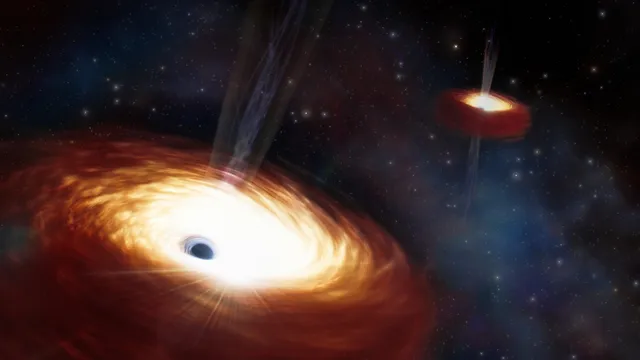
Researchers from Uzbekistan and China built a theoretical model of a rotating Kerr black hole embedded in a uniform Bertotti-Robinson magnetic field and tested it against high-frequency quasi-periodic oscillations — characteristic flickers in X-ray emission near black holes. The model was applied to eight known X-ray sources, including GRO J1655-40, GRS 1915+105, and Sagittarius A* at the center of the Milky Way, using Bayesian inference and Markov Chain Monte Carlo methods.
For four sources, the team obtained a nonzero magnetic field parameter at 68% confidence; for the rest, only upper limits. The field turned out to be weak but not negligible: it shifts particle orbits, moves the innermost stable circular orbit, and alters the accretion disk's temperature profile. This is a first step toward incorporating magnetic fields into precise black hole models tested against real observational data.
Where "dark matter" switches on — and why not everywhere
Astrophysicists Robin Eappen and Pavel Kroupa proposed a new classification of self-gravitating stellar systems that explains why the dark matter phenomenon shows up in some objects but not others. They introduced two indices: a MOND depth index, measuring how far a system's acceleration falls below the characteristic scale a0, and a dynamical maturity index, comparing a system's crossing time to its two-body relaxation time. The mass discrepancy appears only where both conditions hold at once.
Galaxies are slow-moving systems where stars rarely interact, so dark matter effects show up clearly there. Globular clusters and ultra-compact dwarf galaxies, by contrast, are dense, collisional, high-acceleration systems showing no mass discrepancy at all. The authors argue this division emerges naturally within the Milgromian dynamics (MOND) framework, an alternative to conventional dark matter.
One object, two "voices"
Researcher Santosh Arron applied machine learning techniques (UMAP and HDBSCAN clustering) to analyze 233 bursts from the hyperactive repeating fast radio burst FRB 20240114A, recorded by the FAST telescope. Of these, 45 formed a distinct subgroup with an average frequency drift rate of 245.6 MHz/ms versus 98.1 MHz/ms for the rest — 2.5 times faster — and also shorter in duration with slightly lower peak frequencies. The statistical separation between the two groups was reported as highly significant.
The author interpreted this as evidence for two spatially separate emission regions within the object's magnetosphere. However, it is important to note that this paper was later withdrawn by arXiv administrators for not meeting research quality standards, so the claim of "dual emitters" cannot currently be considered confirmed and requires independent verification.
Venus: 88% chance it once had a magnetic field
A team of planetary scientists built a computer model that simultaneously tracks Venus's atmosphere, crust, mantle, and core from formation to the present day. The model searched for scenarios consistent with the planet's known atmospheric composition of water and carbon dioxide and its current lack of a magnetic dynamo. The authors identified four plausible evolutionary pathways — from gradual monotonic cooling to a scenario with a small inner core or one with oscillating internal properties.
The key finding: in 88% of scenarios matching Venus's present state, the planet possessed a magnetic field in its past. In every plausible history, the mantle still holds at least one Earth ocean's worth of water, and volcanic activity continues today — challenging the idea of Venus as a geologically dead world. These predictions are testable by upcoming missions and the model can also be applied to exoplanets.
COSMOS2025: the largest JWST galaxy catalog is now public
An international team of astronomers has released COSMOS2025, an updated galaxy catalog for the COSMOS field, built from 255 hours of observations under the JWST COSMOS-Web program. The data span four NIRCam filters and one MIRI filter across roughly 0.54 square degrees of sky, combined with ground-based and other space telescope observations across 37 photometric bands in total.
The catalog provides photometry, morphology, photometric redshifts, and physical parameters for more than 700,000 galaxies, ranging from nearby systems to those existing within the first 500 million years after the Big Bang. Redshift accuracy is twice as good as in the previous catalog version. It stands as one of the most comprehensive resources for studying galaxy evolution across cosmic history and will underpin dozens of future studies.