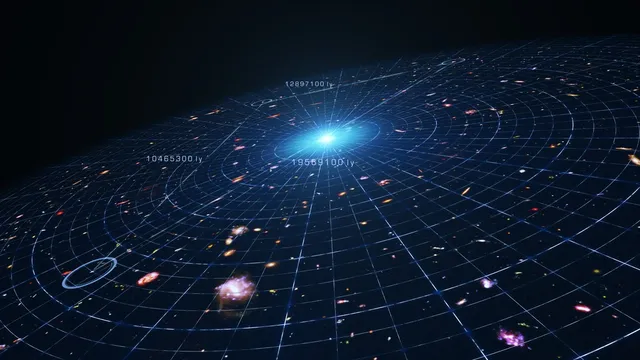
The expansion rate of the Universe, known to astronomers as the Hubble constant, should by now be measured with confidence after decades of observation. Yet two independent approaches — measuring distances to nearby stars and galaxies, and analyzing the cosmic microwave background — keep giving different numbers. The mismatch is larger than the measurement errors can explain, which means the problem runs deeper than simple imprecision. This is the Hubble tension, one of the most stubborn open questions in cosmology today.
The tool that might finally settle it did not exist twenty years ago: gravitational waves. These are ripples in spacetime produced when extremely massive, compact objects — black holes or neutron stars — spiral into each other and merge. The LIGO and Virgo detectors caught the first such signal in 2015, and the number of recorded mergers has been growing steadily since.
A Distance Reading With No Intermediate Rungs
The traditional way to measure distance to a faraway galaxy relies on a "ladder" of several rungs: parallax distances to nearby stars, then the brightness of Cepheid variable stars, then Type Ia supernovae, and so on. Each rung adds its own uncertainty, and those uncertainties stack up.
A gravitational wave sidesteps that ladder entirely. The shape of the signal — how its frequency and amplitude change during the merger — depends on the masses of the merging objects and on how much the signal weakened on its way to Earth. From that weakening, distance can be read off directly, with no intermediate calibration steps. That is why these sources are called standard sirens, echoing the "standard candles" astronomers have long used to gauge distance.
Distance alone, though, is not enough. Getting the Hubble constant also requires the recession velocity — how fast the source is moving away from us as the Universe expands. And velocity requires knowing exactly which galaxy the merger happened in.
One Bright Event, and a Great Many Dark Ones
In 2017, a merger of two neutron stars was observed simultaneously in gravitational waves and in light — the event known as GW170817. The accompanying flash made it possible to pinpoint the host galaxy, measure its recession speed, and derive an independent estimate of the Hubble constant. It remains the only event of its kind, a "bright siren."
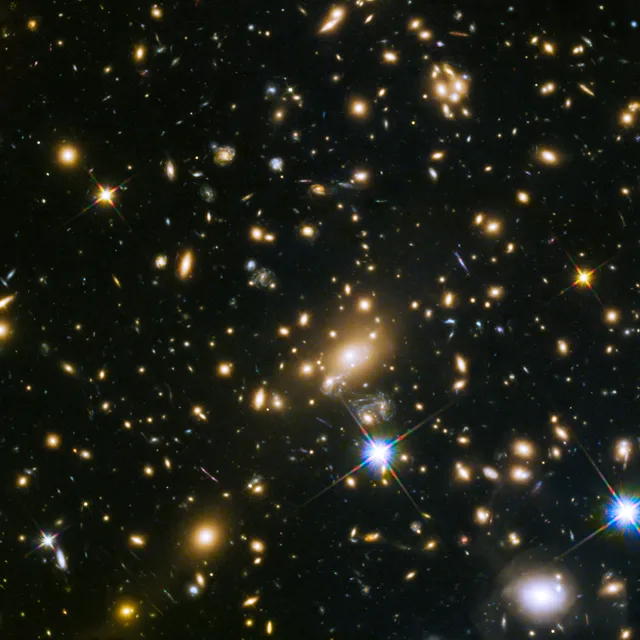
The trouble is that most black hole mergers produce no light at all — black holes carry no matter that could flare up. These "dark sirens" give a precise distance but no link to a specific galaxy. The gravitational-wave signal arrives from a broad patch of sky that may contain hundreds or thousands of candidate galaxies.
Cross-Correlation Instead of a Single Host Galaxy
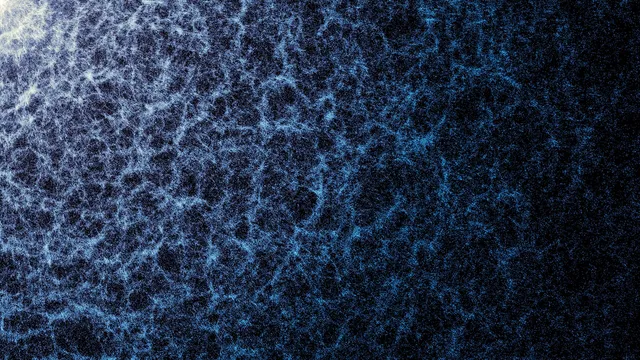
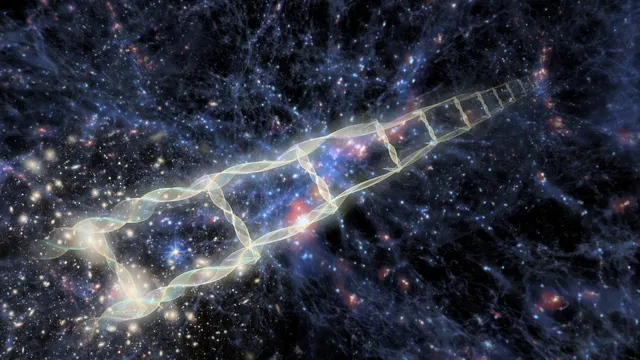
Rather than hunting for one exact host galaxy per event, researchers propose a statistical approach: match the sky positions of gravitational-wave events against galaxy catalogs and check whether the distribution of events correlates with the large-scale structure of the Universe — the cosmic web of galaxies, clusters, and voids that threads through all of space.
If dark sirens genuinely occur in galaxies distributed the same way as matter across the Universe, then the statistical link between events and galaxy catalogs can recover recession velocities without identifying an individual source for every single event.
A new study tested how robust this method is to practical choices: how to bin gravitational-wave events and galaxies in space, which statistic to use for counting correlations, and how to handle the fact that galaxy catalogs are always incomplete — no sky survey ever captures every galaxy down to the required depth.
The conclusion is cautiously optimistic. Given enough recorded events, the cross-correlation method can deliver a precise Hubble constant independent of any other measurement technique — neither the distance ladder nor the cosmic microwave background. As gravitational-wave detector networks expand and statistics accumulate, dark sirens may become an independent arbiter in a dispute that has so far resisted resolution.