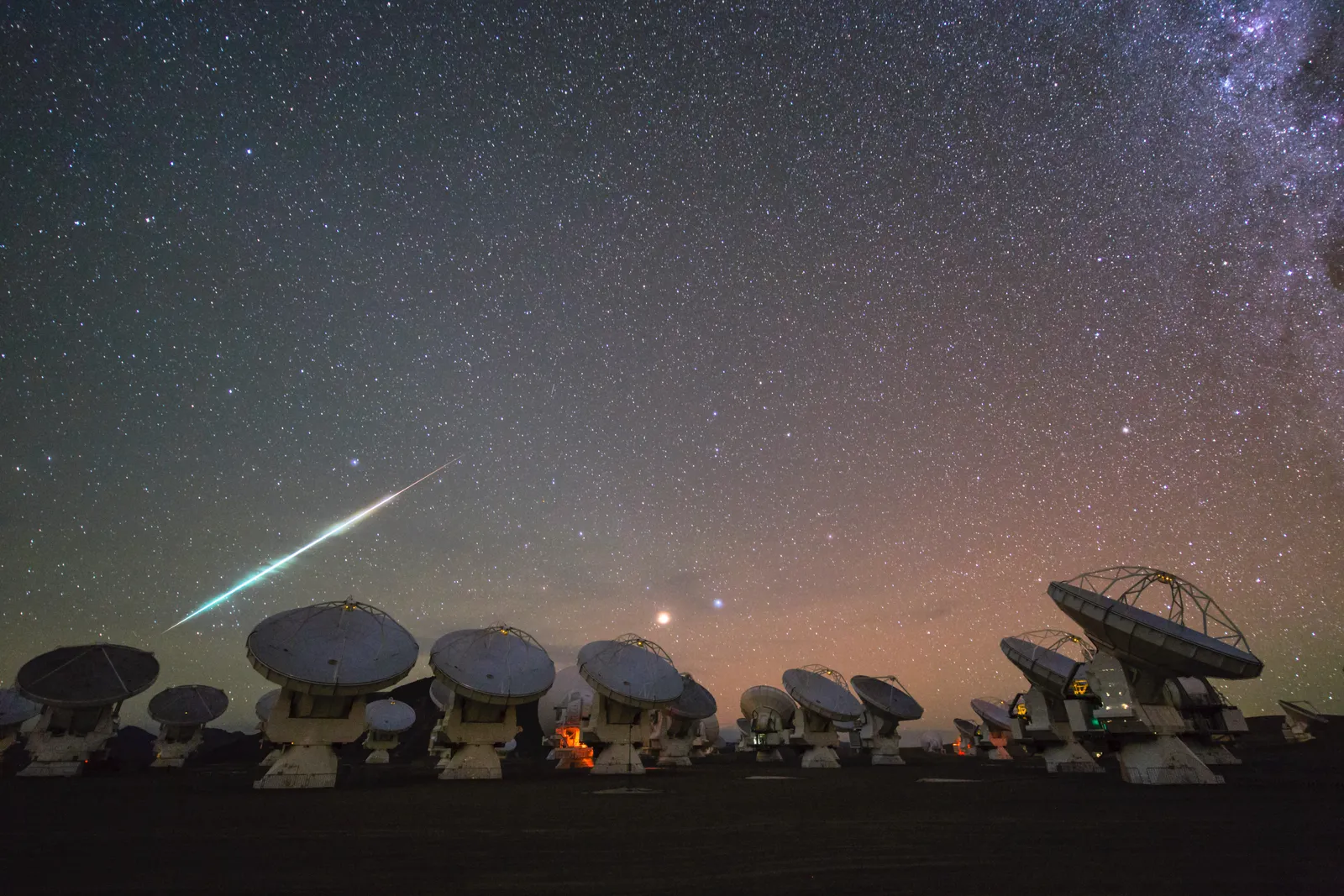
An asteroid on a collision course with Earth is not only a hazard — it is also a rare scientific gift. If astronomers catch it while it is still in space, they can trace the object's entire journey: from a small fragment of interplanetary debris, through a fiery streak across the atmosphere, to a meteorite recovered from the ground. Such bodies are called imminent impactors — objects already heading toward Earth, where the only open question is whether anyone spots them in time.
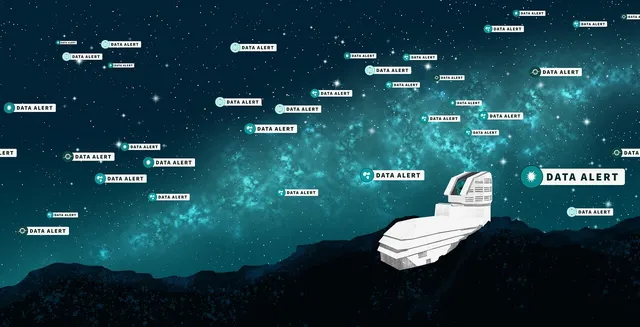
So far, such cases are rare. Only 11 objects have ever been detected before impact. A new study led by Ian Chow evaluates how this picture will change once the Legacy Survey of Space and Time (LSST) begins full operations at the Vera C. Rubin Observatory in Chile — a new telescope designed to repeatedly photograph the entire sky visible from the Southern Hemisphere.
Testing LSST against real fireballs
The researchers did not rely on abstract calculations. They used 343 real fireballs from NASA's CNEOS database — records of meter-size objects that entered Earth's atmosphere between 1994 and 2026. For each one, they modeled how its pre-impact trajectory would have appeared from Earth days before the collision, then checked whether LSST would have caught it.
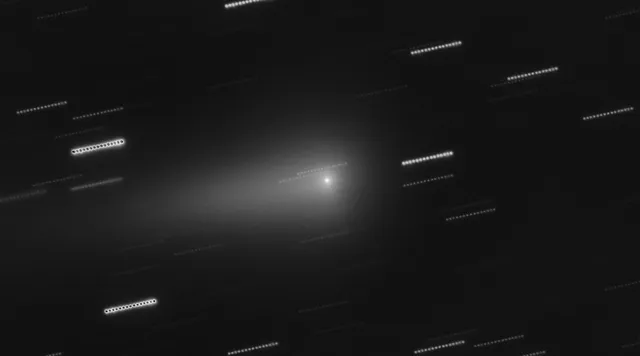
To simulate the observations, the team used Sorcha, a dedicated survey simulator that reproduces a telescope's actual observing schedule, camera sensitivity, and weather conditions. Two search strategies were tested. The first is LSST's default protocol, which flags an object as discovered only after it has been observed across three separate nights. The second is an experimental one-night strategy for fast-moving objects, which relies on matching aligned streaks captured in two exposures taken the same night.
Detection rates and warning times
The difference between the two strategies turned out to be substantial. Under the standard three-night protocol, LSST would detect about 14% of these objects; switching to the one-night strategy raises that figure to 28%. In absolute terms, this translates to roughly 1–2 meter-size or larger imminent impactors discovered per year — about 4% of all Earth impactors larger than one meter in diameter. That would nearly double the current discovery rate for this class of objects.
Warning times remain short. The median time between discovery and impact is about 1.57 days, while the median time from the first recorded observation to impact is around 3.06 days. That is not much, but it is enough to mobilize a global network of telescopes and cameras that can track the object from space, through atmospheric entry, down to fragments landing on the ground.
A Southern Hemisphere counterpart
One notable finding concerns geography. All 11 currently known imminent impactors were discovered by observatories located in the Northern Hemisphere — and, unsurprisingly, most of the resulting impacts also occurred there.
Simulations for LSST point to the opposite trend, shifting detections toward the Southern Hemisphere. Because the Rubin Observatory sits in Chile, it can cover parts of the sky that most existing northern asteroid surveys simply cannot reach.
This means Rubin will not just add to the discovery count — it will reshape the geographic coverage of near-Earth object monitoring, closing a gap that other telescopes are physically unable to fill.
What this means for planetary science
Each such discovery offers something that cannot be recreated artificially: a chance to follow one and the same object as an asteroid in space, a meteor streaking through the atmosphere, and finally a meteorite on the ground. Comparing data from all three stages lets researchers test models of how small Solar System bodies break apart on atmospheric entry and what they were made of beforehand.
LSST has yet to begin full operations, so these figures remain model-based predictions rather than confirmed results. But if they hold up, the survey could become a powerful tool for planetary defense — capable of giving timely warnings about objects that, until now, would simply have gone unnoticed.