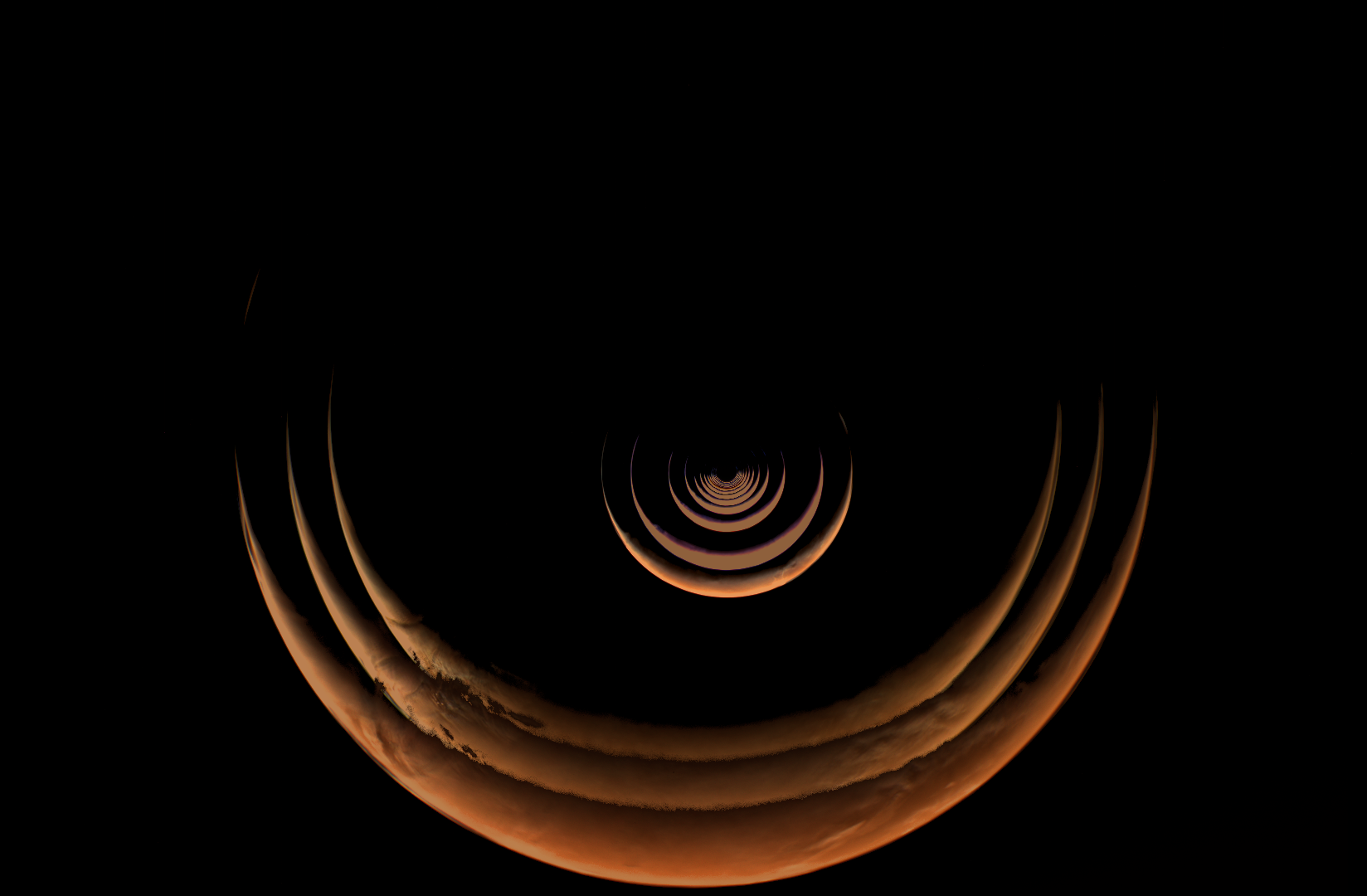
NASA’s Psyche spacecraft was never meant to study Mars — the planet was just a stop along the way to the mission’s real target. Yet that flyby produced an unusual sequence of images: a Martian crescent growing frame by frame.
The images were taken between May 2 and May 15, 2026, as Psyche approached Mars for a gravity assist. The composite arranges several frames so that the smallest crescent sits at the center, surrounded by progressively larger ones as the spacecraft drew nearer.
Why Mars showed up as a crescent, not a disk
The crescent shape isn’t an optical artifact or an imaging glitch. It comes down to the geometry of the flyby.
Psyche approached Mars at a high phase angle — from a side where most of the planet’s sunlit hemisphere faced away from the spacecraft’s camera. The camera could only see a thin strip of the surface catching reflected sunlight, while the rest of the disk stayed in shadow relative to the observer’s viewpoint.
It’s similar to how the Moon appears as a crescent from Earth on certain nights — except here the “observer” was a spacecraft rather than a planet.
The images were captured by Psyche’s multispectral imager, an instrument that records light across several wavelength bands at once. This approach later allows scientists to analyze not just an object’s shape but also surface composition through spectral differences.
From crescent to a disk too big for the frame
As the spacecraft got closer, the crescent kept widening, with the composite arranging Mars in a circular pattern — from the smallest image at the center to the largest ones near the edges.
Eventually the planet grew so large in the camera’s field of view that it no longer fully fit within it. This happened right before closest approach.
During the encounter itself, Psyche switched to capturing high-resolution images of the surface — no longer the whole planet as a disk, but individual patches of terrain.
From all the frames gathered — approach, closest approach, and departure — the mission team assembled a time-lapse showing the entire Mars encounter from start to finish.
A gravity assist that costs no fuel
Flying past Mars, Psyche performed a gravity assist — a technique in which a spacecraft uses a planet’s gravitational pull to change its speed and direction without spending its own propellant.
This method has long been used in interplanetary missions precisely because it saves fuel, a resource that’s always limited on board and impossible to replenish in flight.
Mars, in this mission, isn’t a scientific target — it’s a waypoint. Psyche’s actual destination is the metal asteroid of the same name, located in the asteroid belt between Mars and Jupiter. The spacecraft is expected to reach it by the end of this decade.
Despite being a byproduct of the trajectory, the Mars flyby images gave the science team another chance to test the multispectral imager under real conditions — ahead of its primary job at the asteroid Psyche.